Armed Drones Are Coming to U.S. Schools (And Nobody Knows How to Feel About It)
When pepper-spraying quadcopters controlled from Austin sound like both the future and a terrible idea at the same time
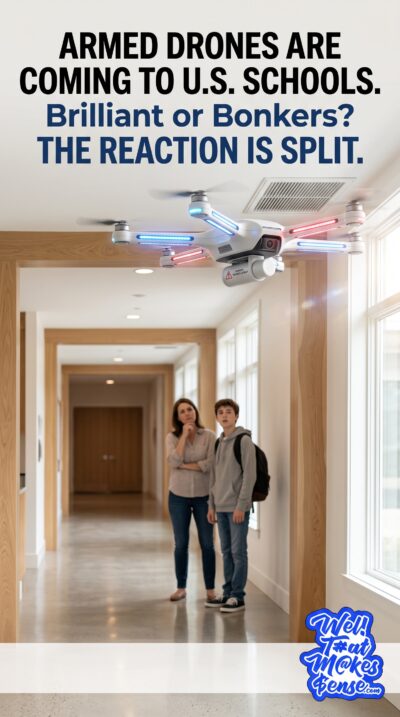
Picture this: It’s a Tuesday morning at a suburban high school. A lockdown alarm sounds. Within seconds, a drone launches from a secure box near the cafeteria, zooms down the hallway at 70 mph, and pepper-sprays an armed intruder while strobing lights and blaring sirens — all controlled by someone in Austin eating breakfast tacos 800 miles away. This isn’t a rejected Black Mirror script. It’s actually happening in nine American schools right now.
Welcome to 2026, where we’ve apparently decided that the best way to protect our kids is with remotely piloted attack drones. And honestly? Nobody knows if this is brilliant or bonkers. Probably both. Let’s talk about it.
The Sky’s the Limit (Literally)
Mithril Defense — yes, that’s their real name, and yes, it sounds like something from Lord of the Rings — has convinced schools in Florida, Georgia, and Colorado to install fleets of quadcopter drones on their campuses. These aren’t your neighbor’s Christmas present drones that crash into trees. These are serious pieces of hardware stationed in secure boxes around school grounds, ready to launch faster than you can say “active shooter drill.”
Here’s how it works: When an emergency happens, human operators at Mithril’s Austin headquarters take control of the drones remotely. The drones can spray pepper gel (the kind that sticks to your face and makes you deeply regret your life choices), fire strobe lights bright enough to disorient someone, blast sirens that would wake the dead, and — this is the kicker — ram into a threat at speeds up to 70 mph. That’s highway speed, folks. Inside a school hallway.
The pitch is compelling in its simplicity: These drones act while traditional security measures just watch and report. They can buy precious minutes before police arrive, relay the shooter’s exact location to responding officers, and potentially save lives during those critical first moments when every second counts. Florida allocated $557,000 for a three-school pilot program. Georgia approved $500,000 for five schools. A new Colorado charter school is paying its own way into the program. We’re talking real money and real commitment here.
The Case for Robot Guardians
Let’s be honest about the problem these drones are trying to solve: American schools spend $4 billion annually on physical security, and kids are still getting shot. Traditional security measures — cameras, metal detectors, armed resource officers — have serious limitations. Cameras can only watch. Metal detectors can be bypassed. Resource officers can’t be everywhere at once, and asking teachers to carry guns is… well, let’s just say that’s its own can of worms.
Drones offer something different: immediate, aggressive intervention without putting another human in harm’s way. They can reach any part of a campus in seconds. They don’t freeze up or make fear-based decisions. They can engage a threat while human responders are still getting into position. And unlike a security guard, a drone doesn’t worry about getting shot.
The technology also provides real-time intelligence to responding officers. Instead of running into a building blind, police get live video feeds and exact locations. That’s huge. The faster police can neutralize a threat, the fewer casualties occur. If these drones can buy even two or three minutes, they could be the difference between a tragedy and a close call.
Supporters argue we’re already comfortable with remote warfare overseas and robot-assisted surgery in hospitals. Why not remote security for schools? The operators are trained professionals, not random contractors. The technology is tested. And parents desperate to keep their kids safe are willing to try something — anything — that might work better than what we’re doing now.
The Case Against Flying Pepper Spray Robots
Now let’s pump the brakes and talk about why this might be absolutely insane. First up: We’re talking about weaponized drones operated by a private company from hundreds of miles away making split-second decisions about when to attack people on school property. What could possibly go wrong?
The article mentions that Omnilert’s AI gun detector once flagged a teenager’s Doritos bag as a weapon. Doritos. It also failed to detect the actual handgun used in a fatal Tennessee school shooting. These systems are far from perfect, and the consequences of mistakes are severe. Imagine a drone pepper-spraying a drama student holding a prop gun during rehearsal. Or ramming into a special needs student having a meltdown while holding scissors. Or misidentifying a police officer responding to the scene.
Then there’s the fundamental question of judgment. These drones are controlled by humans in Austin making life-or-death decisions based on camera feeds of schools they’ve never visited, students they’ve never met, and situations they’re experiencing through screens. No context. No nuance. Just: Is that a gun? Should we engage? These aren’t binary decisions, but we’re treating them like video game scenarios.
There are also serious privacy concerns. These drones have cameras and can be deployed anywhere on campus. Who controls that footage? How long is it stored? What stops these systems from being used for routine surveillance? Once you normalize drones flying through school hallways, the mission creep potential is enormous. Today it’s active shooter response. Tomorrow it’s monitoring bathroom vape detectors and breaking up fights in the parking lot.
And let’s talk about the psychological impact on students. Kids are already growing up with active shooter drills that traumatize them. Now add drones to the mix — literal attack robots stationed around campus as a constant reminder that violence could happen at any moment. What does that do to a learning environment? What does it teach children about trust, safety, and proportional responses to threats?
The Real Estate Angle Nobody’s Talking About
Here’s where this gets interesting for anyone in real estate: School security is rapidly becoming a major factor in home values and buyer decisions. Parents are already choosing neighborhoods based on school ratings, test scores, and facilities. Now add “armed drone defense system” to the list of amenities.
Will homes near schools with these systems sell for more because parents feel safer? Or will they sell for less because buyers see militarized schools as a red flag about the community? Real estate agents are going to need to navigate these conversations, and honestly, nobody has good answers yet. “The elementary school has excellent test scores and a fleet of pepper-spraying drones” is not a sentence anyone expected to say during a showing, but here we are.
There’s also the question of disclosure. If a school in a district has experienced security incidents that led to drone deployment, does that affect property values? Do sellers need to disclose proximity to schools with weaponized security systems? These are uncharted legal and ethical waters, and the real estate industry is going to have to figure it out on the fly — much like these drones.
So What’s the Verdict?
The honest answer? Nobody knows yet. This technology is so new that we don’t have data on effectiveness, false positive rates, or long-term impacts. We’re essentially beta testing armed drones in schools and hoping for the best. That should make everyone at least a little uncomfortable, regardless of where they stand on the issue.
The optimistic view is that these drones represent innovative thinking about an impossible problem. School shootings are a uniquely American nightmare, and traditional security measures haven’t solved them. Maybe technology can do what humans can’t. Maybe these drones will save lives and we’ll look back wondering why we didn’t deploy them sooner.
The pessimistic view is that we’re normalizing surveillance, militarization, and remote-controlled violence in educational spaces instead of addressing root causes. We’re teaching kids that safety comes from attack drones rather than from communities that support mental health, prevent bullying, and keep weapons away from troubled individuals. We’re solving symptoms instead of diseases.
The realistic view is probably somewhere in the middle. These drones might work exactly as advertised in some situations and fail catastrophically in others. They’ll save some lives and probably cause some problems we haven’t anticipated. They’ll be better than nothing and worse than a world where schools don’t need them. And we’ll all muddle through, adjusting policies and protocols as we go, because that’s what we always do with disruptive technology.
What’s certain is that this conversation isn’t going away. As more schools adopt these systems, we’ll get real-world data on their effectiveness and problems. Parents, educators, students, and communities will have to decide whether armed drones make them feel safer or just more anxious. Real estate professionals will need to understand how these systems affect property values and buyer decisions. And all of us will need to grapple with what it means that we’ve reached a point where pepper-spraying robots in schools sounds like a reasonable idea.
The fact that we’re even having this conversation tells you everything you need to know about where we are as a society. Whether armed drones are the right answer is almost beside the point. The real question is: How did we get to a place where this seemed necessary? And what does it say about us that we’re more comfortable deploying attack drones than addressing the underlying issues that make schools targets in the first place?