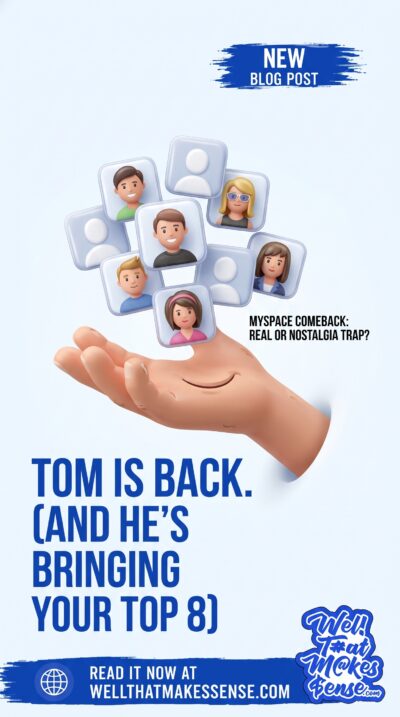
Tom Is Back (And He’s Bringing Your Top 8 With Him)
Myspace plans a comeback in 2026—because apparently we didn’t learn our lesson about autoplay profile songs the first time
Remember when your biggest life decision was choosing which friend made your Top 8? When HTML code was a love language and your profile song said more about you than your actual bio? Well, grab your skinny jeans and eyeliner, because Myspace is plotting a comeback—and this time, they promise it won’t crash and burn like your 2007 relationship status.
According to CNBC, brothers Tim and Chris Vanderhook are teasing a Myspace relaunch in a new documentary that’s either a brilliant business move or the plot of a really expensive episode of “Where Are They Now?” The duo already tried rebooting the platform once in 2013, losing roughly $150 million in the process. As Tim candidly admits in the documentary, “It just became an onslaught of losses.” Which is corporate-speak for “we got absolutely destroyed.”
But here’s the thing that actually matters for those of us who don’t spend our days reminiscing about glitter graphics: this comeback attempt is a real-world test of whether people are genuinely tired of algorithmic feeds or just complaining on algorithmic feeds about algorithmic feeds. And if you’re in real estate or mortgages, you should care—because where attention goes, marketing dollars follow, and understanding the next shift in social media could be the difference between reaching first-time homebuyers and shouting into the void.
The Glory Days (And Why They Ended)
At its 2008 peak, Myspace pulled in about 115 million monthly visitors. To put that in perspective, that’s roughly the entire population of Mexico scrolling through customized profiles with background songs that started playing at maximum volume the second you clicked on someone’s page. It was chaotic, personal, and gloriously weird—a digital scrapbook where you controlled every pixel.
Then Facebook showed up with its clean, uniform design and made everyone’s profile look the same. Turns out, most people preferred simplicity over spending three hours learning CSS just to make their “About Me” section sparkle. Facebook’s streamlined approach won, Myspace became a punchline, and Tom—the friendly face who was automatically everyone’s first friend—faded into internet legend.
The Vanderhook brothers bought Myspace in 2011 and attempted a full rebuild in 2013, repositioning it as a music and entertainment platform. Despite their efforts, the platform couldn’t compete with the massive reach and advertising power of Meta, TikTok, and YouTube. The result? That $150 million lesson in “nostalgia doesn’t equal market share.”
What’s Different This Time (Maybe)
So why try again? Because 2026 isn’t 2013. Social media fatigue is real, and it’s not just your aunt complaining about Facebook in the family group chat. Younger users are increasingly vocal about hating algorithmic feeds that show them what an AI thinks they want instead of what they actually asked for. There’s a growing appetite for platforms that feel more personal, more customizable, and less like a dopamine slot machine designed by engineers in Menlo Park.
The Vanderhooks are betting they can rebuild Myspace’s creative identity—the customization, the music focus, the personal expression—without the technical friction that made the original platform slow, clunky, and eventually obsolete. The challenge is monumental: create something that feels nostalgic and fresh simultaneously, then somehow sell ads against giants who have billions of users and infinitely deeper pockets.
But here’s where it gets interesting for real estate and mortgage professionals. If Myspace can carve out even a small niche with younger, creative users who are tired of Instagram’s polished perfection and TikTok’s algorithmic chaos, it could become a valuable channel for reaching a demographic that’s notoriously hard to engage with traditional marketing. First-time homebuyers don’t want to be sold to—they want to be part of communities that reflect their identity and interests.
Why Real Estate Should Pay Attention
You might be thinking, “I’m trying to close loans, not relive my emo phase.” Fair. But the return of Myspace—successful or not—signals something bigger: people are actively looking for alternatives to the big social platforms. They’re tired of being products, of having their attention harvested and sold, of feeds that show them everything except what they actually want to see.
If Myspace gains traction, it won’t be because it steals users from Instagram. It’ll be because it offers something different—a place where music, creativity, and personal expression matter more than follower counts and engagement metrics. And if you’re in the business of helping people find homes, understanding where your audience is gathering (and why) is crucial.
Even if Myspace flames out again, other platforms will emerge to fill the gap. We’re already seeing it with BeReal, Threads, and a dozen other apps trying to be the “anti-algorithm” alternative. The lesson isn’t “go invest in Myspace marketing right now.” It’s “pay attention to where the pendulum is swinging, because your future clients are already there.”
The hard truth? Nostalgia is a terrible business strategy on its own. But nostalgia plus genuine innovation, targeted at a generation that never experienced the original? That might actually work. Whether Myspace can pull it off is anyone’s guess. Tim Vanderhook says they’re “just waiting for the right time to do it,” which could mean they’ve learned from past mistakes or that they’re really good at kicking the can down the road.
Either way, the attempt matters. It’s a test case for whether smaller, more human-centered social networks can survive in an ecosystem dominated by algorithmic giants. And for those of us trying to reach real humans with real messages about real estate and mortgages, that test is worth watching closely.