**WTMS Blog Today = What’s up in Mortgage Today (AM) – 08/12/2026**
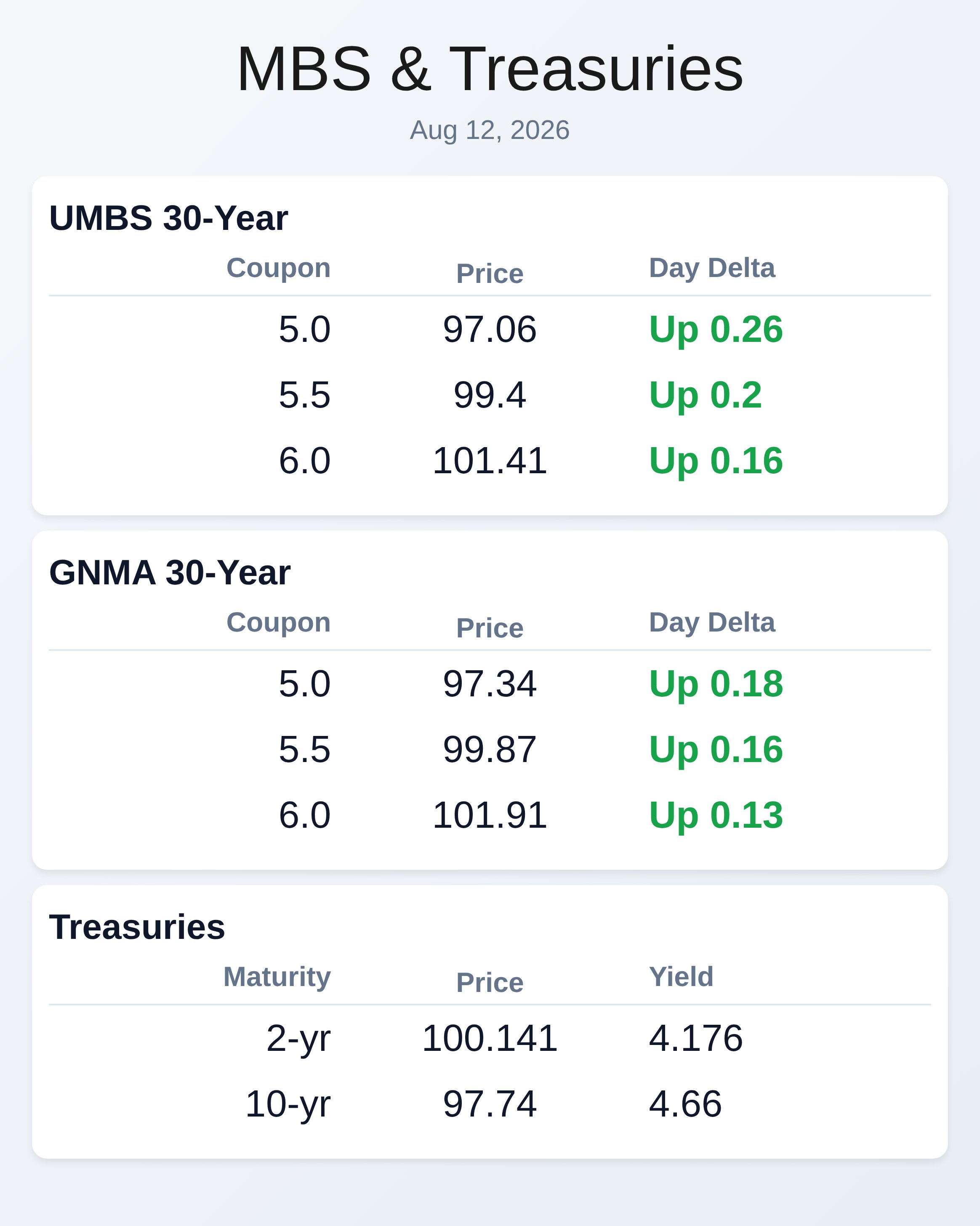
Oil prices retreated on tentative Iran deal optimism, pulling crude from highs and easing some pressure on long-dated Treasury yields overnight. The 10-year dropped three basis points to 4.66% as traders reassessed geopolitical risk ahead of Wednesday’s CPI release. UMBS 5.5s rallied to 99.40, up 21 basis points from Tuesday’s close, signaling renewed appetite for agency mortgage securities.
The flat-to-positive momentum came despite continued war-related headline volatility that remains a daily fixture in rate markets. Investors are waiting for clearer economic signals before committing larger capital to either direction. July’s inflation data arrived exactly as expected across all measures, eliminating any near-term surprise factor and calming Fed-hike anxieties.
Core CPI ticked 0.2% month-over-month and 2.5% year-over-year, matching consensus to the decimal point, while headline CPI rose 0.1% monthly and 3.4% annually. The data’s tameness reduced the urgency around September rate action, though Friday’s weak jobs report and three dissenting Fed officials already signaled caution on hiking. Money markets trimmed Fed-hike probability bets significantly following the release.
For mortgage sellers, this removes an immediate rate shock risk and supports stable pricing into next week. Refinance activity continues its slowdown despite modest weekly gains, with only 3.6% of outstanding 30-year mortgages retaining financial incentive to refi. MBA applications rose 3.6% last week as purchase requests climbed 3%, but refinance volume remains deeply depressed at 22% below year-ago levels.
The persistent lock-in effect—borrowers anchored to sub-5% rates—keeps refi demand structurally weak even as current rates have eased fractionally. Originators hoping for a refinance-driven recovery should reset expectations given household behavior patterns appear durable. Correspondingly, mortgage servicing rights and specified pools remain supported by this muted prepayment environment.
Nonagency lending continues capturing a growing share of origination volume as agency constraints leave borrowers without solutions. Record household equity, the 40% of owners without mortgages now leveraging to extract funds, and changing borrower demographics are pushing non-QM and asset-based loans into a primary growth channel. Lenders refusing to adapt to these shifting demographics face existential pressure in an increasingly segmented market.
HELOCs have become the single best strategy for originators to defend client databases while capturing immediate volume. Streamlined digital HELOC platforms paired with white-glove support are turning what once felt operationally burdensome into a legitimate growth engine. Technology providers are racing to embed AI as an execution layer rather than point solutions, reducing implementation risk and avoiding costly system replacements.
JazzX, ICE, and others are positioning “systems of intelligence” that sit above legacy LOS, CRM, and pricing infrastructure to orchestrate workflows without rip-and-replace disruption. Simultaneously, regulators have made clear that servicers must document AI tools, designate internal overseers, and demonstrate responsible use on demand, adding governance requirements to the deployment process. For lenders navigating these dual pressures—innovation velocity and compliance rigor—the right technology partner becomes critical infrastructure.
Institutions treating AI as a strategic decision-making system rather than a tactical tool will outperform across market cycles. GNMA pricing outpaced UMBS gains across most coupons as investors showed particular appetite for higher-duration agency pools. GNMA 5.5s finished at 99.69, up 12 basis points from the prior day, while broader 30-year coupon strength reflected declining volatility and resilient prepayment expectations.
The mortgage servicing rights complex continues to benefit from muted prepayment speeds, supporting specified pools and vintage inventory that offer relative value to Treasuries. Spreads remain modestly attractive relative to investment-grade corporates, particularly in lower-payup and mid-coupon pools. Traders should monitor next week’s $42 billion 10-year Treasury auction and any signals around Iran negotiations that could reignite crude volatility.
**Locking vs Floating**
War-related headlines continue to create daily volatility, but yields are now testing long-term ceilings with less room for risk-tolerant clients to use technical trigger points. Friday delivered a solid lock opportunity for the average client, and this week’s tame CPI reading has not materially worsened conditions for cautious borrowers. Peace prospects or dramatic inflation surprises would be needed to shift the risk calculus meaningfully.
The combination of geopolitical uncertainty and Fed messaging opacity makes lock-or-float decisions dependent on individual borrower risk tolerance and closing timeline rather than macro conviction.
**Today’s Events**
Core CPI m/m: 0.2% (as expected)
Headline CPI m/m: 0.1% (as expected)
Core CPI y/y: 2.5% (as expected)
Headline CPI y/y: 3.4% (as expected)
Weekly Crude Oil Inventories: pending
July Treasury Budget: pending
$42 billion 10-year Treasury note auction: pending
**Bond Pricing**
**UMBS 30 yr**
| Coupon | Price | Intra-Day Change |
| 5.0 | 97.06 | 0.26 |
| 5.5 | 99.40 | 0.21 |
| 6.0 | 101.41 | 0.16 |
**GNMA 30 yr**
| Coupon | Price | Intra-Day Change |
| 5.0 | 97.34 | 0.18 |
| 5.5 | 99.69 | 0.12 |
| 6.0 | 101.91 | 0.13 |
**Treasuries**
| Term | Yield | Price | Intra-Day Yield Change |
| 2 yr | 4.19 | 100.167 | -0.045 |
| 3 yr | 4.245 | 100.037 | -0.043 |
| 5 yr | 4.347 | 100.154 | -0.038 |
| 7 yr | 4.495 | 99.312 | -0.034 |
| 10 yr | 4.66 | 97.74 | -0.032 |
| 30 yr | 5.227 | 96.582 | -0.013 |