Now reading the articles per the instructions. None of the links in the email content are direct news article URLs that meet the fetching criteria. The links are all tracking links, email platform redirect links, or registration pages.
Per the instructions, I will skip silently and proceed to write the blog post. **WTMS Blog Today = What’s up in Mortgage Today (PM) – 10/09/2026**
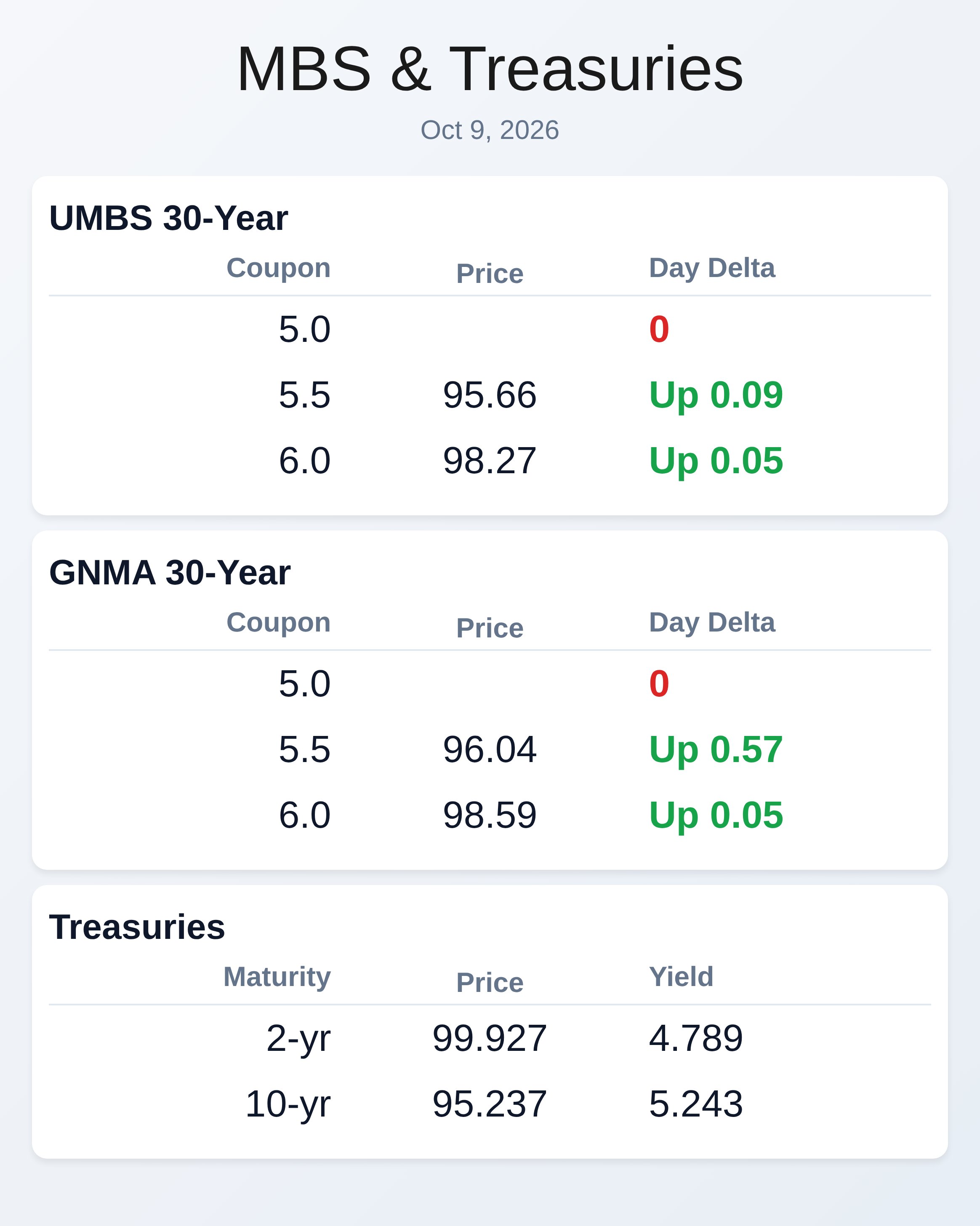
The mortgage bond market delivered a modest bounce this week despite persistent headwinds, with UMBS and GNMA securities posting small intraday gains as 10-year Treasury yields carved out a two-day low near 5.22 percent. After Wednesday’s aggressive rally that briefly touched best levels in four trading days, the week finished with Friday’s sideways action before the Columbus Day weekend, signaling that the market remains cautious rather than convinced of a sustained reversal.
Most importantly for originators, mortgage prices finished the week near their best levels, offering a rare window for positive reprices even as underlying rate pressure continues. The persistent culprits behind elevated yields remain largely unchanged: geopolitical tensions fueling inflation fears and increased Treasury issuance, corporate bond competition for investor demand, resilient economic data refusing to roll over, and a Federal Reserve willing to defend its inflation-fighting stance. War-related headlines provided mid-week relief and triggered the stronger two-day sequence, yet oil prices and fiscal concerns remind the market that any relief could prove fleeting.
The key technical level to watch remains a sustained break below 5.20 percent in the 10-year yield, which would signal genuine phase-one progress toward a legitimate turn. Earnings season momentum and stock market strength are creating an unusual disconnect: the Magnificent Seven technology stocks are driving equity gains with expected third-quarter earnings growth far outpacing the S&P 500 average, while mortgage lending volume fell 15 percent year-over-year in September. Bank trading revenues are expected to reach nearly $19 billion across major firms next week, yet mortgage originator forecasts point to quarter-over-quarter declines of seven to ten percent.
This bifurcated economy—booming tech, struggling housing—means originators must navigate thinner gain-on-sale margins and more difficult pipeline hedging. Credit bureaus Equifax and TransUnion both announced new cost-reduction tools this week aimed at giving lenders more flexibility over when they order scores and what they pay. Neither bureau disclosed specific savings amounts, raising legitimate questions about whether any reductions would benefit borrowers or simply improve lender margins.
The move highlights the industry’s ongoing push for competition and lower credit costs in an environment where every basis point of profit matters. Mortgage prepayment speeds decelerated sharply in September with Fannie Mae speeds falling seven percent month-over-month to 6.7 CPR and Ginnie Mae speeds dropping ten percent to 7.6 CPR, leaving fewer than one percent of outstanding mortgages economically attractive to refinance. Servicer-level data reveals meaningful differences in borrower behavior: Rocket remains among the fastest-paying servicers while Idaho HFA has ranked among the slowest for fourteen consecutive months.
These variations underscore why investors must look beyond headline averages when evaluating mortgage-backed securities performance. Lock or hold decisions remain data-dependent as the market waits for next week’s inflation figures and further Fed guidance before committing to the “big reversal” narrative. A sustained drop below 5.00 percent in late November would confirm a legitimate turning point, but betting on immediate continuation remains risky given ongoing fiscal pressures and geopolitical uncertainty.
Borrowers closing in the next few weeks should consider capturing any improvement rather than hoping for steady declines.
**Locking vs Floating**
Two consecutive days of gains have created an inflection point worth monitoring, yet the market is not jumping into a “big reversal” trade with full conviction. A sustained break below 5.20 percent would mark phase-one progress, but true confirmation requires a move below 5.00 percent by late November.
Until that threshold is reached, rallies should be viewed as tactical opportunities rather than evidence of a fundamental shift in bond market momentum.
**Today’s Events**
Friday brought consumer sentiment data with October readings showing weakness as gasoline prices, elevated borrowing costs, and hiring slowdowns weighed on households. No major economic data is expected over the three-day weekend.
**Bond Pricing**
**UMBS 30 yr**
| Coupon | Price | Intra-Day Change |
| 5.5 | 95.66 | 0.09 |
| 6.0 | 98.27 | 0.05 |
| 5.5 | 96.04 | 0.57 |
**GNMA 30 yr**
| Coupon | Price | Intra-Day Change |
**Treasuries**
| Term | Yield | Price | Intra-Day Yield Change |