**WTMS Blog Today = What’s up in Mortgage Today (AM) – 08/18/2026**
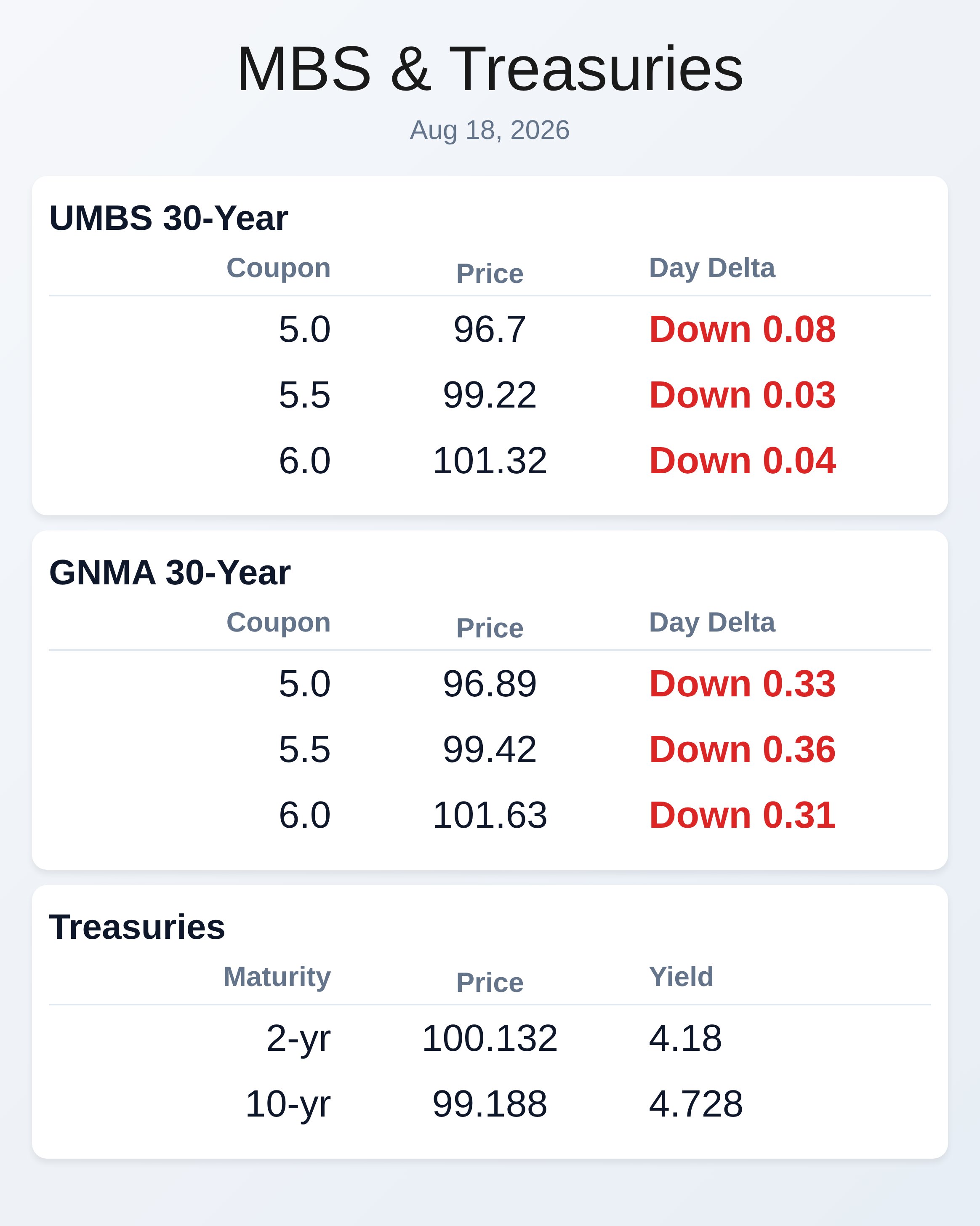
Mortgage-backed securities are taking losses as Middle East tensions push oil prices and Treasury yields toward their highest levels since 2007. The 10-year yield climbed 1.9 basis points to 4.744%, while the 30-year Treasury surged to 5.313%, breaching levels unseen for nearly two decades. UMBS 5.5 coupon fell to 99.11, down 0.14 from the previous close, and GNMA securities suffered even sharper declines.
This selling pressure reflects mounting investor worry about persistent inflation, ballooning federal deficits, and the structural shift toward less-supportive bond buyers. July’s housing data delivered mixed signals, with building permits unexpectedly exceeding forecasts at 1.443 million but housing starts falling short at just 1.239 million versus expectations of 1.35 million. Import prices fell 0.4% month-over-month—better than the forecast for a 0.1% rise—suggesting some deflationary pressure on goods.
Export prices dropped 1.3%, though core import prices rose 0.3%, indicating selective inflation in non-petroleum categories. These readings hint at economic softening, though the Fed faces uncertainty about whether elevated long-term yields stem from inflation expectations or genuine financial tightening. The Federal Reserve faces a delicate balancing act, with September rate-hike odds hovering near just 31% as soft wage growth, labor market weakness, and disappointing retail sales mount evidence of economic moderation.
Higher long-term yields effectively tighten financial conditions without requiring additional policy moves, making Fed restraint increasingly likely through fall. However, if inflation expectations rather than real yields are driving the bond selloff, policymakers may still feel compelled to act. August payrolls and Consumer Price Index reports loom as critical data points, but barring a meaningful inflation surprise, rates appear poised to remain stable.
Global bond markets are experiencing unprecedented stress, with French 30-year yields hitting their highest since 2008 and UK gilt yields approaching 6%. The world’s major governments are shifting issuance toward shorter tenors because they can no longer lock in low financing rates for decades. Pension funds and other traditional long-duration buyers are retreating, forcing governments to rely increasingly on more price-sensitive private investors who demand higher yields.
This structural shift in Treasury ownership—away from official-sector holders toward private traders—accounts for roughly 90 basis points of the term premium on 30-year U.S. debt. AI-fueled corporate borrowing is compounding the selloff, with tech firms tapping both domestic and overseas markets to finance infrastructure spending, adding massive duration supply to global markets.
Oil prices topping $85 per barrel amplify the pressure, as Middle East tensions show no signs of easing and economic observers warn of “no easy way out” for energy costs. Strategists are cautiously monitoring whether “bond vigilantes” might panic, though most still hesitate to sound broad alarm bells. The path forward depends heavily on whether geopolitical risks persist and whether central banks remain focused on inflation control.
Mortgage originators should prepare for continued rate volatility tied to Middle East headlines and Treasury auction results rather than Fed policy this week. Any weakness in upcoming employment or inflation data could briefly stabilize yields, but overnight floating remains perpetually risky in this environment. Lenders are also grappling with shrinking housing production—starts fell 13% month-over-month—which tightens purchase mortgage pipelines and may narrow loan margins.
The convergence of geopolitical stress, structural supply dynamics, and demographic shifts suggests long-term mortgage rates will remain elevated absent a significant external shock or economic deterioration.
**Locking vs Floating**
Overnight floating continues to carry elevated risk as long-term yields remain under sustained selling pressure from Middle East tensions and oil prices. Any day featuring higher fuel costs compounds bond market weakness, making it difficult for lenders to hold lock positions overnight.
While MBS provide intraday risk management via daily price signals, the broader picture shows 10-year yield ceilings and floors tracking persistent upward momentum. Meaningful progress for the bond market remains elusive until either geopolitical tensions ease or economic data shifts materially weaker.
**Today’s Events**
Building Permits (Jul): 1.443M vs 1.37M forecast, 1.374M previous
Housing Starts (Jul): 1.239M vs 1.35M forecast, 1.427M previous
Import Prices (Jul): -0.4% vs 0.1% forecast, 0.3% previous
Later today: Industrial Production, Capacity Utilization, and Pending Home Sales
**Bond Pricing**
**UMBS 30 yr**
| Coupon | Price | Intra-Day Change |
| 5.0 | 96.7 | -0.08 |
| 5.5 | 99.22 | -0.03 |
| 6.0 | 101.32 | -0.04 |
**GNMA 30 yr**
| Coupon | Price | Intra-Day Change |
| 5.0 | 96.89 | -0.33 |
| 5.5 | 99.42 | -0.36 |
| 6.0 | 101.63 | -0.31 |
**Treasuries**
| Term | Yield | Price | Intra-Day Yield Change |