**WTMS Blog Today = What’s up in Mortgage Today (AM) – 08/31/2026**
Federal Reserve Chair Kevin Warsh’s hawkish Jackson Hole speech has roiled mortgage markets, pushing traders to price in nearly a 60% probability of a September rate hike, but skeptical bond investors doubt the Fed will actually pull the trigger. Warsh emphasized that inflation remains sticky and that rates are the Fed’s “predominant tool,” yet he provided no forward guidance on whether officials will act next month. Markets digested competing signals: the 2-year Treasury fell 2 basis points while the 10-year climbed 3.5 basis points intraday, reflecting uncertainty about both near-term policy and long-term inflation.
The real culprit driving uncertainty is Warsh himself—his communications style is less predictable than his predecessors, and he has flip-flopped market reactions three times in four months. Agency mortgage securities shed modest ground as bond weakness pressured valuations across the curve. Mortgage originators face a dangerous confluence of headwinds beyond rate volatility: home prices have fallen to five-year lows, single-family housing starts have collapsed to their second-lowest level since 2020, and fraud is accelerating in DSCR and investor-property segments.
Repurchase claims are climbing as private mortgage insurance deficiencies dominate default outcomes, while occupancy and income fraud add further exposure. Falling home values are pushing more loans into PMI-required territory, expanding losses when defaults occur. Lenders obsessed with political “wins” are missing the real risk: underwriting quality, collateral deterioration, and sophisticated fraud schemes that could materially erode profitability.
The employment report this Friday will be critical; nonfarm payroll growth is expected to rebound to 80,000, but that data alone won’t resolve whether the economy is cooling gradually or heading toward sharper contraction. Mid-curve Treasury yields have climbed to multi-year highs as the market reprices term premium upward, reflecting weaker demand and dimmer growth expectations. The 30-year Treasury yield has spent 37 consecutive days above 5%, and rising 100- and 200-day moving averages signal a structural shift toward a higher-rate regime that is materially bearish for long-duration bonds and mortgage-backed securities.
Oil prices surged nearly 4% on renewed Middle East hostilities, adding inflation complexity to the Fed’s calculation in the weeks ahead. Consumer fundamentals are deteriorating: real disposable income has lagged spending for 25 consecutive months, and wage growth has slowed to just 0.5% year-over-year. That combination of elevated borrowing costs, stagnant incomes, and energy headwinds is beginning to constrain consumption and raise recession odds.
The LDS Church is assembling one of America’s largest and least transparent real estate empires, with plans to develop over 12,000-home master-planned communities near Denver and other major metros using 2.4 million acres worth more than $20 billion in assessed value. This represents a significant supply injection at a time when single-family housing production is already at historic lows, and the move underscores how institutional capital is repositioning around America’s housing shortage. Commercial and residential properties owned through church subsidiaries generate substantial income streams while enjoying tax advantages unavailable to traditional homebuilders.
For mortgage lenders, this signals another headwind: mega-scale developers operating outside conventional financing channels will capture disproportionate share of available development capital and borrower attention. Industry conferences are ramping up this week and next, with the PNMLC Annual Conference, Loan Vision Innovation Conference, and MBAMW Annual Conference all kicking off September 13–17 to discuss technology adoption, underwriting resilience, and growth strategies. Meanwhile, a senior mortgage banking executive with experience in builder channels and production leadership is seeking a role as Chief Production Officer or Head of Production at a lender with expansion ambitions.
Employment remains mixed: Deephaven Mortgage is hiring wholesale account executives nationwide with non-QM and equity product access, while Homa Mortgage seeks loan officers in Texas, Florida, and California markets for AI-native, buyer-only brokerage operations. Talent acquisition remains competitive, and the industry is actively recruiting seasoned producers willing to retool for modern lending operations. STRATMOR Group research reveals a critical gap between borrower satisfaction scores and actual referral behavior: one lender doubled its referral rate from 11.5% in 2022 to 22.6% year-to-date in 2026 despite flat NPS scores.
The key driver was not satisfaction measurement but behavioral activation—asking for referrals, staying connected post-close, and creating memorable experiences that convert satisfied borrowers into advocates. Lenders who merely track “likelihood to recommend” are leaving production on the table; the winners are replicating the specific behaviors that drive real referral volume. This insight matters because referral economics are increasingly critical when purchase pipelines are competitive and borrower acquisition costs are rising.
**Locking vs Floating**
Markets are signaling a defensive posture amid Warsh-driven volatility and sticky inflation expectations. Until the bond market confirms that the recent hawkish messaging is an overreaction, mortgage professionals should remain cautious on duration exposure and protective of lock positions. MBS pricing can help manage intraday risk, but the 10-year ceiling and floor levels provide better visibility into broader bond market momentum and term-premium trends that ultimately dictate mortgage rate floors.
**Today’s Events**
No U.S. economic data is scheduled for today, though G20 finance ministers are meeting in North Carolina. The Dallas Fed will release manufacturing activity this afternoon.
Tomorrow begins a heavier slate: S&P Global and ISM manufacturing PMI, construction spending, JOLTS job openings, and Dallas Fed services data are all due out.
**Bond Pricing**
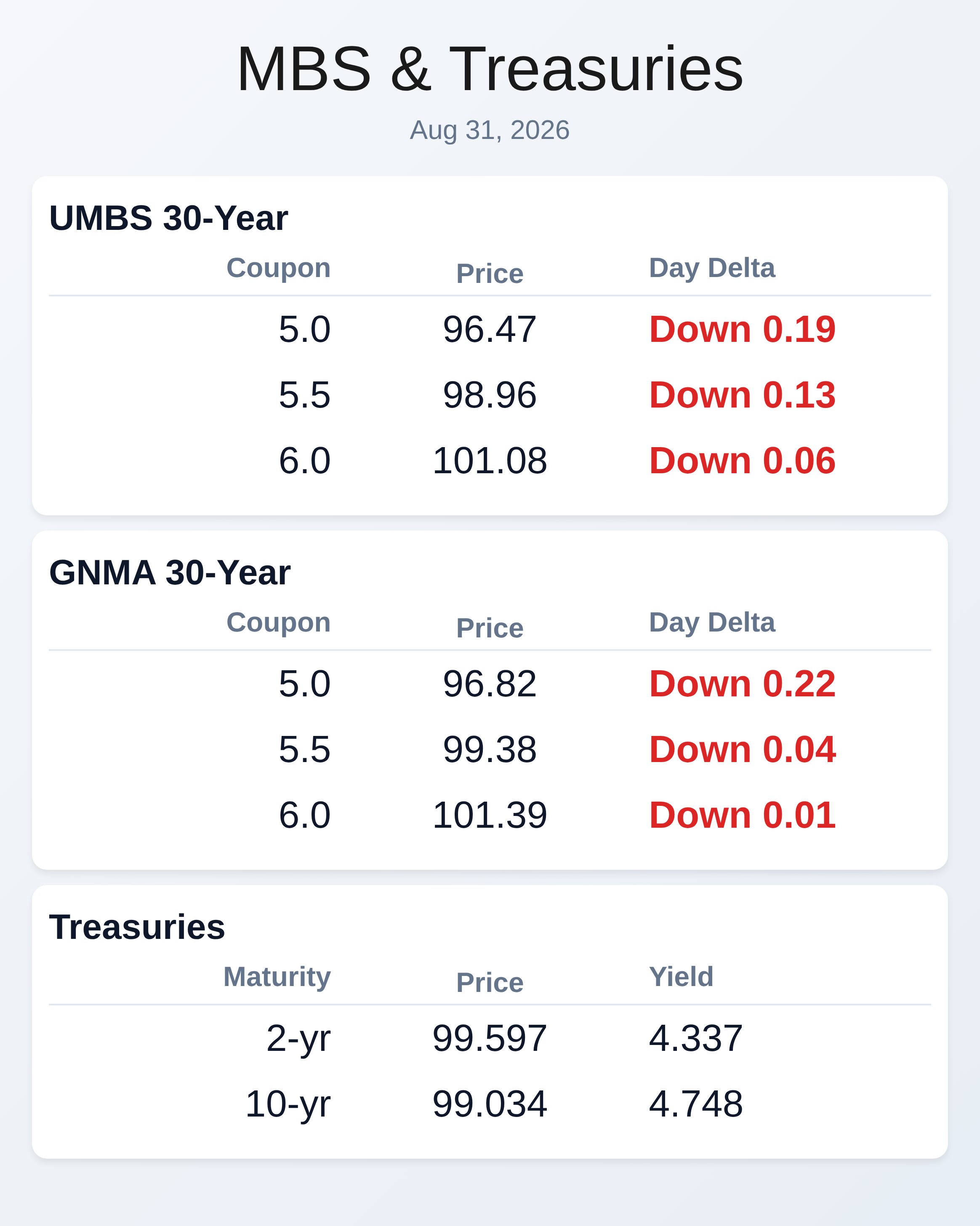
**UMBS 30 yr**
| Coupon | Price | Intra-Day Change |
| 5.0 | 96.47 | -0.19 |
| 5.5 | 98.96 | -0.13 |
| 6.0 | 101.08 | -0.06 |
**GNMA 30 yr**
| Coupon | Price | Intra-Day Change |
| 5.0 | 96.82 | -0.22 |
| 5.5 | 99.38 | -0.04 |
| 6.0 | 101.39 | -0.01 |
**Treasuries**
| Term | Yield | Price | Intra-Day Yield Change |
| 2 yr | 4.337 | 99.597 | -0.021 |
| 3 yr | 4.4 | 99.584 | -0.011 |
| 5 yr | 4.494 | 99.472 | 0.011 |
| 7 yr | 4.611 | 99.34 | 0.018 |
| 10 yr | 4.748 | 99.034 | 0.035 |
| 30 yr | 5.244 | 98.213 | 0.039 |