**WTMS Blog Today = What’s up in Mortgage Today (AM) – 10/15/2026**
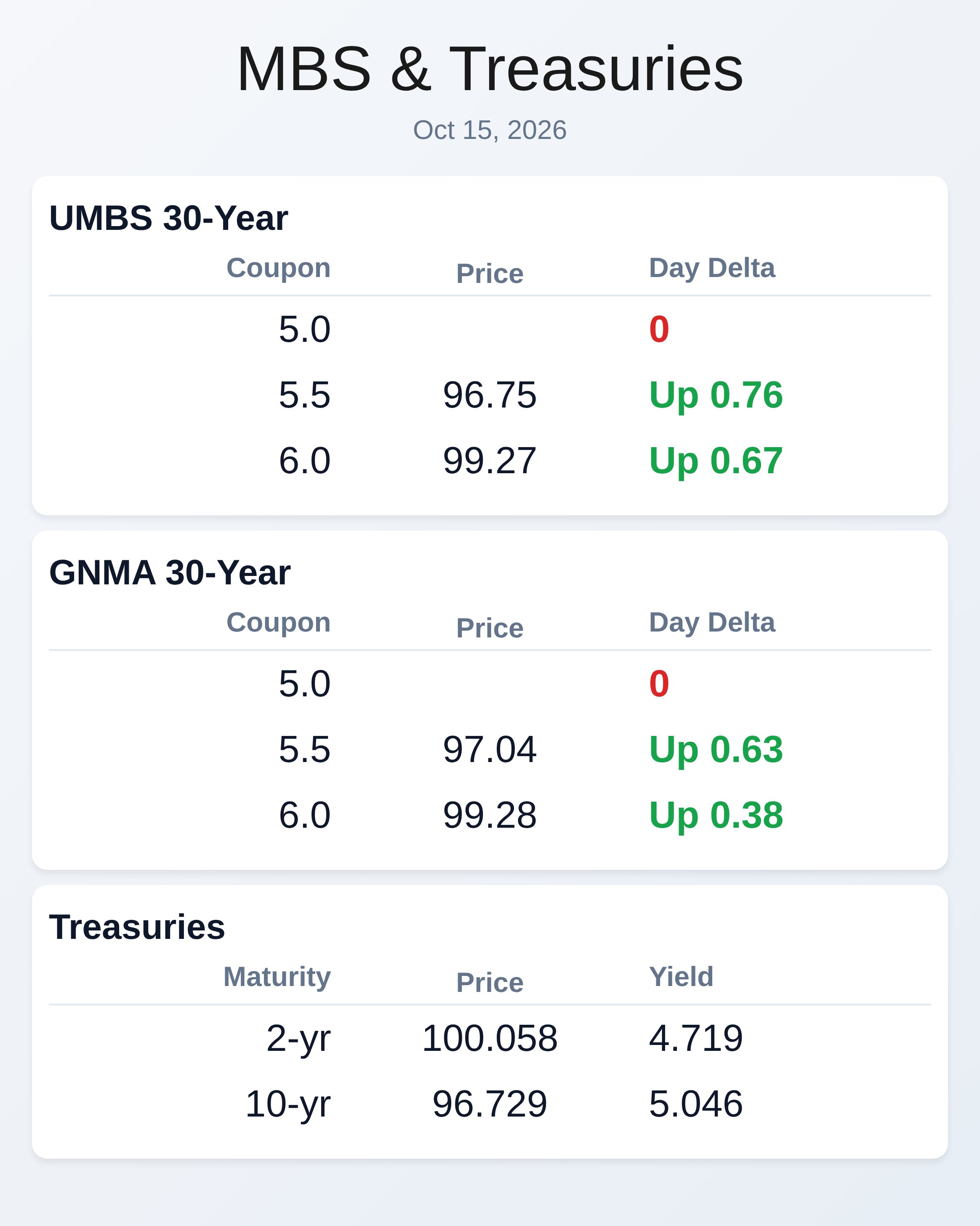
Inflation accelerated faster than expected on Wednesday, sending 10-year Treasury yields spiking to 5.275 percent before the market reversed course on Thursday amid a broader artificial intelligence selloff and flight to safety. The core Consumer Price Index jumped 0.335 percent versus a forecasted 0.2 percent, pushing producer prices and retail sales higher and forcing traders to re-price Fed rate hike probabilities. UMBS 6.0 securities moved roughly 70 basis points lower midweek before stabilizing, while the 10-year Treasury declined to 5.083 percent by Thursday morning as stock market turmoil redirected capital toward bonds.
Mortgage originators faced two-sided risk from convexity hedging pressure and duration uncertainty, making rate-sheet refreshes and capital markets discipline critical throughout the week. Pipeline hedgers must now assess whether the recent energy-driven inflation spike will stick or fade as geopolitical and AI dynamics reshape market positioning. The mortgage industry gathered at the MBA National Conference in Chicago where Director Bill Pulte of the Federal Housing Finance Agency notably canceled his appearance despite overseeing Fannie Mae and Freddie Mac.
The MBA released an affordability roadmap calling for replacing the tri-merge credit report mandate for lower-risk borrowers, reducing loan-level price adjustments, and lowering FHA mortgage insurance premiums. Industry observers noted tension over a FASB proposal to include borrower recapture value in MSR fair value calculations, with largest banks vehemently opposing any valuation changes that would require reduced lending thresholds. Key partnerships emerged including Optimal Blue’s acquisition of CRM platform Usherpa to integrate borrower engagement with pricing intelligence, while Newrez launched Revenos Mortgage as a joint venture with eXp Realty.
The Mortgage Bankers Association also unveiled MBA Homebase, a new education and professional development initiative for loan officers across all origination channels. Optimal Blue’s September Market Advantage report documented significant product mix shifts as rates climbed and lock volume declined 2 percent month-over-month. Non-QM production climbed to 12 percent of total volume, up nearly 5 percentage points year-over-year, while ARM usage reached 14 percent of lock volume—its highest level since 2019.
Purchase volume remained flat both monthly and year-over-year despite overall softening, signaling that alternative products and creative pricing were the only engines keeping origination activity moving. Conforming loans lost share as lenders flexed into non-traditional products, but this strategy carries execution risk if secondary market appetite for non-QM or ARM pools suddenly contracts. Lenders chasing marginal basis points in non-QM execution face the danger of pool failure and significant basis loss if investor demand evaporates.
The retail and employment landscape shifted with Zillow Home Loans actively recruiting mortgage loan officers nationwide, offering leads from the Zillow ecosystem and centralized support infrastructure. Finance of America emphasized the reverse mortgage opportunity as over 11,200 Americans turn 55 daily, creating a steady pipeline of borrowers with evolving retirement financial needs. Job boards filled with both employment postings and talent seeking opportunities, as loan officer mobility and millennial production remain topics of industry focus.
The technical compliance deadline looms on November 2 when Fannie Mae and Freddie Mac transition to UAD 3.6 appraisal standards, requiring lenders and AMCs to adopt new review policies and underwriting frameworks. HomeVision offered a free 60-day trial of its AI-powered MIRA platform to help lenders navigate the complexity and flag issues in the new appraisal format. Fed Funds Futures initially priced in additional rate hike odds after Wednesday’s hotter CPI print, but Thursday’s AI selloff and equity market turmoil rapidly faded those expectations back to 29 percent odds for an October hike.
The 2-year yield fell to 4.76 percent while the 10-year declined nearly 11 basis points to 5.083 percent as investors rotated from technology stocks into fixed income for yield and safety. Retail sales surprised to the upside at 0.8 percent versus a 0.3 percent forecast, but core retail sales control group rose only 0.1 percent, signaling consumer strength may be limited to higher-income households. Producer prices surged 1.3 percent month-over-month and 6.3 percent year-over-year, marking the fastest pace in over four years, yet gasoline price spikes and energy cost volatility may prove temporary.
Next week’s Fed communication from Chair Warsh and the October 28 FOMC meeting will clarify the path forward as markets balance sticky inflation against deteriorating tech sentiment. For daily mortgage market intelligence and actionable origination insights, subscribe free at WellThatMakesSense.com.