**WTMS Blog Today = What’s up in Mortgage Today (AM) – 09/30/2026**
Mortgage applications plummeted 6 percent in the week ending September 25, with refinancing down a staggering 56 percent year-over-year as rates climbed to three-year highs. Purchase applications declined 4 percent seasonally adjusted and 14 percent annually, signaling that borrowers are stepping back from the market entirely. The pullback reflects the brutal impact of elevated borrowing costs, which have now pushed long-term yields to levels unseen since 2002.
Yesterday’s 10-year Treasury closed at 5.26 percent, and the 30-year hit 5.62 percent as the bond market sold off despite weaker economic data. MBS securities lost roughly 25 basis points in the move. This morning brought a mixed inflation picture that sparked a modest intraday relief rally.
The August Core PCE price index came in cooler than expected at 0.2 percent month-over-month (versus 0.3 percent forecast) and 3.0 percent year-over-year (versus 3.3 percent forecast). Personal spending rose 0.6 percent inflation-adjusted in August, marking the fastest pace in over a year, while ADP employment climbed 90,000 jobs—beating the 70,000 forecast. Q2 GDP printed at 2.2 percent, topping the 1.5 percent estimate, which suggests the economy remains resilient despite mortgage headwinds.
By mid-morning, the 10-year Treasury had pulled back three basis points to 5.20 percent and UMBS securities posted modest intraday gains. Fed officials struck a cautious tone overnight, with President Williams stating there is no urgency for additional rate hikes after September’s move and that policymakers should gather more information. Governor Barr emphasized recalibrating policy to balance employment and inflation risks while returning inflation to 2 percent in a timely manner.
The message sent traders into bond-buying mode early in the session, though analysts warned that the relief could prove temporary. Without clear evidence of economic deterioration or a meaningful shift in the Fed’s inflation outlook, dip-buying has lacked sustained conviction. The market remains technically oversold and awaiting more concrete catalysts from Wednesday’s PCE data and Friday’s official payrolls report.
The capital markets are struggling with a fundamental disconnect: economic data shows resilience, yet the bond market keeps selling off long-dated maturities. Heavy corporate issuance is hitting the tape, with jumbo tranches scheduled for pricing today that will add supply pressure. Convexity hedging, positioning concerns, and persistent worries over federal borrowing and inflation have dominated the long end of the curve.
The 2-year-to-10-year curve steepened to 37 basis points yesterday, a move that underscores yield volatility. Originators and lenders are now operating in an environment where mortgage rates have disconnected from near-term Fed policy and are instead driven by structural forces in the Treasury market. Mortgage professionals face a critical decision window in October.
Lock-float recommendations from market analysts suggest waiting until bonds demonstrate a stronger desire to rally without that rally being purely a reaction to heavy selling pressure. The economic calendar remains crowded with potential volatility triggers, and borrowers who held off in September are unlikely to re-enter the market quickly at current rate levels. Portfolio lenders and warehouse lines are under pressure as refi demand evaporates and purchase applications decline.
For originators, the focus must shift from volume preservation to pricing discipline and cultivating relationships with existing clients who might refinance in a lower-rate environment.
**Locking vs Floating**
The data backdrop supports a wait-and-see posture on rate locks. While inflation showed modest improvement this morning, the bond market’s broader trajectory remains firmly upward on yield, driven by supply and structural factors beyond the Fed’s near-term control.
Only concrete signs of economic weakness or a meaningful repricing of inflation risk would justify an aggressive pivot to locking. Borrowers and originators should monitor Friday’s employment report closely, as a significant miss to the downside could finally break the bond selloff momentum.
**Today’s Events**
ADP Employment Change (8:15 AM): +90K vs.
+70K forecast, +38K previous
Core PCE (month-over-month, August): +0.2% vs. +0.3% forecast, +0.2% previous
Core PCE (year-over-year, August): +3.0% vs. +3.3% forecast, +3.3% previous
PCE Price Index (month-over-month, August): +0.3% vs.
+0.4% forecast
PCE Price Index (year-over-year, August): +3.4% vs. +3.7% forecast
Q2 GDP (third estimate): +2.2% vs. +1.5% forecast, +2.1% previous
Q2 Final Sales: +2.8% vs.
+2.2% forecast
Q2 Corporate Profits: +7.7% vs. +8.2% forecast
Chicago PMI (September): Pending, 9:45 AM EDT
Fed Speakers: Governor Cook (3:25 PM), Chicago Fed President Goolsbee (5:10 PM), Minneapolis Fed President Kashkari (later in day)
**Bond Pricing**
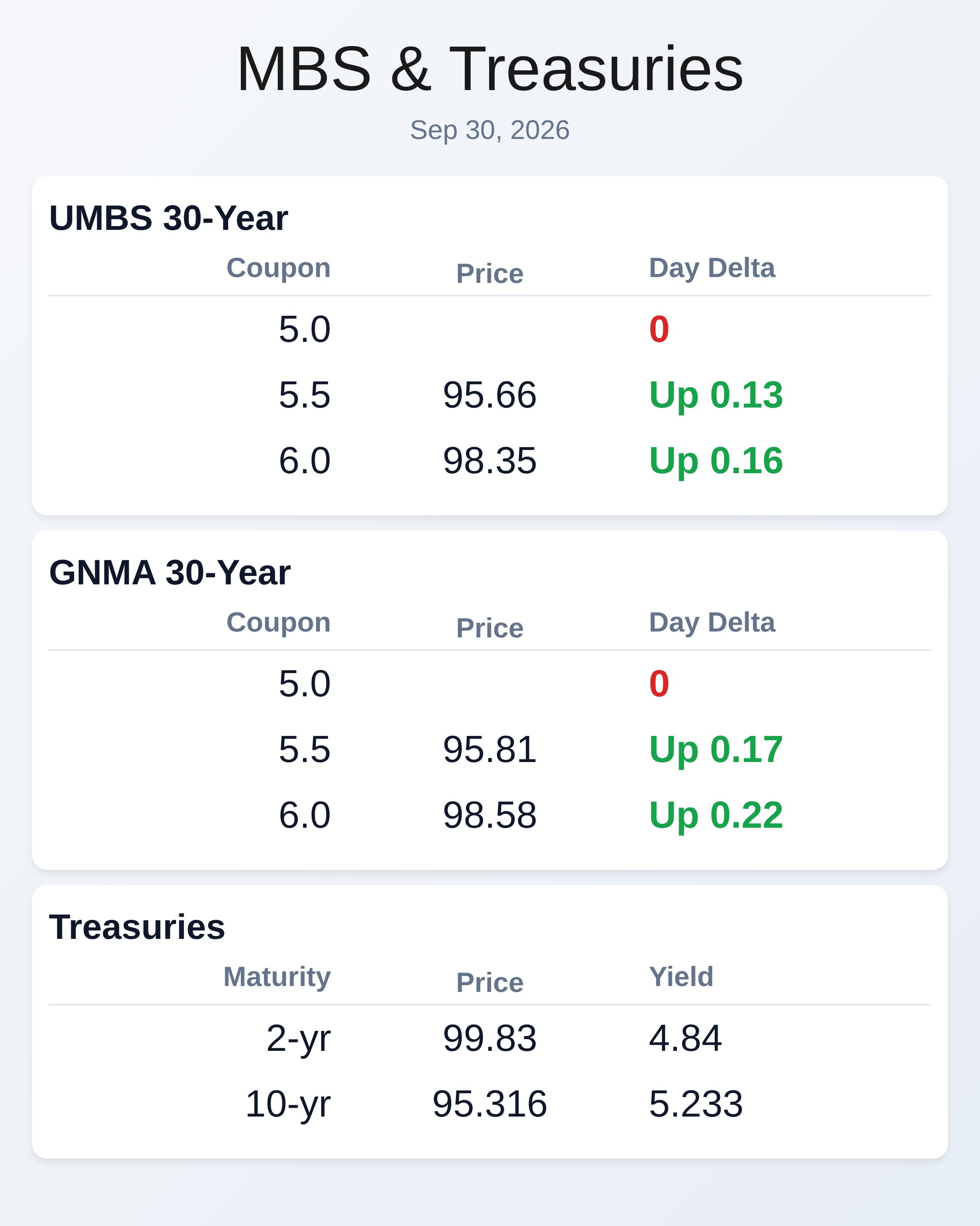
**UMBS 30 yr**
| Coupon | Price | Intra-Day Change |
**GNMA 30 yr**
| Coupon | Price | Intra-Day Change |
**Treasuries**
| Term | Yield | Price | Intra-Day Yield Change |
| 2 yr | 4.84 | 99.83 | -0.036 |
| 3 yr | 4.939 | 98.446 | -0.039 |
| 5 yr | 5.025 | 99.891 | -0.025 |
| 7 yr | 5.129 | 99.25 | -0.014 |
| 10 yr | 5.233 | 95.316 | -0.012 |