**WTMS Blog Today = What’s up in Mortgage Today (AM) – 10/16/2026**
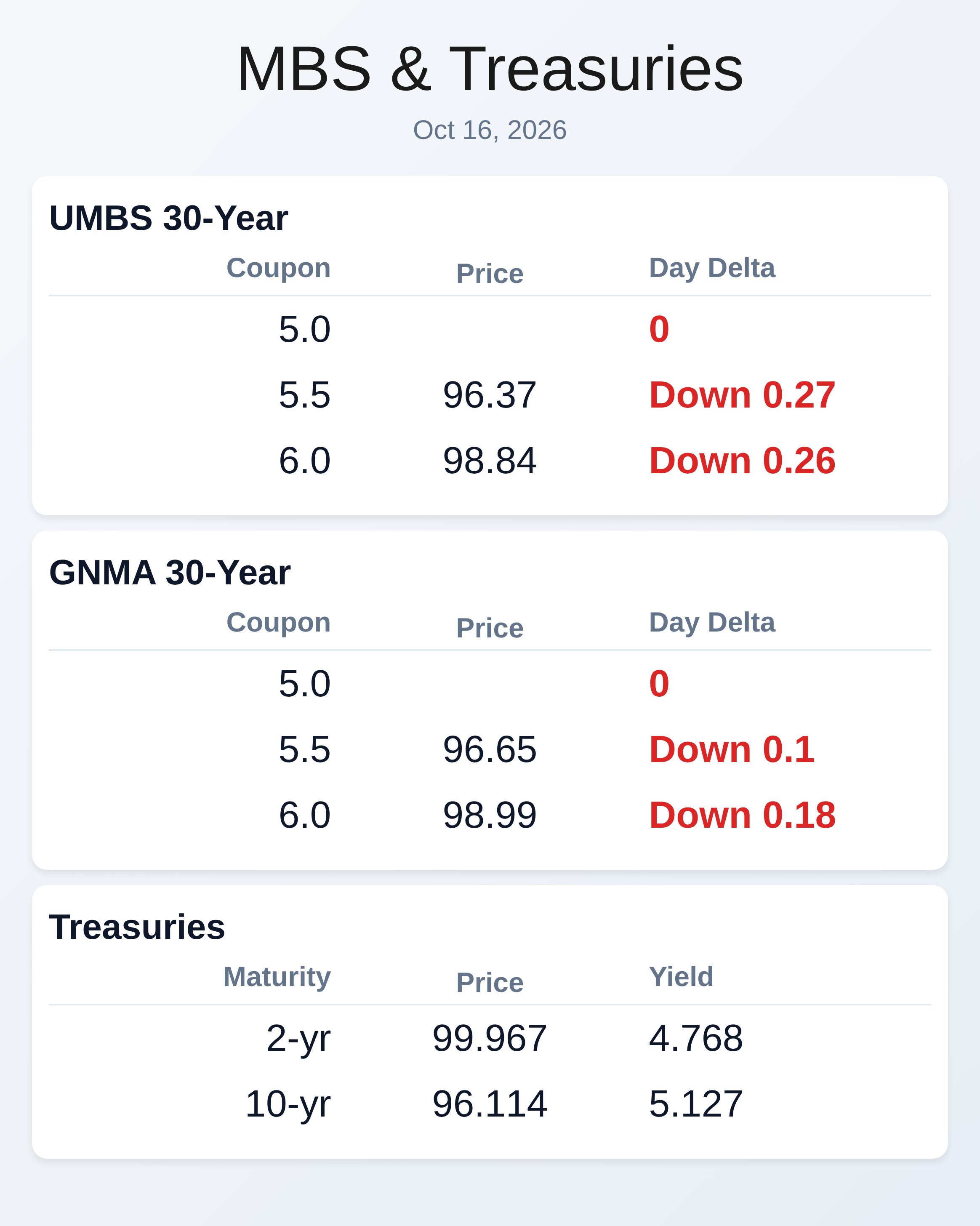
UMBS securities cratered this week as bond markets sold off hard on hotter-than-expected inflation readings, with core CPI jumping 0.335 percent versus 0.2 percent forecast, sending 30-year Fannie Mae 6.0 bonds down as much as 70 basis points in early trading before recovering slightly. Treasury yields rocketed to 5.275 percent immediately after Wednesday’s CPI surprise, though investors pivoted sharply by Friday afternoon when AI stock concerns sparked a classic flight to quality that pushed 10-year yields back down to 5.09 percent. The week underscored fragile market positioning and the challenge lenders face distinguishing temporary volatility from real execution-value changes—refreshing rate sheets simply does not cut it when spreads whip this violently.
September producer prices surged 1.3 percent month-over-month and 6.3 percent year-over-year, both crushing expectations, with core PPI also exceeding forecasts as elevated energy costs ripple through supply chains and threaten broader price pressures. Energy costs remain the culprit, with gasoline surging 9.1 percent and oil hovering near $106 per barrel, creating persistent headwinds for household purchasing power already under strain from seven consecutive months of rising mortgage rates. This inflation persistence complicates the Fed’s path and keeps October rate-hike odds bouncing between 15 and 29 percent depending on daily market whipsaws, though Fed Chair Warsh’s remarks Friday emphasized discipline rather than urgency.
The takeaway for lenders is clear: absent clearer signs of disinflation or economic slowdown, Treasury yields will likely remain elevated, keeping borrowers shopping for adjustable-rate mortgages and non-QM products at record adoption levels. MBA released its policy roadmap focused on near-term administrative fixes to reduce home-financing costs without legislative action, including replacing Fannie Mae and Freddie Mac’s tri-merge credit mandate, cutting loan-level price adjustments for purchase loans, and lowering FHA mortgage insurance premiums by 20 basis points—a move that could save borrowers on a $400,000 loan nearly $800 annually. Better.com added former X CEO Linda Yaccarino to its board as founder Vishal Garg executes a remake following a costly proxy fight that drained $8 million in the third quarter alone, signaling the firm’s push to stabilize and refocus on digital lending.
FHFA Director Bill Pulte’s complete absence from the NBA Annual Conference fueled speculation about priorities and visibility, while Fannie Mae now expects 2027 single-family originations to fall 18 percent to just $1.86 trillion, with the 30-year fixed averaging 7.5 percent—a dramatic downgrade from its September forecast of 6.7 percent. Refinance volume faces the steepest cliff, plunging 46 percent to $430 billion as higher rates persist through end of 2027. Optimal Blue’s September Market Advantage report showed the industry bending in new directions as rising rates clobbered overall lock volume, with total locks down 2 percent month-over-month and 26 percent year-over-year, yet purchase volume held flat and non-QM jumped 8 percent from August to reach 12 percent of all production.
ARM usage hit 14 percent of locks, the highest share since 2019, proving borrowers will embrace rate risk to qualify and afford homes in a pricey, high-rate environment. Product mix now drives purchase origination more than rate improvement, requiring lenders to balance conforming eligibility losses against gains in non-QM and ARM execution—a discipline that separates winners from those left holding unsold pools. Meanwhile, independent mortgage banks shed 100 net loan officers from January through mid-September while broker, wholesale, and non-delegated channels captured 327 LOs and $7 billion in production, reflecting a structural shift toward lower-cost operating models and technology-enabled fulfillment.
Credit and investor attitudes tightened considerably as alternative credit scoring gains traction but investors struggle to value VantageScore equally to FICO despite matched loan-level price adjustments. A borrower with a 720 VantageScore may not perform like one with a 720 FICO, yet the industry has few guardrails beyond pricing parity, creating execution risk for lenders who originate on alternative scores but find fewer investors willing to buy. JPMorgan’s Q3 results showed gain-on-sale margins compressing 56 basis points to just 0.29 percent as retail mix dropped from 61 to 54 percent, signaling profitability pressure amid volume declines, though Redwood Trust reported solid securitization volumes despite depressed valuations and market concerns over dividend sustainability.
Lenders eyeing MSR valuations watched a modest uptick in mortgage servicing rights to 1.50 percent at JPMorgan, consistent with higher rates, yet broader concerns over FASB’s proposal to inflate MSRs through recapture speculation drew fierce opposition from major banks and likely zero public support from trade groups. Fannie Mae will roll out tighter occupancy consistency checks on November 13, flagging loans where borrower occupancy type appears inconsistent with housing history, financial profile, and property characteristics, requiring reclassification as investment property if primary occupancy cannot be confirmed. Lenders who embed clear occupancy documentation and digital income-asset validation early in file development will avoid late-stage requests, repurchase risk, and unnecessary delays.
Across the board, margin management has never been sharper—every basis point counts when lock volumes sink, borrower demand shifts product mix, and hedging costs spike. MCT’s margin management advisory shows one client avoided $1 million in losses before spec pay-up shifts hit pipeline, underscoring that disciplined pricing strategy with independent assessment beats chasing 20 or 30 basis points in non-QM execution and winding up exposed when pools fail to trade.
**Locking vs Floating**
Lock activity cooled this week as Treasuries gyrated wildly—an initial spike to 5.36 percent gave way to a flight-to-quality rally that pushed 10-years down to 5.03 percent by Friday.
Borrowers who locked earlier in the week protected themselves against the CPI shock, while those who floated through Wednesday’s spike faced painful mark-to-market losses before recovering Friday’s bid.
**Today’s Events**
September Industrial Production and Capacity Utilization are due later today, along with September Import and Export Prices, completing the economic calendar before the Fed enters its blackout period. Market focus shifts to corporate earnings and any sign that management guidance can support valuations amid AI spending concerns and inflation persistence.
**Bond Pricing**
**UMBS 30 yr**
| Coupon | Price | Intra-Day Change |
**GNMA 30 yr**
| Coupon | Price | Intra-Day Change |
**Treasuries**
| Term | Yield | Price | Intra-Day Yield Change |