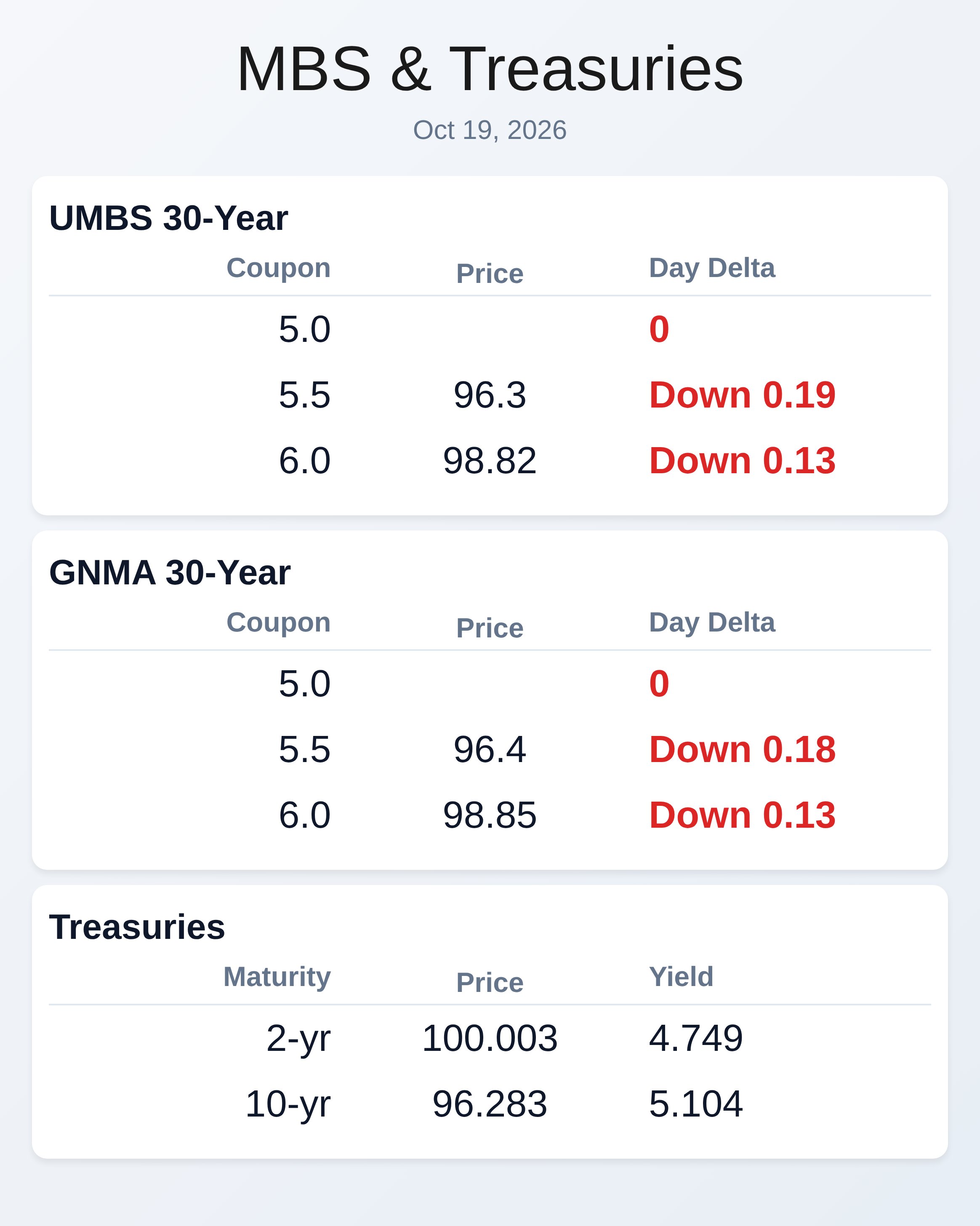
**WTMS Blog Today = What’s up in Mortgage Today (AM) – 10/19/2026**
Hotter-than-expected inflation data this week sent mortgage-backed securities tumbling while Treasury yields spiked, upending a week of rate turbulence that left lenders scrambling to manage hedges and pricing execution. September’s core consumer prices accelerated 0.335% versus 0.2% forecast, and producer prices surged 1.3% compared to 0.5% consensus, signaling persistent price pressures across the economy. Despite the inflation shock, aggressive flight-to-safety demand in equities—driven by artificial intelligence funding concerns and technology selloffs—triggered an unexpected Treasury rally by Friday, pulling the 10-year yield down from 5.36% to as low as 5.03%.
UMBS 6.0 securities fell roughly 70 basis points intraweek before recovering modestly on safe-haven flows and short-covering activity. Mortgage spreads widened amid rough $90 billion in daily trading volume, yet speculative payups for 6.0s and 6.5s coupons suggest selective demand for favorable prepayment profiles persists. The week exposed fundamental market tension: sticky inflation and elevated oil prices support Fed tightening bets, yet deteriorating growth signals and consumer resilience concerns fuel defensive positioning.
Producer prices climbed 1.3% month-over-month, the fastest pace in more than four years, while September retail sales surprised to the upside at 0.8% versus 0.3% forecast, complicating the economic narrative. Markets have priced roughly a 29% probability of an October Fed hike and 88% likelihood of a December move, though Fed officials have signaled no immediate urgency to act. Capital markets teams now face the challenge of distinguishing temporary market reactions from meaningful shifts in execution value, requiring disciplined assessments of investor demand for specific coupon compositions and borrower profiles.
Lenders navigating non-QM execution must avoid chasing incremental basis points in premiums at the risk of pipeline exposure when pools fail to trade. Fannie Mae expanded occupancy verification protocols effective November 13, flagging loans where occupancy type appears inconsistent using broader data sets including housing history, financial profile, and property characteristics. If lenders cannot confirm primary occupancy after review, they must reclassify loans as investment property and resubmit, though flagging is procedural guidance rather than fraud accusation.
This change underscores the GSEs’ renewed focus on preventing occupancy misrepresentation early in underwriting, reducing late-stage document requests and repurchase risk. Meanwhile, GSE repurchase activity surged 19.5% in the second quarter compared to the first, with 1,401 loans totaling $465.2 million in unpaid principal returned for defects. Fannie Mae drove 58.2% of that volume and resolved 83.2% of demands with repurchase versus Freddie’s 53.1%, signaling aggressive quality enforcement.
Pending home sales plummeted this week, falling 4% month-over-month in September—the largest drop in over three years—as mortgage rates exceeded 7.4% and pushed contract signings to 12-year lows outside the pandemic. Existing home sales rose just 1.5% from August to a 3.99 million annual pace while inventories climbed to 4.8 months of supply, indicating supply absorption rather than renewed buyer demand. Nearly one in five sellers reduced asking prices last month, and 14.5% of purchase agreements failed—the highest breakage rate on record—as affordability pressures mount on households already straining under higher food, fuel, and housing costs.
Agent sentiment hit its weakest level since fall 2023, with only 8% of National Association of Realtors respondents expecting buyer traffic to increase over the next quarter. Fannie Mae’s latest forecast slashed 2027 single-family origination projections to $1.86 trillion, down 18% from September’s $2.28 trillion estimate, with refinance volume cut by 46% to just $430 billion. Lenders are actively reassessing loan officer staffing and retention strategies as the Mortgage Bankers Association projects 2027 production will fall 5% to below $2 trillion.
Tight margins, reduced origination volume, and seasonal weakness are forcing harder questions about whether LO workforces can sustain profitability through winter without significant rate recovery. Technology adoption and borrower engagement remain central to scaling production with leaner teams, while non-agency and portfolio lending channels are capturing market share from traditional conforming lenders. Alternative credit scoring through VantageScore 4.0 is gaining traction as a cost-reduction tool, yet investor acceptance remains fragmented, creating execution flexibility constraints for lenders who originate with alternative models but sell to investors with traditional FICO preferences.
AI governance and controlled decision-making continue shaping compliance frameworks, particularly as lenders deploy automation across document review, underwriting, and quality control. Capital markets volatility will persist until economic and inflation data clarify the Fed’s path forward and investor confidence in AI valuations stabilizes. The 10-year Treasury yield closed Friday near 5.10%, down 14 basis points from the prior week’s close, while agency MBS prices remained resilient relative to the scale of rate swings, suggesting technical mean reversion and positioning adjustments rather than durable directional conviction.
Loan-level payups have broadened for smaller-balance loans and favorable coupon compositions, while high-balance discount loans continue trading at substantial haircuts reflecting ongoing prepayment and market risk. Origination profitability hinges on disciplined pricing execution, accurate hedge positioning relative to pipeline risk, and clear communication with loan officers on rate lock timing and investor demand dynamics. This week brings housing starts, pending home sales, and a 20-year Treasury auction, with Fed communication limited to the FOMC blackout period through week’s end.
Free mortgage industry insights delivered daily—subscribe at WellThatMakesSense.com to stay ahead of market moves and policy changes.