**WTMS Blog Today = What’s up in Mortgage Today (AM) – 10/26/2026**
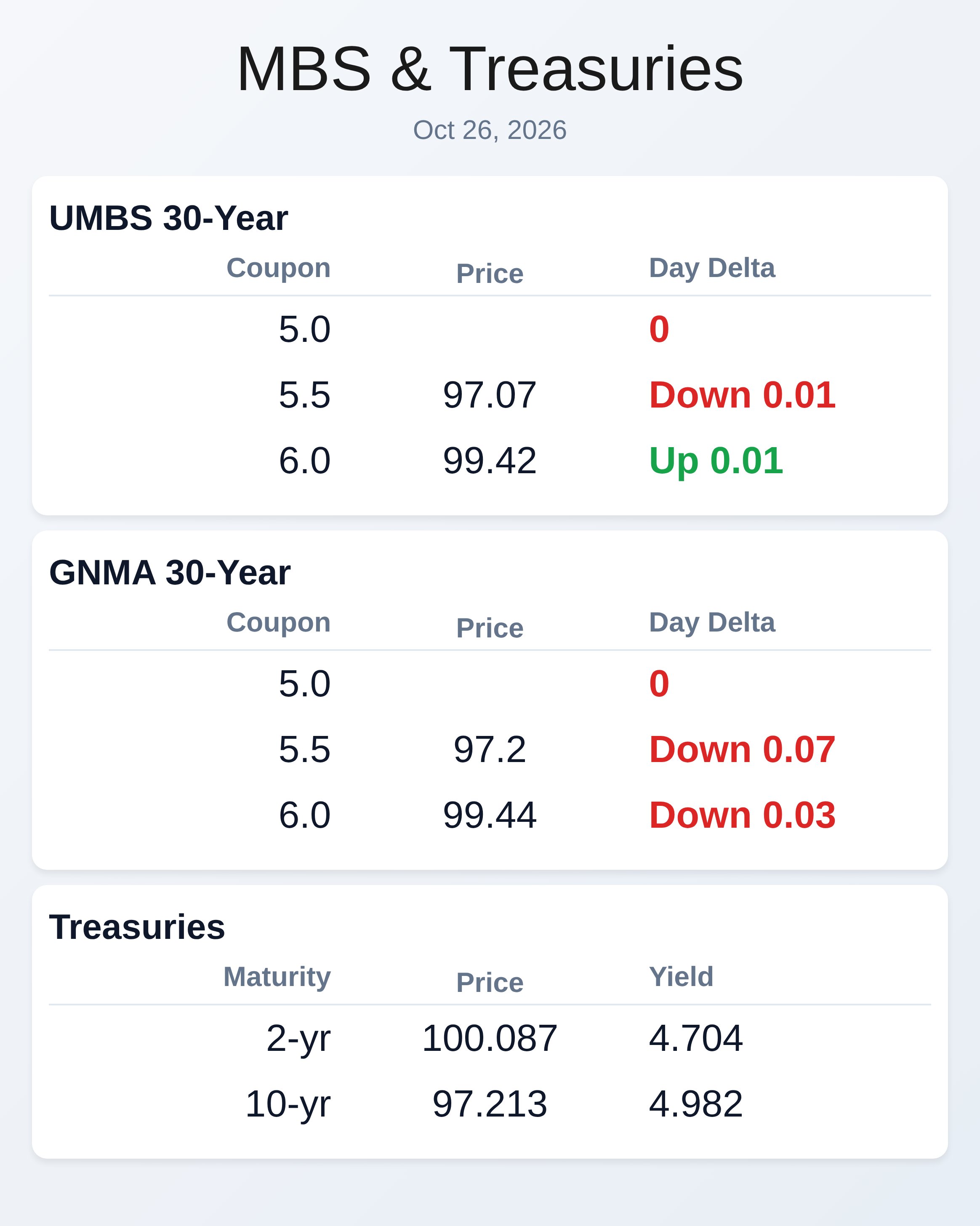
Mortgage rates dropped below 5 percent this week as technology stock turmoil triggered a safe-haven rally in Treasury bonds, marking the 10-year yield’s sharpest decline since mid-September. The flight to quality came despite persistent inflation data and elevated oil prices near $100 per barrel, signaling that investor concerns over artificial intelligence funding stress now dominate market direction. UMBS 6.0 securities rallied meaningfully, gaining ground as the 2-year/10-year curve flattened to around 30 basis points and volatility became the defining feature of the week.
Mortgage application volume continued its decline, falling for a seventh consecutive week as elevated rates and high home prices keep borrowers sidelined despite the modest relief. Producer prices surged unexpectedly, core PPI rose 0.7 percent month-over-month, and housing starts plunged 5.2 percent, all reinforcing that the housing market remains under pressure from affordability constraints. President Trump signed an executive order directing the GSEs and federal agencies to lower mortgage insurance cancellation costs, expand title insurance waivers, and reduce USDA and VA loan rates, though implementation remains uncertain and could take months.
Non-QM production continues to grow as borrowers unable to qualify under traditional agency guidelines pursue alternative loan products with higher DTI tolerances and flexible documentation standards. Lenders are reporting strong demand for adjustable-rate mortgages and temporary buydown products, which together now account for significant share of production mix as borrowers adapt to higher rate environments. Home equity demand is surging, with some lenders closing HELOCs in as few as five days, and servicers are seeing continued pressure from GSE margin compression.
Builder confidence fell to its lowest level since June 2012, driven by construction cost inflation, labor shortages, and buyer pullback from elevated financing rates. Fannie Mae revised its 2027 mortgage production forecast down 18 percent to $1.86 trillion, citing expectations that rates will average 7.5 percent through year-end, while the MBA similarly projects rates staying between 7 and 7.5 percent. Loan officer retention remains top-of-mind for lenders facing volume challenges, with many examining whether their entire workforce can remain sustainable through slower market conditions.
Credit quality metrics show stress building in certain segments, with Ginnie Mae borrowers carrying DTI ratios above 45 percent experiencing serious delinquency rates of 5.1 percent compared to 3.2 percent for those below that threshold. GSE repurchase activity jumped 19.5 percent in Q2 2026 to $465.2 million in unpaid principal, with Fannie Mae initiating repurchases on 83.2 percent of resolved demands versus Freddie Mac’s 53.1 percent. Alternative credit scoring models like VantageScore are gaining traction as lenders seek cost reductions, but investor acceptance remains fragmented and execution risk persists for originators who rely on alternative scores when investor acceptance is uncertain.
The FASB’s proposal to include borrower recapture value in mortgage servicing rights valuation continues to generate debate, with major banks opposing the change while MSR holders argue it reflects economic reality. Appraisal standards shift to UAD 3.6 effective November 2, requiring lenders and AMCs to update review policies and prepare teams for significantly longer, more complex reports. FHFA Director Bill Pulte signaled possible movement toward reducing credit report requirements from three to one or two by year-end, which could meaningfully lower closing costs if implemented.
Capital markets professionals watch a growing divergence between equity weakness in technology stocks and bond strength, indicating that traditional risk-off correlations may be reasserting after months of disconnect. The 10-year Treasury yield broke below 5 percent for the first time in three weeks on safe-haven demand triggered by concerns over highly leveraged AI data-center companies and geopolitical tensions in the Middle East surrounding Iran. Short-covering, hedge fund position unwinding, and potential convexity-related selling in technology equities created intraday volatility while MBS lagged Treasuries on a spread basis.
Mortgage spreads remain mixed despite the sharp Treasury rally, limiting rate relief for borrowers and keeping execution complexity high for secondary market teams. The yield curve continues its bull-flattening pattern with the 2s/10s spread compressing to historic lows, raising questions about sustained demand for longer-duration assets. Prepayment risk remains elevated in discount MBS pools as financially pressured borrowers pursue cash-out refinances despite unfavorable rates, driven by record home equity and deteriorating household finances.
**Locking vs Floating**
Lock strategists face two-sided risk: further rate increases could widen MBS spreads and reduce lock profitability, while a sustained Treasury rally could force costly hedge adjustments as duration shortens. Pipeline hedgers must balance conviction on inflation trajectory against uncertainty over Fed timing and geopolitical escalation. Current volatility argues for disciplined, position-sizing approaches rather than aggressive bets in either direction.
**Today’s Events**
Chicago Fed National Activity Index for September releases this morning, followed later by the Dallas Fed Manufacturing Business Index for October. Treasury auctions begin with $69 billion in 2-year notes at 1 PM ET. The Federal Reserve’s Open Market Committee meets Wednesday with a hold widely expected, though markets price roughly 80 percent probability of a 25-basis-point hike in December.
**Bond Pricing**
**UMBS 30 yr**
| Coupon | Price | Intra-Day Change |
**GNMA 30 yr**
| Coupon | Price | Intra-Day Change |
**Treasuries**
| Term | Yield | Price | Intra-Day Yield Change |