**WTMS Blog Today = What’s up in Mortgage Today (PM) – 10/23/2026**
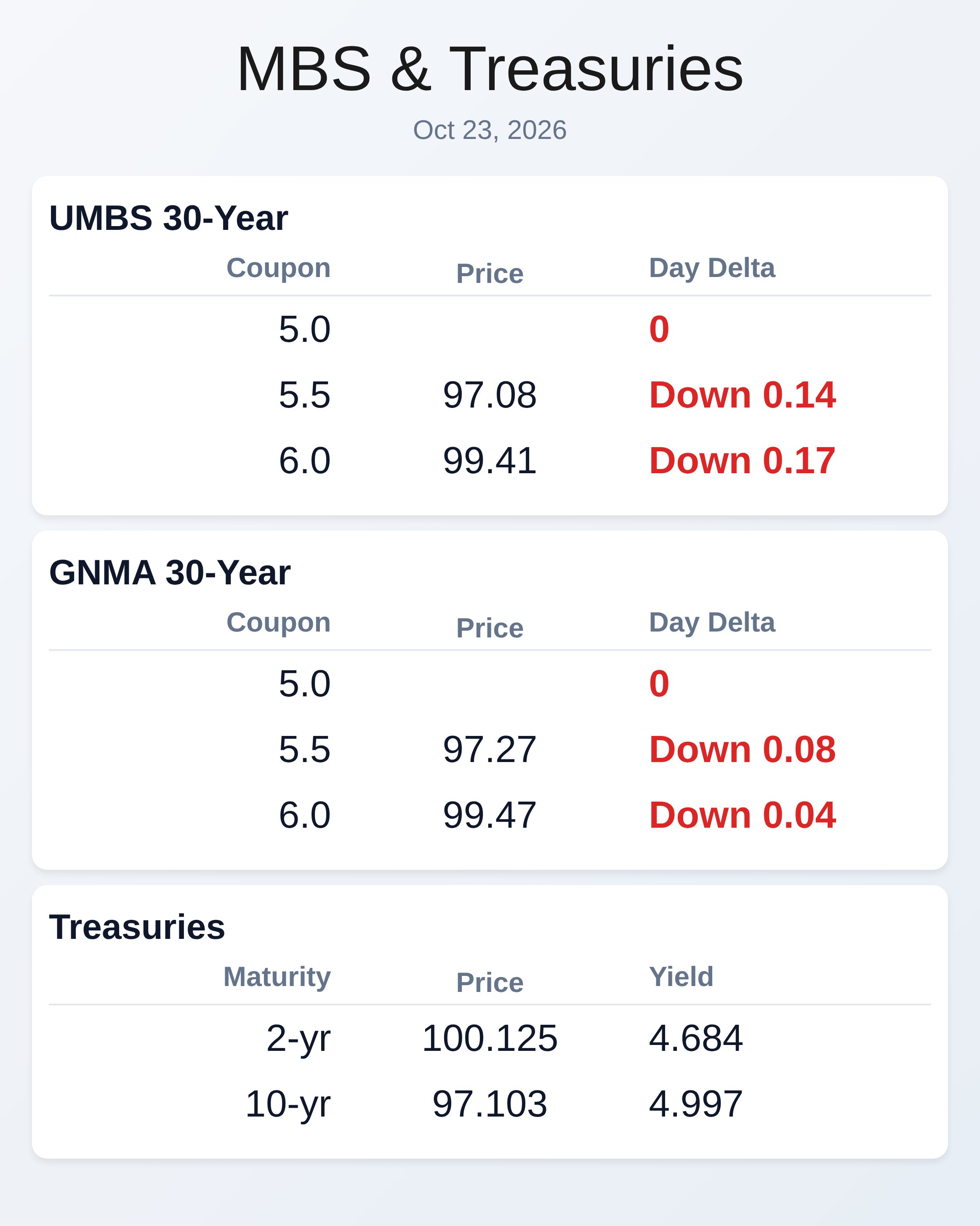
Mortgage rates improved sharply Thursday as technology stocks tanked and investors sought safety in bonds, sending 10-year Treasury yields down 16 basis points to their lowest level in a month. The flight-to-safety trade dominated markets following disappointing earnings from major AI-related companies, particularly semiconductor firms and data-center operators like Coreweave. This marks the best single day for Treasuries since August 2025, with MBS gaining over 68 basis points as lenders rapidly repriced for the better.
The rally extends a two-week trend where tech concerns have kept rates in a lower range despite persistent inflation worries and geopolitical tensions pushing oil toward $112 per barrel. Borrowers who received quotes earlier this month should request fresh offers, as modest but meaningful rate relief may now be available. President Trump signed an executive order Thursday targeting mortgage costs through expanded title insurance waivers, mortgage insurance pilot programs, and potential reductions in loan-level price adjustments on qualifying refinances.
The order directs FHFA to make permanent a program substituting automated title-risk reviews for lender’s title insurance on eligible refinances, which could save borrowers $500 to $1,500 per transaction. A pilot program would cancel PMI proactively for loans originated after the program begins, based on current property values—though this helps existing homeowners rather than struggling buyers. The Treasury also directs VA and USDA to lower interest rates on their single-family home loans and establishes a task force to improve manufactured housing standards.
However, the final order was watered down from draft versions, leaving questions about whether cost savings will meaningfully improve access for first-time homebuyers facing persistent affordability gaps. Home affordability remains a critical challenge even with substantial down payments, according to Q3 data showing the income needed to purchase a median-priced home ($368,000) has reached $90,191 annually—nearly $11,000 above the average worker’s wage. Even with a 20% down payment ($73,600), monthly ownership costs consume 31.8% of average wages, exceeding recommended guidelines in 467 of 583 counties analyzed.
Existing homeowners could see relief through PMI cancellation and refinancing cost reductions outlined in Trump’s order, but purchase affordability remains constrained by limited housing supply, elevated prices, and borrowing costs. The MBA released its own affordability roadmap proposing reduced credit requirements, lower LLPAs, and FHA insurance premium decreases that could save buyers $1,000 to $800 annually respectively. Without supply-side policy changes addressing housing inventory and construction costs, demand-side relief measures risk primarily benefiting existing homeowners while leaving first-time buyers behind.
United Wholesale Mortgage reported preliminary Q3 results showing $33.4 billion in volume with a 124-basis-point gain-on-sale margin, but reduced full-year revenue guidance amid continued industry volume pressure. More significantly, UWM is selling $70 to $80 billion in mortgage servicing rights this quarter for $1.8 billion, which would shrink its $270 billion servicing portfolio to approximately $210 billion. This divestiture helps pay down non-funding debt while shifting away from servicing-dependent revenue streams, though it accelerates the company’s transition toward origination-focused operations.
The preliminary numbers preceded a rights offering at $2.00 per share, positioning founder Mat Ishbia for potential increased ownership if outside investors decline participation. The servicing sale underscores broader industry challenges, with consolidation pressure and margin compression forcing even top-5 lenders to reassess their business model foundations. Fannie Mae and Freddie Mac have implemented increasingly divergent artificial intelligence governance requirements that complicate compliance for lenders selling to both enterprises simultaneously.
Fannie’s new Section 4 requirements, effective January 18, 2027, emphasize model governance, data controls, and technology lifecycle management, while Freddie Mac focuses more heavily on audits, executive approvals, and liability frameworks. The GSEs have essentially swapped their previous positions—Freddie was traditionally more prescriptive while Fannie took a principles-based approach—forcing lenders to rework policies, vendor agreements, and internal controls to meet the stricter standards of each counterparty. The terminology shift from “AI” to “Super Intelligence” reflects executive order guidance but doesn’t change the substantive scope, creating potential confusion without alleviating compliance complexity.
Originators selling to both agencies now face a 2027 deadline to align governance programs across competing regulatory frameworks, adding operational cost and complexity during an already challenging market environment. GSE credit score policies are evolving to expand access while creating new pricing dynamics that lenders must navigate carefully. The MBA’s affordability roadmap proposes allowing borrowers with scores above 700 to use single-credit-report instead of tri-merge reports, potentially saving $150 per transaction and reducing closing costs by roughly 1 percent of the average.
United Wholesale has already waived credit-score pricing adjustments on FHA and VA loans through year-end, and Pennymac implemented VantageScore 4.0 across all production channels, signaling broader industry movement toward more favorable credit treatment. However, the expansion of alternative credit scoring and lower-cost credit procurement could introduce hidden risks if lenders prioritize favorable scores over complete credit pictures, potentially weakening underwriting discipline. Servicer-level data reveals meaningful differences in prepayment speeds—with Rocket consistently among the fastest payers and Idaho HFA among the slowest for 14 consecutive months—underscoring that credit policy changes must account for borrower composition and risk dynamics across different originator portfolios.
**Locking vs Floating**
Tech sector weakness is creating genuine safe-haven demand for bonds, but this support remains fragile and depends entirely on whether equity concerns accelerate or stabilize. The recent rally benefited from a unique confluence of stock-market decline, bond-seller exhaustion at elevated yields, and opportunistic value buying—not from fundamental economic weakness or Fed rate-cut certainty. If technology stocks stabilize or recover even modestly, Treasuries could lose their safe-haven bid and yields could resume their ascent toward recent highs near 5.36 percent.
Borrowers locking today capture the lowest rates seen in two weeks, but the rally’s durability is highly uncertain given persistent inflation, fiscal concerns, and geopolitical risks that continue to pressure bond valuations.
**Today’s Events**
Existing home sales rose 1.5% month-over-month in September to 3.99 million annualized, but remained 2.2% below year-ago levels. Building permits declined month-over-month while housing starts missed expectations.
Import prices rose 1.1% versus 0.8% forecast. Industrial production grew 0.7% versus 0.4% expected.
**Bond Pricing**
**UMBS 30 yr**
| Coupon | Price | Intra-Day Change |
**GNMA 30 yr**
| Coupon | Price | Intra-Day Change |
**Treasuries**
| Term | Yield | Price | Intra-Day Yield Change |