**WTMS Blog Today = What’s up in Mortgage Today (PM) – 10/23/2026**
Mortgage rates finally caught a break this week as technology stock turmoil sent investors fleeing to the safety of U.S. Treasury bonds. The 10-year yield dropped sharply from 5.36% to below 4.96%, marking the best day for Treasuries since August 2025 and lifting mortgage-backed securities higher for the first time in weeks.
This rally provided meaningful relief after rates had climbed to 20-year highs on persistent inflation fears and geopolitical tensions, though borrowing costs remain elevated by historical standards. Lenders reported improved pricing power as MBS spreads tightened and borrowers who had paused their searches showed renewed interest in locking rates. The AI sector selloff, particularly in companies like Coreweave that heavy investors had bet on for artificial intelligence infrastructure, sparked genuine flight-to-safety demand that overshadowed hawkish Fed signals and hotter-than-expected inflation data.
President Trump signed a housing executive order targeting mortgage costs through proactive mortgage insurance cancellation pilots, expanded title insurance alternatives, and reduced loan-level price adjustments on qualifying refinances. The order directs FHFA to make title insurance waivers permanent across both Fannie Mae and Freddie Mac, potentially saving borrowers $500 to $1,500 on refinances. However, the final version narrowed the most ambitious provisions from the draft—the mortgage insurance pilot now applies only to future originations rather than retroactively canceling premiums for existing borrowers based on current valuations.
The MBA separately released its own affordability roadmap proposing single-bureau credit reporting for scores above 700, lower annual FHA mortgage insurance premiums, and reduced loan-level price adjustments, estimating borrowers could save $1,000 to $800 annually on respective transactions. Both initiatives acknowledge the affordability crisis while targeting existing homeowners and refinance activity more than first-time buyers struggling with down payments and home prices. Meanwhile, Fannie Mae and Freddie Mac have diverged significantly on artificial intelligence governance requirements that lenders selling to both GSEs must now navigate.
Fannie’s revised Information Security Supplement employs “Super Intelligence” terminology and takes a stricter principles-based approach to AI model governance, data controls, and technology lifecycles effective January 18, 2027. Freddie Mac’s requirements, already in effect since March, remain more prescriptive on audits, executive approvals, and vendor liability frameworks. Lenders cannot simply comply with one GSE’s standards and expect alignment with the other, forcing many to redesign policies and vendor agreements before Fannie’s deadline.
The divergence highlights how rapidly agency expectations are evolving and how compliance costs mount when the two largest mortgage purchasers develop separate AI rulebooks instead of coordinated standards. September mortgage origination volume declined sharply with the MBA reporting total applications down 37.5% year-over-year, pushed lower by rates climbing to 7.5% and a refinance environment offering minimal savings for most borrowers. The MBA’s 2027 forecast predicts total origination volume will drop approximately 5% to just under $2 trillion, down from the $2.1 trillion expected in 2026, with purchase originations barely growing at 0.8% while refinances collapse by 17%.
Existing home sales data revealed an unprecedented imbalance—home sellers now outnumber buyers by 63%, the widest gap since records began in 2013, with just 928,892 buyers on the market against 1.51 million sellers. Home affordability remains a structural problem, with ATTOM data showing buyers need $90,191 in annual income to purchase a median-priced $368,000 home, roughly $10,657 above average worker wages, and ownership costs consuming nearly 32% of median wages even with 20% down. Real estate credit conditions show stress emerging, with GSE repurchase activity climbing 19.5% in the second quarter and sub-700 FICO loans hitting their highest share of 2026 UMBS issuance at 11.4%.
**Locking vs Floating**
The bond market’s recent rally appears driven more by temporary equity market distress than confirmed fundamental improvement. Investors reduced expectations for Fed rate hikes next year, but that shift remains fragile and could reverse quickly if technology stocks stabilize or new inflation data disappoints. Persistent oil prices above $110 per barrel, elevated Treasury issuance, and foreign capital outflows keep upward pressure on longer-term yields.
Borrowers closing within 30 days should strongly consider locking rates at current levels rather than floating into the Q4 closeout period when demand may spike and margins compress.
**Today’s Events**
Core PPI Month-over-Month (September): 0.7% vs. 0.3% forecast, 0.2% prior
Building Permits: 1.400M vs.
1.390M forecast
Housing Starts: 1.221M vs. 1.300M forecast
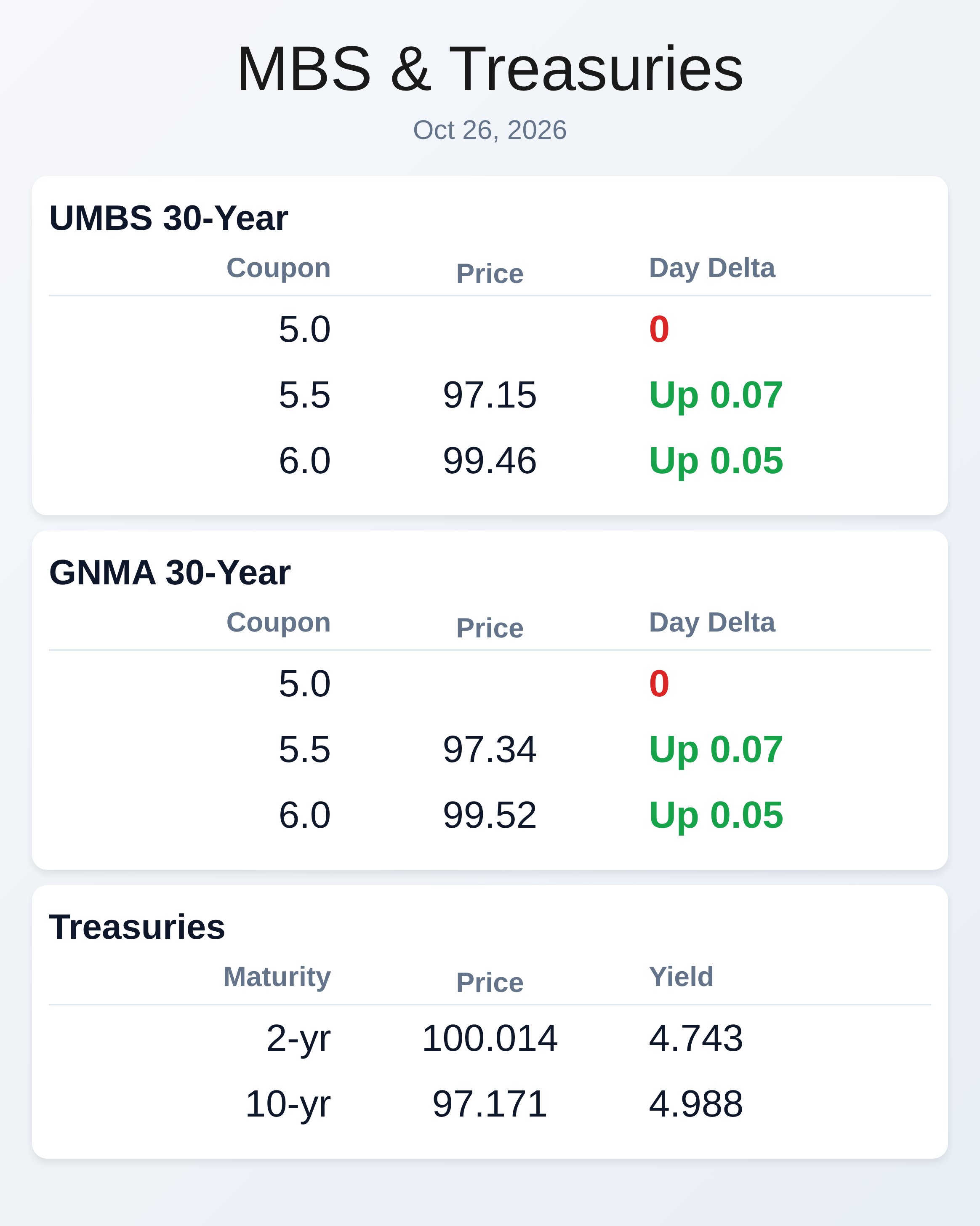
**Bond Pricing**
**UMBS 30 yr**
| Coupon | Price | Intra-Day Change |
**GNMA 30 yr**
| Coupon | Price | Intra-Day Change |
**Treasuries**
| Term | Yield | Price | Intra-Day Yield Change |