Loading...
HOME2023-01-22T13:43:33-07:00

Damn, there is so much great knowledge out there. Did you know that “BOOKS” are full of smart?? No, I mean like life changing, I-wish-I-knew-that-years-ago type stuff.

I know that I was waaaayyy late to the game figuring it out. And I know that a lot of you are too busy to read as much as you ‘should’. And that is why you need me.

I still remember how it started for me. It started in June of 2008. After 11  years …..Click to continue

Mortgage Today (AM) - 09/21/26 {{catlist}}
September 21, 2026
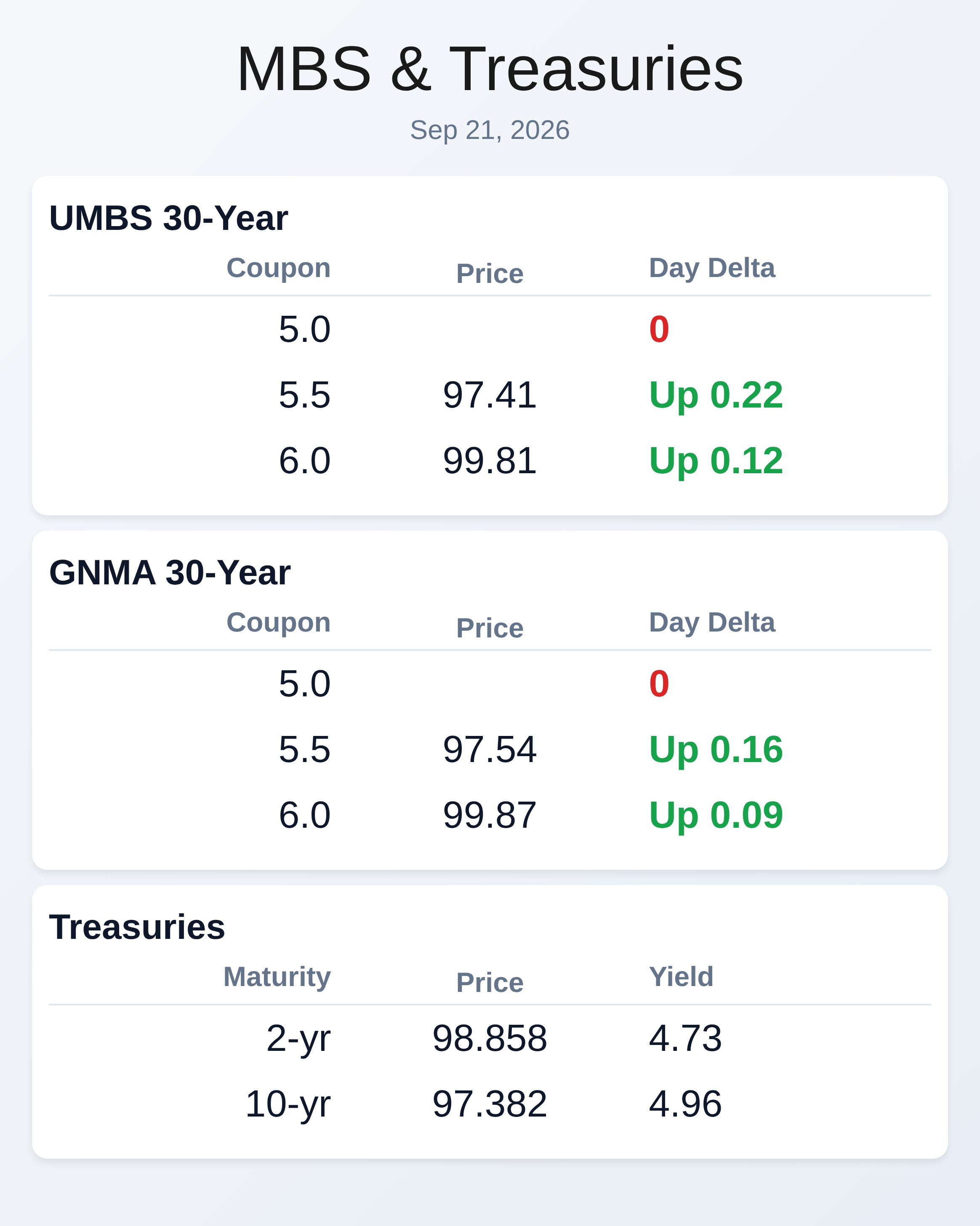
READ MORE **WTMS Blog Today = What's up in Mortgage Today (AM) - 09/21/2026** The Federal Reserve's hawkish quarter-point rate hike to 3.75–4.00% last week sent shockwaves through Treasury markets, pushing the 10-year yield to nearly 5% multiple times as inflation fears resurface. The benchmark 10-year closed Friday at 5.00% and opened today at 4.95%, with traders caught between two competing forces: renewed confidence in Fed credibility versus persistent fiscal concerns demanding higher real yields. Agency MBS prices responded positively in pre-market trading, up 0.125–0.250 from Friday's close, though mortgage spreads remain tactically cheap on a spread basis. Buyers remain hesitant to add risk until Treasury yields establish a stable trading range. The choppy environment also complicated mortgage hedging, with the deeply special FNCL 6.5 roll straining extension and financing costs for pipeline hedgers. Economic data this morning delivered mixed signals for mortgage market momentum. Jobless claims came in better than expected at 196K versus 208K forecast, while continued claims fell to 1.730M from 1.774M previously. However, housing starts declined to 1.275M in August versus 1.31M expected, and building permits fell short at 1.394M versus 1.41M forecast. The Philly Fed Business Index surprised to the upside at 37.8 versus 30.5 expected, but Philly Fed Prices Paid accelerated to 48.60, signaling persistent pricing pressure in manufacturing. These data points reinforce that growth remains resilient even as inflation concerns persist, keeping the Fed's rate-hiking bias intact. UMBS 30-year coupon prices showed modest intra-day gains this morning across the curve. The 5.5 coupon gained 0.22 points to 97.41, the 6.0 coupon rose 0.12 to 99.81, and the 6.5 coupon added 0.11 to 102.05. GNMA 30-year coupons performed similarly, with the 5.5 coupon at 97.54 (up 0.16), the 6.0 at 99.87 (up 0.09), and the 6.5 at 101.76 (up 0.16). The modest gains suggest buyers are testing the market after Friday's heavy selling, but conviction remains limited until yield stability improves. These modest moves reflect the cautious tone across Agency MBS as traders await clearer Treasury direction. Multiple conforming loan limit increases effective immediately or this week signal lender confidence despite rate volatility. Pennymac raised its conforming limit to $850,000, the highest announced increase, ahead of FHFA's official 2027 announcement expected in December. UWM, Newrez, Loan Stream, and AmeriHome all announced increases, with limits ranging from $845,000 to $850,000 for mainland properties. These expansions allow lenders to compete more aggressively for higher-balance loans that would otherwise fall into non-Agency territory. The coordinated moves suggest lenders are preparing inventory strategies for a tighter conventional landscape. Industry consolidation is reshaping borrower relationships and recapture strategy as lenders compete on technology innovation and servicing capabilities. This week's ACUMA conference in Las Vegas attracts 800 registrants, with AI and automation as central themes across vendor booths and lender meetings. Spring EQ, mLoop, Balerion, and other platforms are emphasizing speed (top performers closing home equity loans in under 10 days) and seamless borrower experience through white-labeling and automated verification. The competitive pressure to reduce friction and improve processing speeds is accelerating technology adoption across the mortgage ecosystem. Pipeline hedging and mortgage volatility remain key headwinds as the market awaits clearer direction on inflation and Fed policy. The deeply special FNCL 6.5 roll created financing strain for hedgers last week, illustrating how extended duration and low prepayment sensitivity magnify costs in volatile markets. With 16 of 18 Fed officials now expecting at least one more rate hike this year, the risk of higher volatility persists until energy prices stabilize and September inflation data prove benign. For now, the default posture remains conservative on lock/float decisions until a definitive Treasury rally emerges to justify a shift in borrower positioning. **Locking vs Floating** Technical resistance at 4.94% and 5.00% in 10-year yields has created important inflection points for lock/float decisions. One-off distortions in the bond market today suggest waiting for next week to better assess post-Fed momentum. The consensus view remains conservative: maintain neutral positioning until a definitive shift or rally emerges that justifies moving away from cautious borrower guidance. **Today's Events** Building Permits (Aug): 1.394M vs 1.41M forecast, 1.433M prior Continued Claims (Sep/05): 1.730M vs 1.780K forecast, 1.774K prior Housing Starts (Aug): 1.275M vs 1.31M forecast, 1.239M prior Jobless Claims (Sep/12): 196K vs 208K forecast, 206K prior Philly Fed Business Index (Sep): 37.8 vs 30.5 forecast, 47.4 prior Philly Fed Prices Paid (Sep): 48.60 vs forecast unavailable, 40.90 prior **Bond Pricing** **UMBS 30 yr** | Coupon | Price | Intra-Day Change | **GNMA 30 yr** | Coupon | Price | Intra-Day Change | **Treasuries** | Term | Yield | Price | Intra-Day Yield Change | **UMBS 30-Year** | Coupon | Price | Intra-Day Change | |---|---|---| | 5.5 | 97.41 | 0.22 | | 6.0 | 99.81 | 0.12 | | 6.5 | 102.05 | 0.11 | **GNMA 30-Year** | Coupon | Price | Intra-Day Change | |---|---|---| | 5.5 | 97.54 | 0.16 | | 6.0 | 99.87 | 0.09 | | 6.5 | 101.76 | 0.16 | **Treasuries** | Term | Yield | Price | Intra-Day Yield Change | |---|---|---|---| | 2-Year | 4.73 | 98.858 | -0.025 | | 3-Year | 4.803 | 98.818 | -0.026 | | 5-Year | 4.823 | 98.031 | -0.032 | | 7-Year | 4.89 | 97.713 | -0.039 | | 10-Year | 4.96 | 97.382 | -0.04 | | 30-Year | 5.294 | 97.471 | -0.033 | Subscribe free to stay ahead of daily mortgage market moves at WellThatMakesSense.com Market Data
Mortgage Today (AM) - 09/18/26 {{catlist}}
September 18, 2026
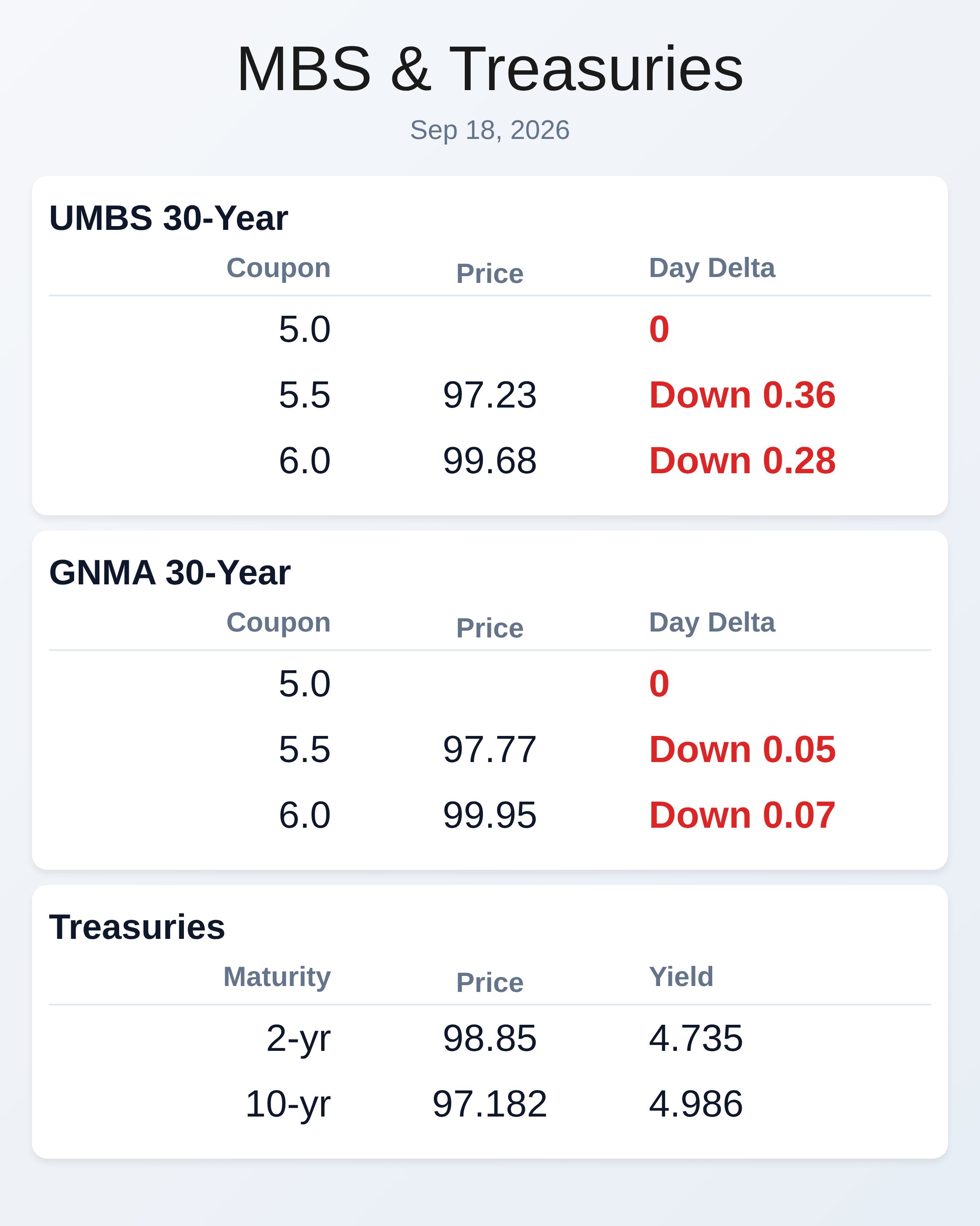
READ MORE **WTMS Blog Today = What's up in Mortgage Today (AM) - 09/18/2026** Bonds are selling off sharply this morning as the 10-year Treasury yield climbs to 4.986%, up 5.3 basis points, signaling renewed investor caution despite Thursday's modest rally. UMBS 30-year coupons are down across the board—5.5s off 0.36, 6.0s down 0.28, and 6.5s sliding 0.20—while GNMA securities show more modest declines. The market is wrestling with competing narratives: the Fed's hawkish 25-basis-point hike on Wednesday reasserted inflation-fighting credibility, but today's weakness suggests investors are already pricing in multiple additional rate increases through 2027. Oil prices remain under pressure, which typically supports bonds but has not reversed this morning's slide. The key technical level to watch is 4.94% on the 10-year; a sustained move below that threshold would signal genuine momentum toward lower rates. Yesterday's economic data painted a decidedly mixed picture that explains the current volatility. Housing starts came in at 1.275 million versus 1.31 million forecast, while building permits printed at 1.394 million against expectations of 1.41 million, both suggesting residential construction is losing steam. Jobless claims crushed estimates at 196,000 versus 208,000 forecast, indicating the labor market remains unusually resilient despite high borrowing costs. The Philadelphia Fed Index held strong at 37.8, but prices paid jumped to 48.60, signaling that inflation pressures are re-emerging even as housing activity cools. This disconnect—weak housing alongside tight labor and price growth—leaves the Fed with limited comfort on rate cuts, making the current yield environment sticky. The mortgage market faces structural headwinds from negative convexity as roughly 98% of 30-year borrowers now lack refinancing incentive. When rates rise, homeowners stay put, forcing MBS investors to hold longer-duration assets just as prices fall—the opposite problem they face during rallies. This convexity drag is particularly acute in higher-coupon 5.5% mortgages, which are experiencing positive convexity as refinancing options vanish entirely. Originators should recognize that MBS are increasingly range-bound rather than trending in either direction, reducing the urgency for extreme positioning either way. The current market environment rewards lender discipline over aggressive directional calls. The conventional conforming market continues to tighten eligibility standards and adjust loan pricing. FHFA Director Bill Pulte directed Fannie Mae to align servicing policies with Freddie Mac, allowing proactive borrower outreach for mortgage insurance cancellation based on current home values—a modest borrower relief measure. Fannie Mae expanded VantageScore 4.0 credit scoring from limited rollout to broad availability, giving approved lenders another underwriting option as the industry modernizes credit frameworks. Fiscal concerns pose a headwind to longer-duration bonds, making a sustained move below 5% in the 30-year difficult without meaningful economic deterioration. With much of 2027's expected tightening already priced in, bond yields may drift lower as investors reassess realistic rate-hike limits, though geopolitical energy pressures and AI-driven demand complicate inflation forecasts. Originators should prepare for range-bound rates and avoid over-extending capacity on the assumption of meaningful rate relief. **Locking vs Floating** Recent economic data shows housing construction losing momentum—starts and permits both missed estimates—while labor markets remain tight and price pressures are re-emerging. This mixed backdrop argues against aggressive floating positions, as the Fed retains hawkish optionality despite softer housing. Borrowers stretched on affordability have less margin for error, making lock discipline especially important to avoid future repurchase risk. **Today's Events** August Building Permits: 1.394M (forecast 1.41M, previous 1.433M) August Housing Starts: 1.275M (forecast 1.31M, previous 1.239M) September 5 Continued Claims: 1.730M (forecast 1.78M, previous 1.774M) September 12 Jobless Claims: 196K (forecast 208K, previous 206K) September Philadelphia Fed Business Index: 37.8 (forecast 30.5, previous 47.4) September Philadelphia Fed Prices Paid: 48.60 (previous 40.90) **Bond Pricing** **UMBS 30 yr** | Coupon | Price | Intra-Day Change | | 5.5 | 97.23 | -0.36 | | 6.0 | 99.68 | -0.28 | | 5.5 | 97.77 | -0.05 | **GNMA 30 yr** | Coupon | Price | Intra-Day Change | **Treasuries** | Term | Yield | Price | Intra-Day Yield Change | Market Data
Mortgage Today (PM) - 09/17/26 {{catlist}}
September 17, 2026
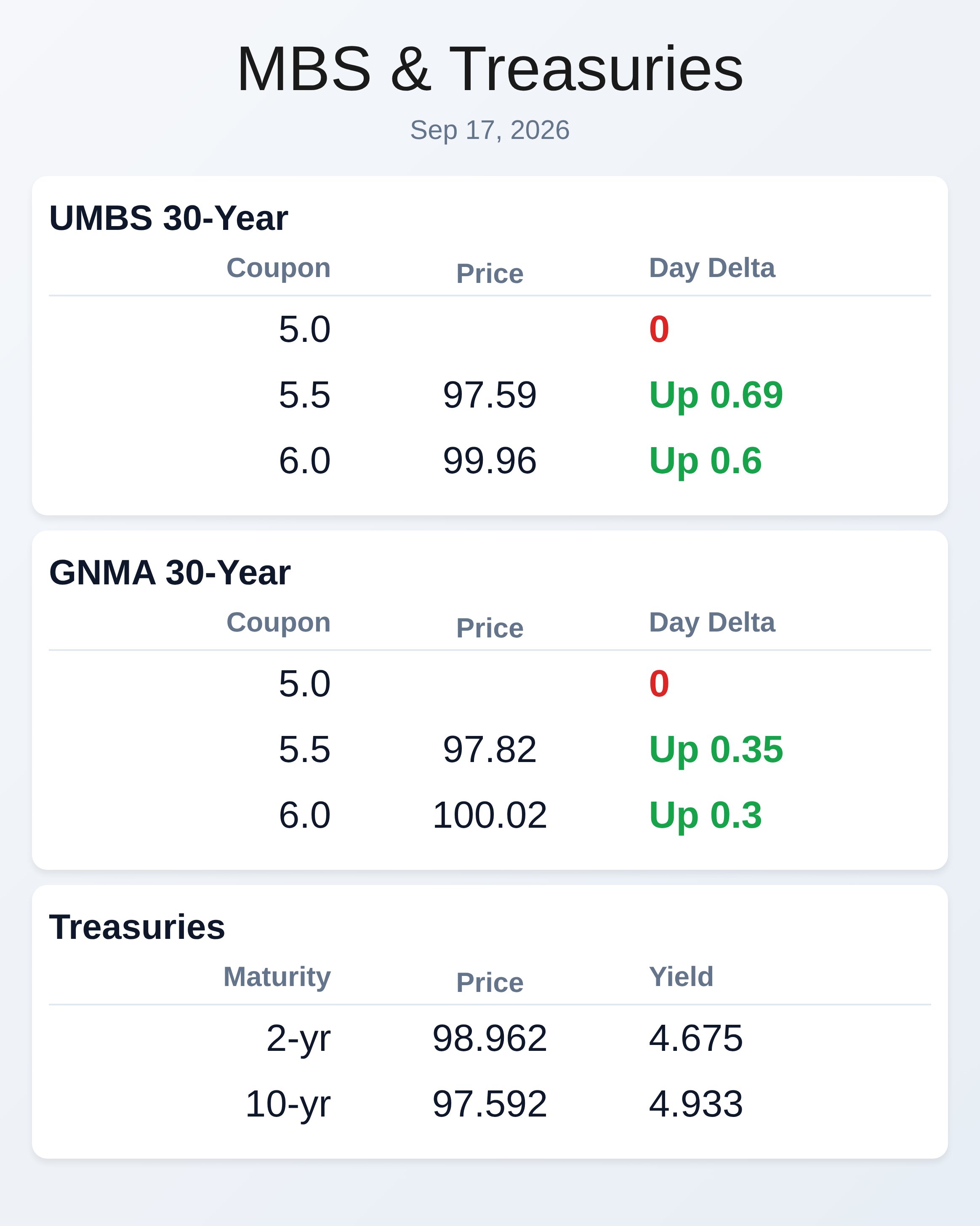
READ MORE **WTMS Blog Today = What's up in Mortgage Today (PM) - 09/17/2026** Mortgage rates caught a reprieve today as Treasury yields retreated following the Federal Reserve's widely anticipated rate hike, with the 10-year yield sliding 8.5 basis points to settle near 4.93%. UMBS securities gained significant ground throughout the session, with the 5.5 coupon jumping 69 basis points to 97.59 and the 6.0 coupon rising 60 ticks to 99.96. The bond market's positive reception suggests investors believe the Fed's tightening cycle may be nearing its end, though officials signaled additional rate increases could still be on the table if inflation persists. Economic data painted a mixed picture, with jobless claims coming in better than expected at 196K versus 208K forecast, while building permits and housing starts both lagged forecasts. The market's challenge now revolves around whether this modest rally represents a true shift in momentum or merely profit-taking before the Fed's next move. The disconnect between Fed policy and mortgage rates remains a critical lesson for originators to communicate. While the Fed's rate hike will push HELOC costs higher immediately—since those products typically track the prime rate—mortgage rates hardly budged because they forward-price Treasury expectations and long-term inflation outlooks. This fundamental difference allows loan officers to educate borrowers that a Fed hike does not automatically translate into higher mortgage rates, especially when Treasury yields are moving lower simultaneously. Homebuyers fixated on Fed announcements often miss the more relevant driver: 10-year Treasury yields. Understanding this relationship helps originators cut through market noise and position themselves as credible advisors during volatile rate environments. The Philly Fed Business Index surged to 37.8 from the prior 47.4 reading, falling short of the 30.5 forecast and signaling cooling manufacturing activity. Continued jobless claims dropped to 1.73 million from 1.774 million previously, suggesting labor market resilience despite tightening monetary policy. Building permits slipped to 1.394 million versus a 1.41 million forecast, while housing starts fell to 1.275 million compared to expectations of 1.31 million. Prices paid in the Philly region jumped to 48.6, marking persistent inflationary pressures even as economic growth moderates. These crosscurrents reinforce the volatility mortgage originators face: softening activity paired with sticky inflation creates an uncertain outlook for rate direction and borrower demand. The critical technical level to watch remains the 4.94% threshold on 10-year yields, which serves as both a floor for optimistic traders and a ceiling for risk-averse investors. Breaking below this level cleanly would signal a meaningful shift toward lower rates, though energy prices remain a wildcard that could undermine sustained improvement. By day's end, UMBS 6.5 coupons notched a 54-basis-point gain to 102.08, providing some relief for lenders holding in-the-money servicing portfolios. GNMA securities lagged slightly, with the 6.5 coupon up just 4 basis points to 101.77, likely reflecting different prepayment assumptions. Treasury curve steepening—particularly the 2-year to 10-year spread—adds complexity for hedging strategies and lock management. Originators should recognize that today's rally occurred on tighter credit spreads and improving risk sentiment, not on weakness in economic fundamentals. The fact that mortgage rates held firm near 7% despite the Fed's hike demonstrates the secondary market's confidence in a pause cycle, but that conviction could evaporate if inflation data surprises to the upside. Lock strategies should remain disciplined; borrowers closing within 30 to 45 days face genuine rate risk if Treasury yields retest higher levels. Float positions benefit from the current softness, but the risk-reward profile deteriorates quickly once we move past September's data calendar. Loan officers must balance optimism about today's moves with realistic hedging around next week's economic releases. Subscribe free to WTMS Blog Today at WellThatMakesSense.com to stay ahead of mortgage market shifts and origination insights. **Locking vs Floating** The market's narrative shifted today: the Fed's rate hike did not automatically derail mortgage rates because those products are driven by Treasury yields and inflation expectations, not Fed policy directly. Jobless claims beating forecasts reinforced the view that one more rate hike may already be priced in, removing some urgency around aggressive Fed tightening. The 4.94% ceiling on 10-year yields represents a psychological and technical pivot point—breaking below it cleanly would favor floaters and increase confidence in lower future rates. Conversely, if yields retest higher after better-than-expected data next week, locks become increasingly attractive relative to floating risk. **Today's Events** Building Permits (Aug): 1.394M vs 1.41M forecast, 1.433M previous Housing Starts (Aug): 1.275M vs 1.31M forecast, 1.239M previous Jobless Claims (Sep/12): 196K vs 208K forecast, 206K previous Continued Claims (Sep/05): 1.73M vs 1.78M forecast, 1.774M previous Philly Fed Business Index (Sep): 37.8 vs 30.5 forecast, 47.4 previous Philly Fed Prices Paid (Sep): 48.60 vs forecast not available, 40.90 previous **Bond Pricing** **UMBS 30 yr** | Coupon | Price | Intra-Day Change | **GNMA 30 yr** | Coupon | Price | Intra-Day Change | **Treasuries** | Term | Yield | Price | Intra-Day Yield Change | **GNMA 30yr** | Coupon | Price | Intra-Day Change | |---:|---:|---:| | 5.5 | 97.82 | 0.35 | | 6.0 | 100.02 | 0.3 | | 6.5 | 101.77 | 0.04 | **Treasuries** | Term | Yield | Price | Intra-Day Yield Change | |---|---:|---:|---:| | 2yr | 4.675 | 98.962 | -0.059 | | 3yr | 4.742 | 98.984 | -0.078 | | 5yr | 4.787 | 98.185 | -0.087 | | 7yr | 4.858 | 97.9 | -0.088 | | 10yr | 4.933 | 97.592 | -0.086 | | 30yr | 5.289 | 97.548 | -0.07 | Market Data
LATEST ARTICLES

RECENT ARTICLES

Article Archive

According to this nontraditional—channeled attention — approach, to get desired action it’s not necessary to alter a person’s beliefs or attitudes or experiences. It’s not necessary to alter anything at all except what’s prominent in that person’s mind at the moment of decision.

November 8th, 2022|0 Comments

Reading Notes for: ARE YOU ADVENTUROUS ENOUGH TO CONSIDER A REVOLUTIONARY MODEL OF INFLUENCE? According to this nontraditional—channeled attention — approach, to get desired action it’s not necessary to alter a [...]

Subscribe

Send me some brain food

Go to Top