Loading...
HOME2023-01-22T13:43:33-07:00

“Damn, there is so much great knowledge out there. Did you know that “BOOKS” are full of smart?? No, I mean like life changing, I-wish-I-knew-that-years-ago type stuff.

I know that I was waaaayyy late to the game figuring it out. And I know that a lot of you are too busy to read as much as you ‘should’. And that is why you need me.

I still remember how it started for me. It started in June of 2008. After 11  years …..Click to continue

Mortgage Today (PM) - 09/28/26 {{catlist}}
September 28, 2026
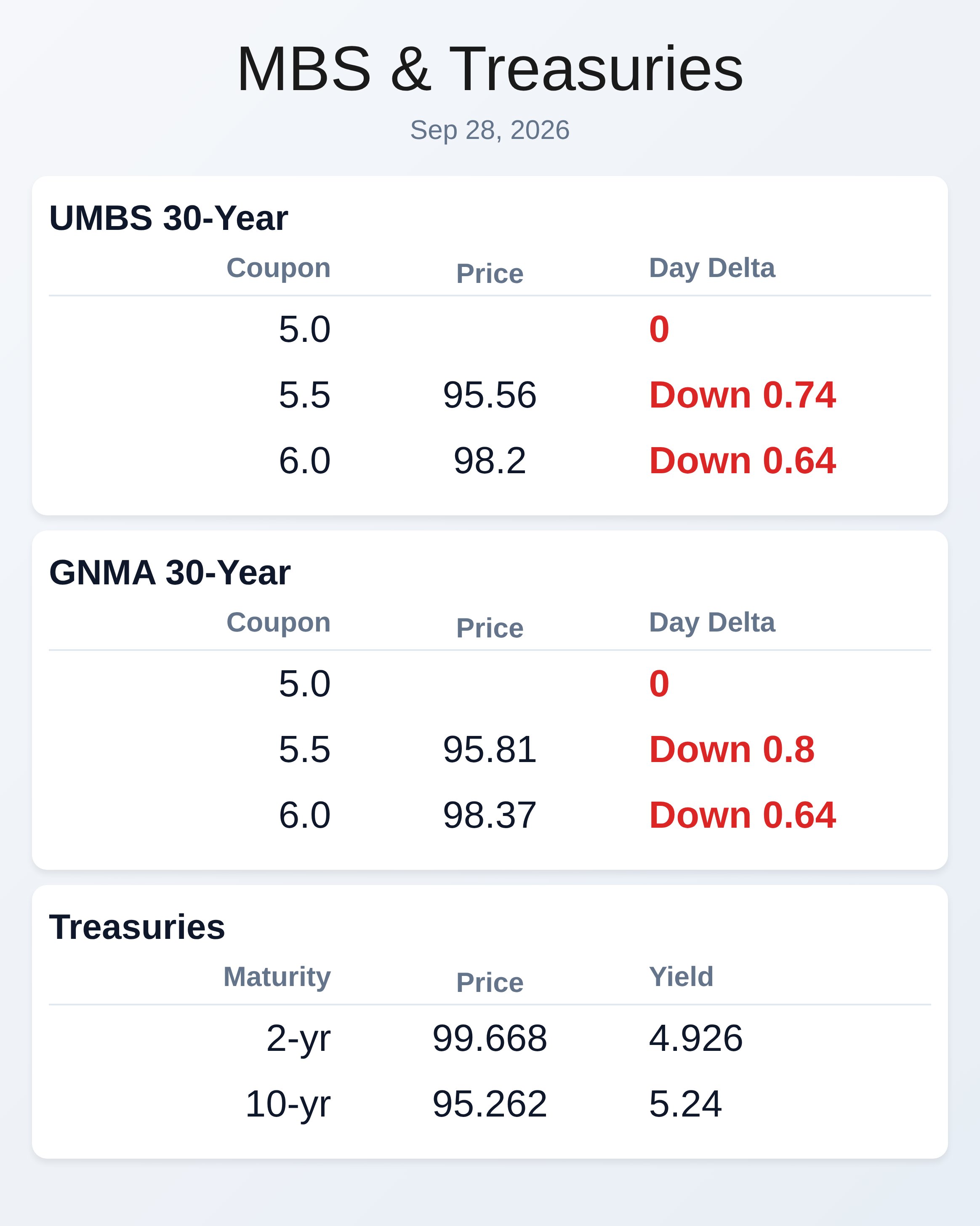
READ MORE **WTMS Blog Today = What's up in Mortgage Today (PM) - 09/28/2026** Bond weakness accelerated Monday as Treasury yields jumped to 19-year highs on geopolitical tensions and persistent inflation concerns. The 10-year yield climbed 7.6 basis points to 5.24%, with the benchmark 30-year bond rising to 5.55%, the highest level since 2004. UMBS 6.0 prices dropped 0.64 points while GNMA securities tracked similarly, signaling broader weakness across mortgage-backed securities amid elevated oil prices and concerns about prolonged Middle East conflict. Major banks are rolling out incentives to compete for borrowers as mortgage activity slows and affordability stretches beyond reach. Chase launched a limited-time rate sale offering up to 25 basis points off through October 4, while Bank of America is offering grants up to $17,500 toward down payments and closing costs. Wells Fargo is rewarding existing customers with rate discounts based on account balances, and Navy Federal introduced a no-refi rate drop program for members with six on-time payments, signaling industry-wide concern about origination volume. The wholesale channel is contracting as Eleven Mortgage exits its correspondent and wholesale businesses in 60 days, leaving broker loans still in the pipeline. Benchmark Mortgage announced aggressive lock policy changes including a flat 100 basis point extension fee versus the former 2 basis point daily rate. This marks another casualty in a consolidating industry where wholesale platforms continue to wind down operations amid rising capital pressures and reduced profitability in the current rate environment. UWM is raising at least $400 million through a rights offering as the wholesale giant pushes ahead with broker growth and capital restructuring. Oaktree Capital and the Ishbia family are backstopping the 200 million-share offering, reinforcing investor commitment to the channel's expansion despite industry headwinds. The move signals confidence in wholesale mortgage banking but comes amid broader market uncertainty and competitive pressures from both retail and correspondent channels. Mortgage industry practices around producer compensation reveal the "Moneyball problem" of measuring the wrong metrics when evaluating LO value. Volume-based rankings obscure true profitability, as $100 million in production from one originator may generate vastly different economics than the same volume from another depending on required support, pricing concessions, and pull-through rates. Stratmor argues lenders should track contribution dollars at the loan, LO, and branch level to understand actual profitability rather than relying solely on production volume comparisons. NFM Lending confirmed unauthorized access to customer data after a ransomware group claimed it stole 2.5 terabytes of information including Social Security numbers and financial accounts around September 7. A proposed class action lawsuit was filed September 16 in Maryland federal court, alleging the company failed to notify affected customers in a timely manner. The breach illustrates escalating cybersecurity risks in the mortgage industry and the critical importance of rapid incident response and customer notification protocols. **Locking vs Floating** Investors should continue waiting for stronger bond market signals before adjusting lock-and-float strategies. While weak economic data could trigger rate recovery, stronger data will likely push yields higher, adding to recent upward momentum. Until bonds demonstrate genuine rally conviction independent of forced selling, cautious positioning remains prudent given the conflicting technical signals and macro uncertainty. **Bond Pricing** **UMBS 30 yr** | Coupon | Price | Intra-Day Change | **GNMA 30 yr** | Coupon | Price | Intra-Day Change | **Treasuries** | Term | Yield | Price | Intra-Day Yield Change | **GNMA 30 yr** | Coupon | Price | Intra-Day Change | |---:|---:|---:| | 5.5 | 95.81 | -0.8 | | 6.0 | 98.37 | -0.64 | | 6.5 | 100.43 | -0.61 | **US Treasuries** | Term | Yield | Price | Intra-Day Yield Change | |---|---:|---:|---:| | 2 yr | 4.926 | 99.668 | 0.067 | | 3 yr | 5.012 | 98.247 | 0.073 | | 5 yr | 5.072 | 99.688 | 0.079 | | 7 yr | 5.151 | 99.121 | 0.076 | | 10 yr | 5.24 | 95.262 | 0.076 | | 30 yr | 5.549 | 93.833 | 0.06 | Stay current on mortgage markets and industry strategy—subscribe free at WellThatMakesSense.com. Market Data
Mortgage Today (AM) - 09/28/26 {{catlist}}
September 28, 2026
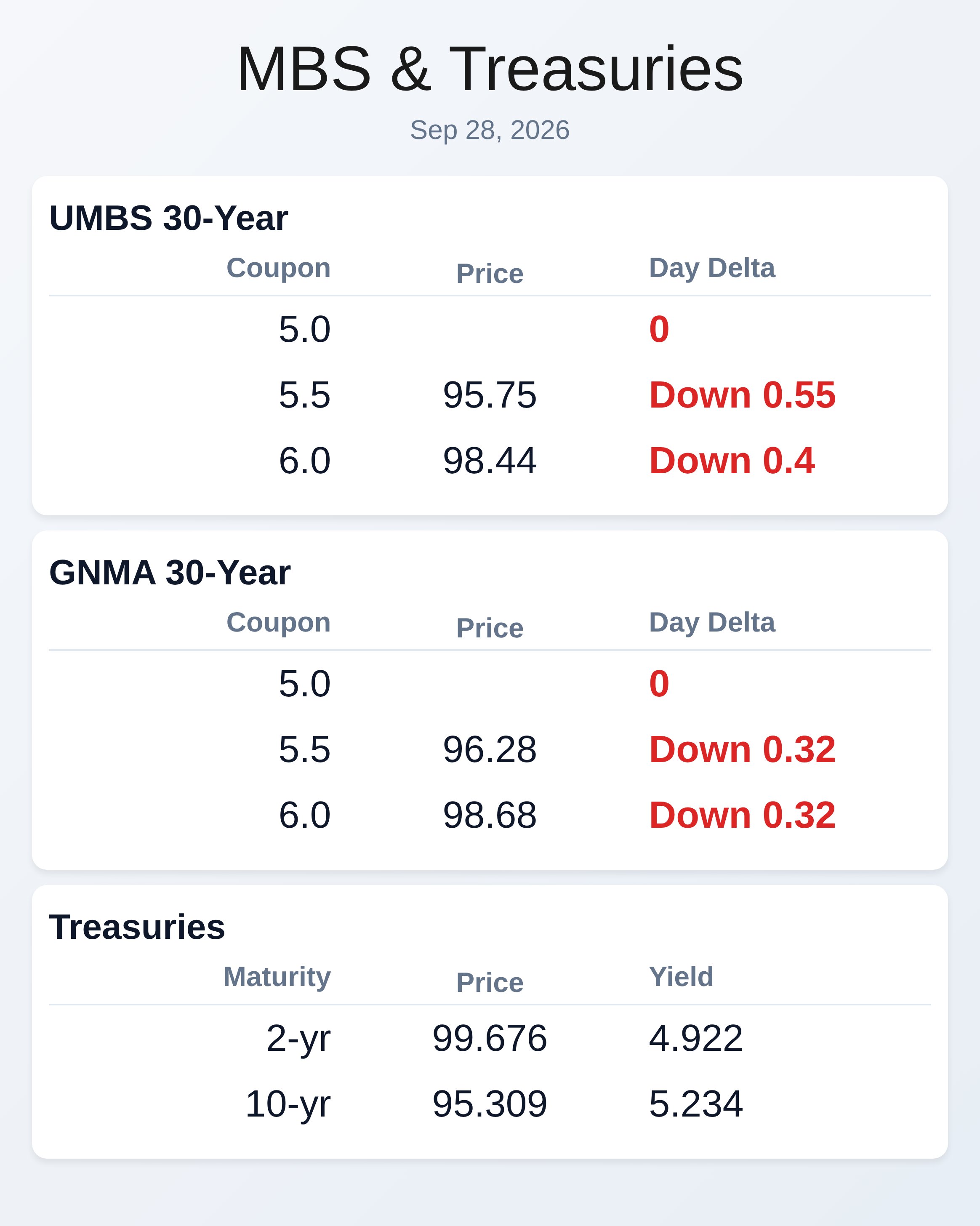
READ MORE **WTMS Blog Today = What's up in Mortgage Today (AM) - 09/28/2026** MBS securities took a beating early Monday as Treasury yields surged to two-decade highs, with the 10-year climbing to 5.23% and the 30-year near 5.55%, extending what increasingly looks like a permanent shift higher. UMBS 30-year coupons ranged from 95.75 (5.5% coupon) down 0.55 points to 100.83 (6.5% coupon) down 0.41, while GNMA 30-year coupons showed relative resilience with smaller intraday declines across the board. The catalyst remains a combination of hawkish Fed communication, resilient economic data, persistent inflation expectations, and a lack of willing bond buyers, with the market assigning roughly a 70% probability to an October rate hike. The real question facing lenders is whether Friday's modest rally—driven more by valuation bargain-hunting than conviction—signals we're finally out of the woods or merely a correction before further selling. Extension and liquidity risks have exploded as wider basis spreads, weaker specified pools, and higher primary rates force originators to navigate blown-out rate sheets and elevated trading levels. Affordability is reaching a breaking point, with consumer sentiment at four-month lows and one-year inflation expectations jumping to 4.6%. Buydown mortgages have emerged as a critical tool, now representing roughly $45 billion or about 2% of the Ginnie Mae II single-family universe, particularly in FHA and VA lending where they account for two-thirds of issuance. The product temporarily reduces borrower rates for one to three years while absorbing costs through sellers, builders, or lenders, attracting stronger-credit borrowers with FICO scores averaging 20 points higher than comparable loans. The Federal Reserve faces an uncomfortable dilemma: how much economic weakness will it tolerate before changing course if inflation remains the priority? Historical precedent from 2022–2023 suggests the Fed may tolerate considerable stress in housing, equities, and rate-sensitive sectors while maintaining restrictive policy. However, competing arguments suggest current inflation stems less from excess domestic demand and more from temporary supply-side forces like tariffs, geopolitical shocks, and AI investment buildout, while wage growth slows and housing-price gains remain modest. If that's true, further rate hikes could damage the economy without addressing underlying inflation drivers, meaning the market will search for visible economic cracks that finally convince the Fed to pivot. This week's economic calendar includes core PCE inflation, consumer income and spending, JOLTS, ADP, and ISM manufacturing reports, with Friday's employment data potentially the most consequential. Payroll growth is expected to slow to roughly 95,000 jobs in September while unemployment holds near 4.1%, suggesting labor softening even as spending and income remain relatively strong. Energy inflation tied to the Iran conflict, particularly record diesel prices, threatens to intensify cost-of-living pressures across transportation and production sectors. Consumer confidence deterioration combined with rising inflation expectations creates a fragile backdrop for the housing market heading into what mortgage originators had hoped would be a more stable autumn season. Mortgage industry consolidation concerns continue to percolate, with technology playing an increasingly central role in how smaller lenders compete with larger platforms. Conferences scheduled for this week and next—including MBA's Compliance and Risk Management Conference, the Virginia Mortgage Banker's Association Annual Convention, and MBA Annual 2026—provide networking opportunities and insight into shifting competitive dynamics. Industry discussions focus heavily on AI governance, loan origination technology, and how lenders can streamline borrower experiences while maintaining compliance in an increasingly complex market. The emerging consensus suggests that companies struggling with the build-versus-buy decision for technology solutions need clarity on which tools drive strategic advantage versus which are table-stakes requirements. Loan officers and branch managers continue to evaluate where they can build their businesses most effectively, with family-owned mortgage companies emphasizing autonomy and direct leadership access as competitive differentiators. Margin management tools and pricing analytics have become essential for retail channel lenders attempting to balance competitive pricing with controlled loan exceptions, particularly as spreads have widened and production coupons have become less attractive. Lenders searching for buydown opportunities or early-life prepayment protection in MBS pools are finding interesting pockets as they seek to bridge the affordability gap created by elevated home prices and high mortgage rates. The next few weeks will test whether originators can execute effectively while managing rate volatility and protecting their profitability as economic headwinds build. **Locking vs Floating** Market technicians face a pivotal decision as a decent bond rally Friday raised questions about whether it represents genuine recovery or merely a correction before further selling. The MBS decline of 11 ticks and 10-year yield increase of 4.8 basis points suggest weakness persists despite token improvement, and experts recommend waiting for stronger, more conviction-driven rallies before adjusting lock-float positioning. The extreme level of rate-sheet deterioration creates high risk-reward dynamics in the days ahead, meaning disciplined originators should hold protective positions and monitor whether the market demonstrates sustained appetite to move higher without heavy-selling catalysts driving moves. **Today's Events** No economic data releases scheduled for September 28, 2026. Markets remain focused on forward guidance ahead of this week's economic reports and next week's employment data. **Bond Pricing** **UMBS 30 yr** | Coupon | Price | Intra-Day Change | | 5.5 | 95.75 | -0.55 | | 6.0 | 98.44 | -0.4 | | 5.5 | 96.28 | -0.32 | **GNMA 30 yr** | Coupon | Price | Intra-Day Change | **Treasuries** | Term | Yield | Price | Intra-Day Yield Change | | 2 yr | 4.922 | 99.676 | 0.062 | | 3 yr | 5.005 | 98.266 | 0.073 | | 5 yr | 5.066 | 99.713 | 0.075 | | 7 yr | 5.148 | 99.137 | 0.075 | | 10 yr | 5.234 | 95.309 | 0.073 | | 30 yr | 5.547 | 93.871 | 0.053 | Market Data
Mortgage Today (PM) - 09/25/26 {{catlist}}
September 25, 2026
READ MORE **WTMS Blog Today = What's up in Mortgage Today (PM) - 09/25/2026** Bonds staged a respectable recovery Friday, with MBS rallying more than 5/8ths of a point and the 10-year Treasury yield falling to 5.164% by day's close, but market analysts are asking whether this reversal represents genuine relief or merely a correction after two weeks of relentless selling. The parabolic bond selloff has been nearly unprecedented in recent memory, with concentrated acceleration at the tail end of months-long weakness, drawing comparisons only to late September 2023 when Fed communications and stronger-than-expected economic data sparked similar declines. Geopolitical headlines played a significant role today, with reports of Iran-US talks entering a technical stage sending oil prices down sharply from $94 to below $92, pulling yields down in tandem. The question now is whether bonds have sold enough absent fresh catalysts, or whether next week's high-stakes economic data will reignite selling pressure. Mortgage originators should remain cautious before adjusting lock-float strategy based on today's gains alone. Economic data delivered mixed signals on Friday, with core capital expenditures accelerating to 1.6% versus a 0.5% forecast, suggesting underlying business investment resilience, while durable goods orders printed flat at 0% against a -0.4% forecast. Consumer sentiment eased slightly to 48.1 versus the 47.6 forecast, with consumers maintaining elevated inflation expectations at 4.6% for one-year and 3.4% for five-year horizons. University of Michigan sentiment came in at 50.9, above the 49.5 forecast, indicating some stabilization in consumer confidence despite higher rates. These results don't paint a clear picture of economic weakness that would force the Fed to reverse course, though they provide no additional evidence for aggressive tightening either. The data backdrop suggests the bond market's next direction will depend more on Fed communications and geopolitical developments than on the economic calendar. Mortgage rates remain trapped above 7%, a psychological threshold that is reshaping buyer behavior and forcing builders to adjust their playbook. Freddie Mac's 30-year fixed crossed 7% this week, prompting lenders to report heavier conversion conversations with borrowers already locked in at lower rates. More than half of new homes sold in August were priced below $400,000, reflecting builders' shift toward lower-priced inventory as a strategy to move units despite rate headwinds. Builders are leaning harder on concessions, rate buydowns, and price reductions to offset the payment shock from higher rates. Loan officers can't make 7% disappear, but they can frame the full payment picture—including down payment assistance, pricing, and financing—to keep buyers engaged. Mortgage market technicians are watching key ceiling and floor levels on the 10-year Treasury, which have shifted to 5.14% (ceiling/lock trigger) and a series of supports at 4.62%, 4.71%, 4.80%, 4.83%, 4.93%, and 5.00%. These levels are critical for originators because they help track whether the bond market is consolidating or ready for directional movement. In intraday trading, MBS proved more resilient than Treasuries, suggesting that while rates rose mid-morning, the mortgage-Treasury spread benefited from shorter-duration positioning. The 10-year yield ceiling of 5.14% represents the level above which repricing risk accelerates for originators, and the pattern of support floors provides clear gauges for when a sustainable rally may be forming. Originators should continue to monitor whether any bounce in MBS holds without fresh selling pressure before committing to longer-float positions. Underwriting standards continue to create friction in the origination process, with borrowers reporting excessive documentation requests for items that have already been submitted or that seem tangential to credit risk. One Brooklyn mortgage applicant found his closing delayed by requirements for proof that a loose toilet was repaired, despite having already provided the purchase agreement listing the repairs. Across the industry, recurring payments to domestic help are triggering debt-verification letter requests, and minor contractual repairs are becoming closing conditions despite the sponsor's documented completion. The mortgage industry invests heavily in AI, automated underwriting, and one-day approvals, yet borrowers still face processes where duplicate documents are requested and minor items balloon into conditions. The real underwriting opportunity may not be processing speed, but rather determining which conditions genuinely matter to credit risk versus which add cost and time without proportional return. **Locking vs Floating** Originators should resist the temptation to aggressively float after today's rally. Friday's recovery came on the heels of an extreme two-week selloff and geopolitical headlines rather than sustainable bond demand, making it too early to declare the worst is over. The MBS Live commentary recommends waiting until the bond market shows genuine desire to rally without said rally being a direct response to heavy selling before adjusting lock-float positioning. However, the extreme weakness over the past two weeks has created blown-out rate sheets and attractive risk-reward trading levels if even a modest recovery takes hold next week. High caution is warranted, especially with big-ticket economic data and month-end trading dynamics ahead. **Today's Events** Core Capital Expenditures (August): 1.6% vs. 0.5% forecast, 0.2% prior Durable Goods Orders (August): 0.0% vs. -0.4% forecast, 1.1% prior Consumer Sentiment (September): 48.1 vs. 47.6 forecast, 51.7 prior One-Year Inflation Sentiment (September): 4.6% vs. 4.6% forecast, 4.0% prior Five-Year Inflation Sentiment (September): 3.4% vs. 3.4% forecast, 3.3% prior University of Michigan Consumer Sentiment (September): 50.9 vs. 49.5 forecast, 51.9 prior **Bond Pricing** **UMBS 30 yr** | Coupon | Price | Intra-Day Change | **GNMA 30 yr** | Coupon | Price | Intra-Day Change | **Treasuries** | Term | Yield | Price | Intra-Day Yield Change | Market Data
LATEST ARTICLES

RECENT ARTICLES

Article Archive

Subscribe

Send me some brain food

Go to Top