Loading...
HOME2023-01-22T13:43:33-07:00

“Damn, there is so much great knowledge out there. Did you know that “BOOKS” are full of smart?? No, I mean like life changing, I-wish-I-knew-that-years-ago type stuff.

I know that I was waaaayyy late to the game figuring it out. And I know that a lot of you are too busy to read as much as you ‘should’. And that is why you need me.

I still remember how it started for me. It started in June of 2008. After 11  years …..Click to continue

Mortgage Today (AM) - 10/06/26 {{catlist}}
October 6, 2026
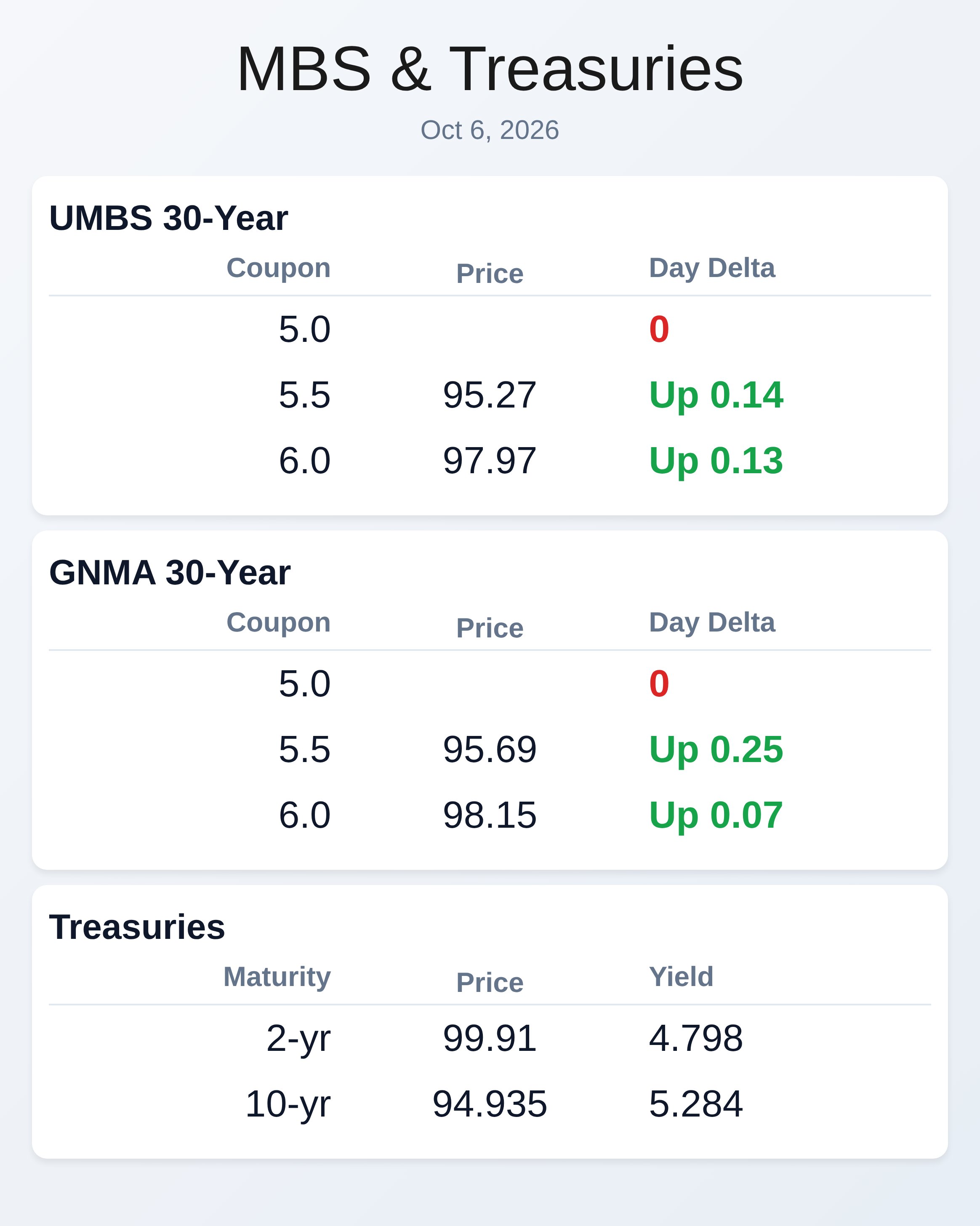
READ MORE **WTMS Blog Today = What's up in Mortgage Today (AM) - 10/06/2026** Treasury yields sold off sharply to start the week as 10-year and 30-year yields hit their highest levels since 2022, keeping 30-year mortgage rates locked in the mid-seven percent range. The broader bond market weakness stems from a mix of concerns: escalating global fiscal pressures (particularly French sovereign debt turmoil), elevated U.S. Treasury issuance driven by budget deficits, and competition for investor capital from booming artificial intelligence investment and rising corporate debt. Brent crude has dipped below $98 per barrel, which provided some modest relief to the bond curve, but the underlying structural headwinds pushing rates higher remain intact. Services sector pricing data continues to reinforce inflation fears among investors, signaling potential consumer price pass-through that keeps longer-term yields under pressure. The market is bracing for meaningful concessions required at tomorrow's 10-year and Thursday's 30-year Treasury auctions, where investor demand faces headwinds from already-elevated yields and fiscal uncertainty. UMBS and GNMA securities showed mixed but modest intraday gains this morning, with UMBS 6.5 coupon pricing at 100.55 (up 0.16) and GNMA 6.5 at 100.48 (up 0.15). The resilience in agency MBS reflects some technical support from overnight trading and a stronger 10-year JGB auction in Japan, though the overall rally lacked conviction given the magnitude of the week's bond selloff. Mortgage originators remain cautious about locking significant volumes given the relentless upward rate pressure since late August and the lack of a sustained correction to provide confidence. Without a meaningful two-day rally averaging at least six basis points per day in yields, defensive positioning remains the prudent strategy for most lenders. The spread between current mortgage rates and Treasury yields suggests limited cushion for originators betting on further rate compression. Weaker-than-expected September payroll data has knocked down Fed rate-hike expectations to just 20 percent probability for October, shifting market focus to whether softer labor momentum can justify holding policy rates steady. The modest unemployment tick and continued job growth keep labor conditions broadly stable, which may still warrant concern among policymakers focused on inflation dynamics. However, the trade deficit widened more than expected to $105.6 billion in August (versus the $102.1 billion estimate), signaling robust domestic demand and adding another layer to the Fed's inflation calculus. These competing signals—softer jobs but stickier goods demand—leave policymakers in a holding pattern as they weigh whether inflation remains too persistent to pause. The market now prices in lower odds of aggressive Fed action, though terminal rates remain elevated at levels that constrain mortgage demand. High U.S. Treasury issuance, war-related oil price pressures, tariff-driven import costs, and weakening foreign demand for American bonds collectively explain why rates have climbed relentlessly since late August. The Federal Reserve remains committed to using the Fed Funds Rate to fight inflation, though it is an imperfect tool that creates spillover effects across the entire yield curve and mortgage market. Elevated corporate bond issuance and resilient equity markets (S&P 500 futures up 0.4% and approaching record highs) continue to draw investor demand away from bonds, compressing valuations. Mortgage originators should prepare for an extended period of elevated mortgage rates unless one or more of these structural headwinds reverses substantially. The near-term technical setup does not yet suggest a meaningful correction is imminent. Loan officers exploring mortgage hedging strategies face a critical decision point: whether to position defensively for further rate increases or size hedges to protect against the one-in-five chance of an October Fed hold combined with a stabilization in the long end. Capital markets teams are watching upcoming Treasury auctions and speeches from Federal Reserve speakers (Governor Bowman, Boston President Logan, and New York President Williams scheduled for today) for signals of policy resolve. The August trade surplus widening despite the elevated dollar suggests pent-up foreign demand for U.S. goods could normalize, potentially easing some inflation pressures if geopolitical risks diminish. For now, the risk-reward of aggressive long positioning remains unfavorable compared to maintaining smaller pipeline positions and locking only rate-sensitive borrowers. Secondary market managers should stress-test both hedge ratios and dealer concentration given the binary nature of current rate risks. Mortgage companies navigating this volatile landscape should lean on data-driven credit scoring models (like the new VantageScore 4.0 now live across all production channels) and fiduciary-grade lending data to manage costs and workflows amid pricing uncertainty. Treasury Secretary Scott Bessent's recent assurance that the government's debt load can be tamed offers limited comfort to bond markets already pricing in elevated term premiums and fiscal risk. The week ahead brings the 3-year Treasury auction (today at 1 p.m. ET), 10-year auction (tomorrow), and 30-year auction (Thursday), with results likely to set the tone for mortgage rates through early next week. Originators should communicate clearly with borrowers about rate lock windows and leverage updated pricing tools to stay competitive in a 7.5 percent mortgage rate environment. Market recovery will require either demonstrated Fed commitment to cooling inflation or clear signs that geopolitical risks and fiscal pressures are easing. **Locking vs Floating** Rising rate momentum since late August has been relentless, making a defensive stance prudent until the market demonstrates a sustained correction. A successful reversal would require yields to fall at least six basis points daily for two consecutive days, which has yet to materialize. War-related inflation, Treasury issuance pressures, corporate bond competition, equity resilience, weaker foreign demand, solid economic data, and an inflation-fighting Federal Reserve all contribute to the current upward bias. MBS prices offer intraday risk guidance, but monitoring 10-year Treasury yield ceilings and floors provides better visibility into broader bond market momentum and directional shifts. **Today's Events** The economic calendar includes the August Trade Balance (already released, showing a wider-than-expected deficit of $105.6 billion), Redbook same-store sales, Federal Reserve remarks from Governor Bowman, Boston Federal Reserve President Logan, and New York Federal Reserve President Williams, plus a $58 billion auction of 3-year Treasury notes at 1 p.m. ET. **Bond Pricing** **UMBS 30 yr** | Coupon | Price | Intra-Day Change | | 5.5 | 95.27 | 0.14 | | 6.0 | 97.97 | 0.13 | | 5.5 | 95.69 | 0.25 | **GNMA 30 yr** | Coupon | Price | Intra-Day Change | **Treasuries** | Term | Yield | Price | Intra-Day Yield Change | | 2 yr | 4.798 | 99.91 | -0.016 | | 3 yr | 4.926 | 98.482 | -0.028 | | 5 yr | 5.034 | 99.852 | -0.02 | | 7 yr | 5.155 | 99.101 | -0.028 | | 10 yr | 5.284 | 94.935 | -0.024 | | 30 yr | 5.658 | 92.345 | -0.005 | Market Data
Mortgage Today (PM) - 10/05/26 {{catlist}}
October 5, 2026
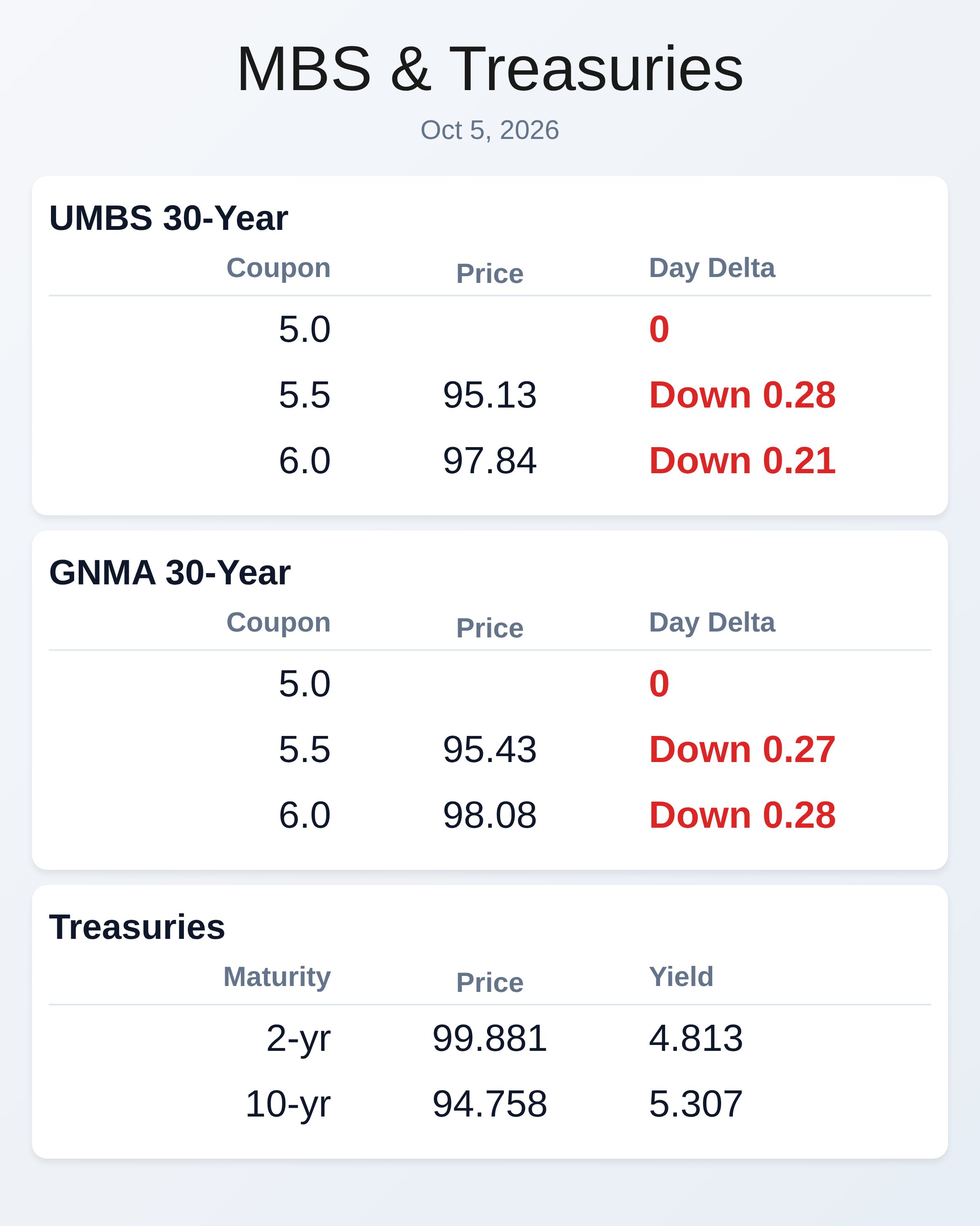
READ MORE **WTMS Blog Today = What's up in Mortgage Today (PM) - 10/05/2026** Bonds had nowhere to go but sideways today as traders searched for any reason to bid them higher, ultimately settling for a modest quarter-point recovery off the day's lows despite no fundamental catalyst for the bounce. The 10-year Treasury closed at 5.309%, up only 3 basis points from morning weakness that pushed yields to 5.334%, while UMBS 6.0 declined 25 basis points to 97.81 as mortgage investors faced relentless selling pressure. September's ISM economic data painted a mixed picture: business activity fell to 56.5 from 61.7 while services employment unexpectedly climbed to 50.1, suggesting labor markets remain resilient even as manufacturing softens. Mortgage originators saw intraday reprice risk spike at 11:11 AM, and traders warned that yields may need to fall 6 basis points per day for 2 consecutive days before the bear market trend reverses. The real issue is that nothing has fundamentally changed to stop the bleeding, only that exhaustion and technical levels are providing temporary relief. Multiple structural headwinds continue to fuel higher yields regardless of daily volatility, including persistent war-driven inflation expectations, elevated Treasury issuance from fiscal imbalances, and a Federal Reserve committed to fighting price pressures with rate policy. Corporate bond issuance and resilient equity markets are competing for investor capital that might otherwise flow into mortgage-backed securities, while foreign demand has weakened gradually due to tariffs and deteriorating trade relationships. Silicon Valley's sudden enthusiasm for mortgage servicing represents the only genuine bright spot in market sentiment today, as Valon raised $150 million at a $2.3 billion valuation on the promise that boring infrastructure can generate extraordinary returns when backed by $200 million in annualized recurring revenue. The startup has reportedly captured ServiceMac, Carrington, and NewRez as clients, with one in six U.S. mortgages eventually migrating to its ValonOS platform within the next few years. For mortgage professionals, this signals that legacy technology stacks may finally be facing real competition from well-capitalized fintechs willing to rebuild workflows from scratch rather than patch aging systems. The broader mortgage industry is also wrestling with accountability gaps exposed by the UAD 3.6 implementation delay, where vendors, appraisal management companies, and appraisers all struggled to meet a deadline years in the making. A senior mortgage executive argues that the voluntary waiver program solves nothing and instead reveals that responsibility for modernization is distributed across too many players without any single party holding authority to execute. Lenders cannot force AMCs to demonstrate readiness with data; instead, service providers merely self-reported their status with no measurable proof, leaving originators unable to manage the transition effectively. The executive advocates for demanding evidence rather than words, reconsidering appraiser compensation models to reflect actual value creation, and ultimately pushing the industry toward operating models that concentrate both responsibility and decision-making authority. This moment represents an inflection point for mortgage infrastructure, where companies choosing new partners can gain competitive advantage over those defending legacy arrangements. Without structural reform, the next wave of UAD changes will repeat the same dysfunction despite another year of preparation. **Locking vs Floating** Rising rate momentum since late August remains relentless, and originators should stay defensive until yields prove they can fall 6 basis points daily for at least two consecutive days to signal a meaningful correction. Seven factors are driving higher yields in no particular order: war-related inflation concerns and Treasury issuance impacts, elevated Treasury supply from fiscal deficits, corporate bond competition, stronger equities markets, weakening foreign investment due to tariffs, resilient economic data, and an inflation-focused Federal Reserve. Mortgage professionals should monitor the 10-year yield ceiling at 5.41% and 5.34%; breaks below the floor at 5.00% or 4.93% would signal a real trend reversal. **Today's Events** ISM Business Activity (September): 56.5 vs. 61.7 previous ISM Non-Manufacturing PMI (September): 54.9 vs. 55.4 previous ISM Services Employment (September): 50.1 vs. 47.8 previous ISM Services New Orders (September): 59.8 vs. 60.9 previous ISM Services Prices (September): 74.0 vs. 72.6 previous **Bond Pricing** **UMBS 30 yr** | Coupon | Price | Intra-Day Change | | 5.5 | 95.13 | -0.28 | | 6.0 | 97.84 | -0.21 | | 5.5 | 95.43 | -0.27 | **GNMA 30 yr** | Coupon | Price | Intra-Day Change | **Treasuries** | Term | Yield | Price | Intra-Day Yield Change | Market Data
Mortgage Today (AM) - 09/17/26 {{catlist}}
September 17, 2026
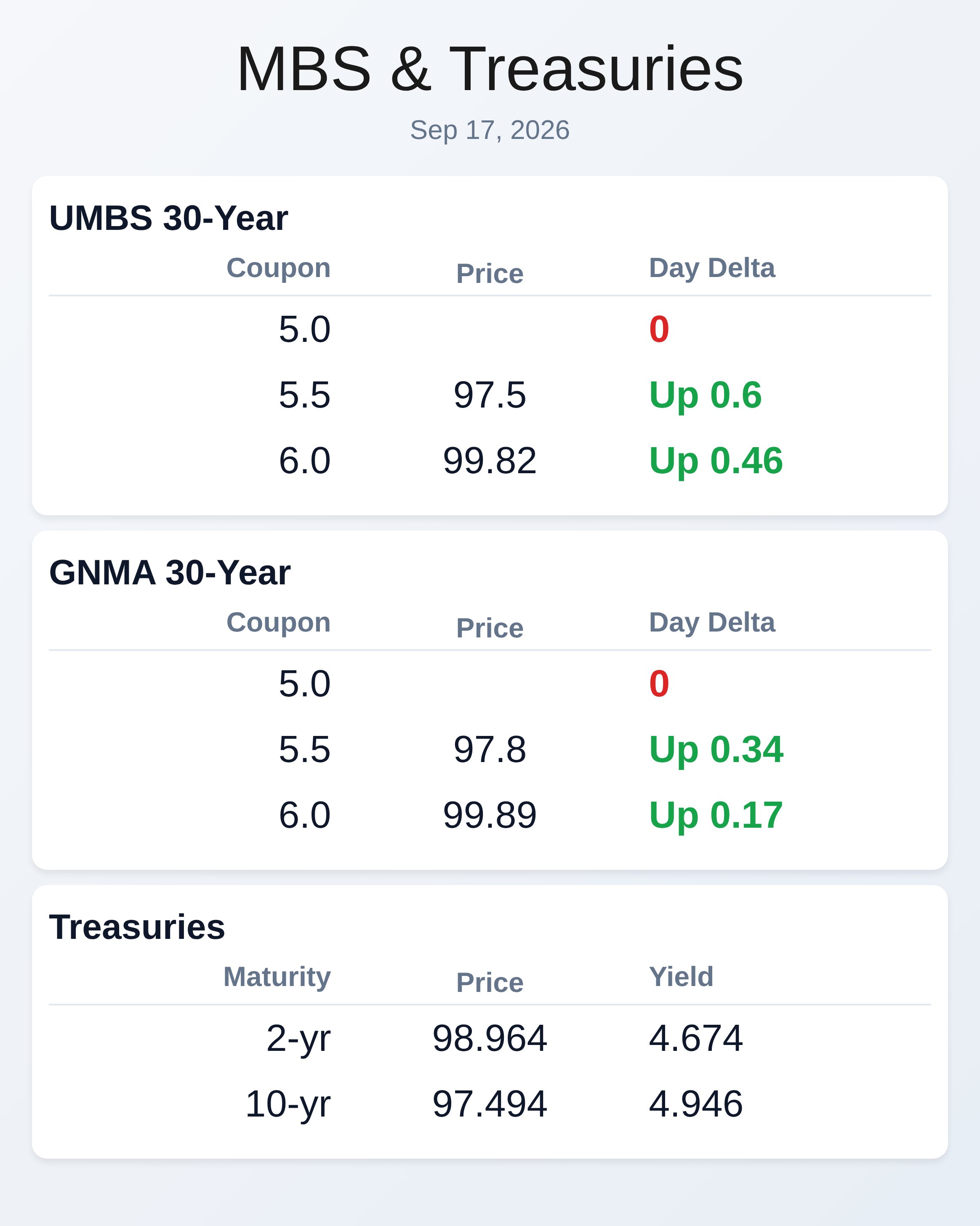
READ MORE **WTMS Blog Today = What's up in Mortgage Today (AM) - 09/17/2026** The Federal Reserve's quarter-point rate hike to 4.00 percent sent mixed signals through bond markets yesterday, with Treasury yields rallying back this morning even as policymakers signaled more tightening ahead. Agency MBS prices rebounded modestly overnight, with UMBS 6.0s holding at 99.82, suggesting some stabilization after the initial volatility. The hawkish tone from Fed policymakers—16 of 18 officials now see at least one more hike in 2026—continues to create uncertainty for lenders trying to lock or float rate locks. Jobless claims came in stronger than expected at 196,000 versus forecasts of 207,000, adding to the mixed economic picture. The 10-year Treasury yield opened this morning at 4.97 percent, down nearly 5 basis points from yesterday's close at 5.01 percent. The week's economic data painted a picture of an economy resilient on employment but fragile on housing. August housing starts fell short at 1.275 million versus expectations of 1.31 million, marking continued weakness in new construction. Building permits also disappointed at 1.394 million, though continuing claims declined to 1.730 million from 1.774 million the prior week. The Philly Fed Business Index dropped to 37.8 from 47.4, signaling a noticeable pullback in regional manufacturing sentiment. These crosscurrents leave originators navigating an environment where robust labor markets contrast sharply with deteriorating housing demand. GNMA 30-year securities showed less volatility than UMBS in overnight trading, with the 6.0 coupon priced at 99.89 after gaining just 17 basis points intraday. The 6.5 coupon held at 102.03, suggesting investors are rotating into higher coupons as rate expectations stabilize. GNMA's more stable performance reflects the government guarantee and continued demand from portfolio managers seeking yield in a higher-for-longer rate environment. Treasury curve positioning shows the 2-year yielding 4.67 percent and the 30-year at 5.30 percent, indicating markets are pricing in eventual rate cuts but not expecting them anytime soon. The spread dynamics between shorter and longer maturities remain the key lens for tracking duration bets across fixed-income desks. Originators face a critical decision point as secondary desks have already repriced locks following the Fed's move. Some lenders held back repricing yesterday afternoon, likely setting themselves up for adjustments this morning, which increases float risk for brokers still holding paper. The consensus among trading desks is cautious: higher Fed funds rates should ultimately help mortgage rates by fighting inflation, but the near-term noise from Fed decisions makes it impossible to confirm that benefit immediately. Floating on lenders who haven't repriced introduces execution risk, while those who repriced for the worse still leave room for tactical positioning before a clear trend emerges. The defensive strategy of waiting for momentum confirmation remains the prudent choice given the elevated uncertainty in rate direction. Mortgage application data from the Mortgage Bankers Association revealed that builder applications for new home purchases fell 5.5 percent year-over-year and declined 6 percent month-over-month in August. This marks the fifth consecutive month of declining applications and represents 2026's lowest monthly total for new construction purchases. Retail sales proved stronger than anticipated at 1.2 percent month-over-month, with core sales up 1.4 percent, showing consumers remain willing to spend even at elevated borrowing costs. The tension between consumer spending power and housing affordability continues to define market dynamics as mortgage rates remain elevated despite yesterday's Treasury rally. The Fed's updated projections now show a median year-end fed funds rate of 4.125 percent, implying one to two additional rate moves before year-end depending on inflation data. Treasury yields have stabilized this morning after moving lower on expectations that the aggressive tightening cycle may finally be plateauing, though any signs of sticky inflation could trigger another leg higher. Oil prices fell 2.5 percent overnight to $99.90 per barrel, easing some of the near-term inflation concerns that had pushed yields to multi-decade highs. The combination of cooling commodity prices, resilient labor markets, and weaker housing activity creates a complex backdrop where mortgage originators must balance rate lock strategy with pipeline management. Markets will closely watch the October and December Fed meetings and any revisions to the neutral rate before committing to a clear directional view on 2027 rates. **Locking vs Floating** Yesterday's Fed hike created an extremely difficult environment for lock-versus-float decisions. Several lenders did not reprice yesterday afternoon, meaning brokers holding loans with those lenders face repricing risk this morning when the lender adjusts. Floating strategy works best when lenders who repriced for worse leave room for positive adjustments, but even then the prudent approach is to wait for clear momentum before abandoning defensive positioning. Treasury support has returned near yesterday's levels, confirming some stability, but the bigger picture question remains unanswered: will higher Fed funds rates ultimately help or hurt mortgage rates? The safest path is to hold defensive floats while monitoring for a strong directional shift rather than trying to catch tops or bottoms during Fed weeks. **Today's Events** Building Permits (Aug): 1.394M vs 1.41M forecast, 1.433M prior Continued Claims (Sep/05): 1.730M vs 1.780K forecast, 1.774K prior Housing Starts (Aug): 1.275M vs 1.31M forecast, 1.239M prior Jobless Claims (Sep/12): 196K vs 208K forecast, 206K prior Philly Fed Business Index (Sep): 37.8 vs 30.5 forecast, 47.4 prior Philly Fed Prices Paid (Sep): 48.60 vs no forecast, 40.90 prior **Bond Pricing** **UMBS 30 yr** | Coupon | Price | Intra-Day Change | | 5.5 | 97.5 | 0.6 | | 6.0 | 99.82 | 0.46 | | 5.5 | 97.8 | 0.34 | **GNMA 30 yr** | Coupon | Price | Intra-Day Change | **Treasuries** | Term | Yield | Price | Intra-Day Yield Change | | 2 yr | 4.674 | 98.964 | -0.06 | | 3 yr | 4.745 | 98.976 | -0.08 | | 5 yr | 4.791 | 98.17 | -0.089 | | 7 yr | 4.863 | 97.869 | -0.088 | | 10 yr | 4.946 | 97.494 | -0.073 | | 30 yr | 5.304 | 97.323 | -0.059 | Market Data
LATEST ARTICLES

RECENT ARTICLES

Article Archive

Subscribe

Send me some brain food

Go to Top