Loading...
HOME2023-01-22T13:43:33-07:00

Damn, there is so much great knowledge out there. Did you know that “BOOKS” are full of smart?? No, I mean like life changing, I-wish-I-knew-that-years-ago type stuff.

I know that I was waaaayyy late to the game figuring it out. And I know that a lot of you are too busy to read as much as you ‘should’. And that is why you need me.

I still remember how it started for me. It started in June of 2008. After 11  years …..Click to continue

Mortgage Today (AM) - 09/23/26 {{catlist}}
September 23, 2026
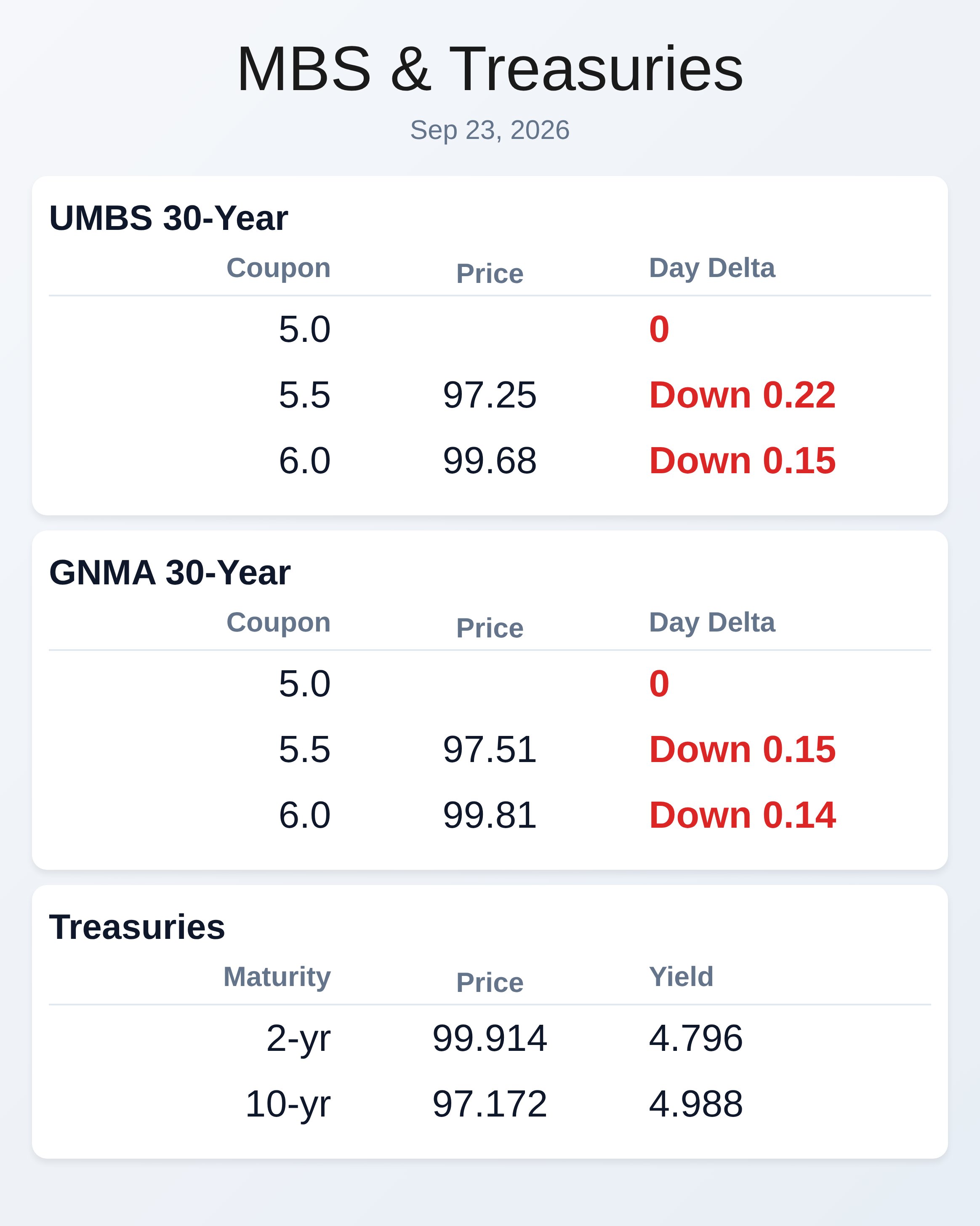
READ MORE **WTMS Blog Today = What's up in Mortgage Today (AM) - 09/23/2026** Mortgage rates surged to 7.12% last week, the highest level since 2024, forcing application volume down 1.5% and pushing nearly one in ten borrowers toward adjustable-rate mortgages. Refinance activity collapsed to its lowest level since February 2025, with refi applications down 62% year-over-year. The 30-year fixed is now more than a percentage point above ARM rates, making the exotic product suddenly attractive during this affordability crisis. Purchase applications slipped just 1% week-over-week but remain 11% lower than last year. As the fall market officially begins, real estate agents are already reporting a sharp pullback from prospective buyers. War headlines and oil price volatility are dominating bond market attention, with geopolitical uncertainty creating daily swings that overwhelm economic data. Late yesterday, reports of productive U.S.-Iran negotiations temporarily stabilized Treasuries and helped the market absorb a $69 billion 2-year note auction. The 10-year Treasury sits at 4.988%, while Agency MBS prices remain little changed from yesterday's close. Without a clear catalyst for rate relief, the structural deficit and persistent oil concerns should keep upward pressure on long-end yields. The Fed's public silence on skyrocketing fiscal spending contrasts sharply with its aggressive stance on inflation tied largely to crude oil pricing. Homebuilders are increasingly dependent on FHA-financed buyers to move volume during this cyclical slowdown. Ashton Woods has seen FHA-financed sales surge from 15% of total transactions in 2022 to 39% today. This trend reflects broader affordability pressures squeezing move-up buyers out of traditional markets. The shift demonstrates how housing affordability deterioration is forcing both lenders and builders to lean more heavily on government-backed programs. KB Homes warned in earnings that market conditions have weakened significantly since June, with higher rates and buyer hesitation dampening demand. Fannie Mae is tightening documentation requirements for investors converting homes into rentals, eliminating lease agreements as acceptable proof of rental income effective November 1. Lenders must now use appraisals, Form 1007, or comparable market data from sources like Zillow or MLS with three recent comps. Move-up buyers benefit because they no longer need an existing tenant before applying, though the qualifying math remains unchanged with a 25% reduction for vacancy and expenses. Freddie Mac maintains a more flexible approach, still accepting leases and refusing market-analysis tools. Lenders must verify which GSE they're delivering to before presenting rental income strategies to borrowers. A bipartisan proposal would provide up to $50,000 in down payment assistance to first-time homebuyers, addressing the affordability crisis gripping the market. The legislation represents a direct response to the mounting pressure consumers face as rates hover near 7% and median home prices remain historically elevated. Zillow faces a new legal challenge seeking to dismiss a RESPA lawsuit accusing the platform of steering borrowers to its in-house mortgage business through its real estate referral program. The court has already rejected two previous versions of the complaint, and Zillow is now pushing for permanent dismissal with prejudice. Pending home sales edged up just 0.3% in August, suggesting buyer activity remains tepid despite seasonal expectations. UAD 3.6 appraisal format changes are driving costs higher as appraisers navigate expanded inspection requirements and extended reporting timelines. Class Valuation's analysis shows appraisers already charging premium fees due to the added labor and time demands of the new standards. Hybrid appraisals that meet UAD 3.6 data capture standards offer lenders faster turnarounds and lower pricing, making them increasingly attractive as traditional appraisal fees climb week-to-week. Lenders should disclose longer appraisal timelines now and prepare borrowers for extended underwriting schedules over the next 90 days. Ignoring hybrid appraisal options during this transition period could cost originators both time and revenue as conventional processing delays mount. **Locking vs Floating** War and oil volatility are controlling daily bond moves without creating a directional bias. Technical levels remain relevant between 4.93% and 5.01% on the 10-year, so traders should wait for a definitive break outside this range before shifting lock-float strategy. The default conservative stance established in July remains unchanged—originators should maintain cautious locking discipline until a clear rally develops in bond pricing. **Today's Events** Fed Governor Barr remarks, preliminary S&P Global Manufacturing PMI, Services PMI, crude oil inventory reports, and a $70 billion 5-year Treasury note auction are scheduled for later today. **Bond Pricing** **UMBS 30 yr** | Coupon | Price | Intra-Day Change | | 5.5 | 97.25 | -0.22 | | 6.0 | 99.68 | -0.15 | | 5.5 | 97.51 | -0.15 | **GNMA 30 yr** | Coupon | Price | Intra-Day Change | **Treasuries** | Term | Yield | Price | Intra-Day Yield Change | Market Data
Mortgage Today (PM) - 09/22/26 {{catlist}}
September 22, 2026
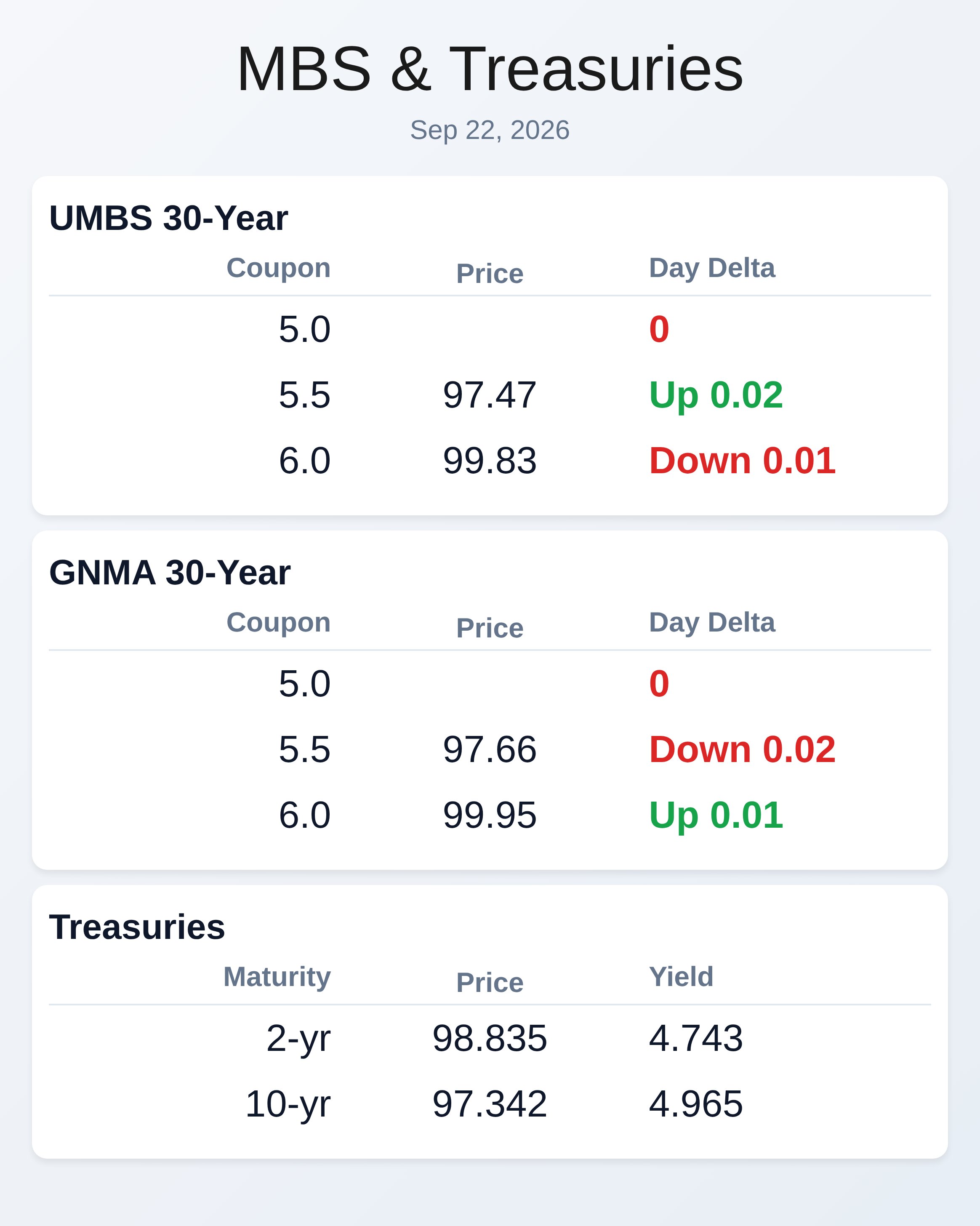
READ MORE **WTMS Blog Today = What's up in Mortgage Today (PM) - 09/22/2026** Bonds rebounded strongly after a volatile midday selloff, as geopolitical headlines regarding U.S.-Iran discussions pushed oil prices lower and yields back into positive territory. The 10-year Treasury fell to 4.949% on the latest diplomatic reports, while UMBS 6.0 closed up 2 basis points at 99.86. MBS moved down an eighth of a point from morning highs earlier in the session, but late-day momentum reversed the weakness. Oil price gyrations and war-related newsflow dominated trading rather than any scheduled economic data. Markets remain firmly anchored to technical levels until a clear directional break emerges. UMBS pricing showed mixed results throughout the day, with the 5.5 coupon ending flat and the 6.5 coupon down 4 ticks despite late-day gains. GNMA 30-year securities tracked similarly, with the 6.0 coupon barely positive on the day. These sideways moves reflect the broader uncertainty in mortgage spread values as headline risk continues to eclipse fundamental drivers. The range-bound trading pattern persists because neither bond bulls nor bears have a compelling macro catalyst this week. Lenders must prepare for potential reprices if geopolitical tensions escalate further. The 10-year yield closed near 4.955%, down just 3 basis points on the day but touching lows near 4.949% in afternoon trading. Treasury pricing benefited from flight-to-quality flows and the oil price decline tied to diplomatic progress reports. The 2-year remained flat while the 30-year yield climbed 11 basis points, steepening the yield curve modestly. This modest steepness creates tactical opportunities for mortgage hedging strategies. Intraday swings of 20+ basis points in 10-year yields highlight how shallow conviction remains among institutional traders. Geopolitical dynamics rather than economic fundamentals are steering the bond market. Headlines about Strait of Hormuz reopening talks and Trump UN speech comments regarding Iran negotiations created the day's directional moves. Oil fell sharply on these reports, which traditionally helps long-duration fixed-income assets outperform. The light data calendar means no competing narratives challenge war-related sentiment through week-end. Mortgage pros should recognize that this environment rewards flexibility in lock-float decisions. **Locking vs Floating** Wait for a definitive directional break before committing to aggressive positioning. The market remains trapped between 4.93% and 5.01% on the 10-year, with no inherent bullish or bearish bias underlying current price action. Geopolitical headlines provide tactical swings but not fundamental direction, so conservative lock-float positioning remains prudent. Oil price volatility and diplomatic developments will likely dominate through the UN General Assembly session. Only a clear technical break outside the established range should trigger a shift away from your neutral stance. **Bond Pricing** **UMBS 30 yr** | Coupon | Price | Intra-Day Change | | 5.5 | 97.47 | 0.02 | | 6.0 | 99.83 | -0.01 | | 5.5 | 97.66 | -0.02 | **GNMA 30 yr** | Coupon | Price | Intra-Day Change | **Treasuries** | Term | Yield | Price | Intra-Day Yield Change | | 2 yr | 4.743 | 98.835 | -0.007 | | 10 yr | 4.965 | 97.342 | 0.014 | | 30 yr | 5.301 | 97.377 | 0.02 | Market Data
Mortgage Today (AM) - 09/22/26 {{catlist}}
September 22, 2026
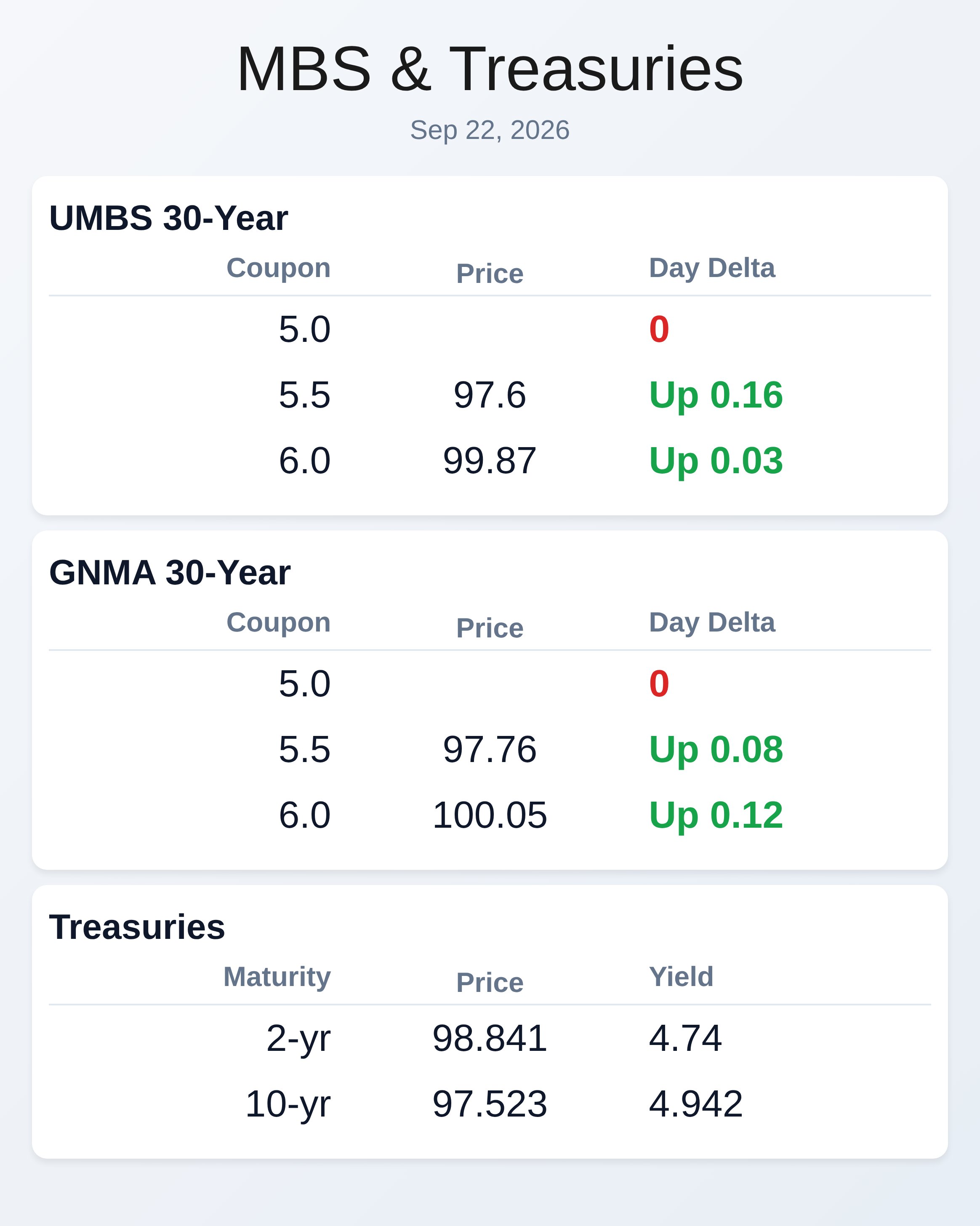
READ MORE **WTMS Blog Today = What's up in Mortgage Today (AM) - 09/22/2026** Geopolitical headlines are moving bonds even when unconfirmed, as overnight markets rallied hard on reports—later denied by Iranian officials—that Tehran could reopen the Strait of Hormuz within seven days. Oil prices dropped instantly on the news, and Treasury yields followed lower across the curve. The market's logic is sound: financial traders believe some Iranian official probably did say something to multiple news agencies that disagreed with the government's official denials. What matters most to mortgage professionals is that bond prices improved for the second consecutive day, benefiting both MBS coupons and rate-lock opportunities. UMBS 6.0 securities closed yesterday at 99.90 and have moved higher in overnight trading, while the broader 6.5 coupon remains around 102.12 despite sideways momentum. GNMA 6.0 securities gained ground overnight, now trading at 100.08 with intraday gains of 0.15 points. Both agency MBS cohorts show modest strength in a risk-on environment driven by lower oil and geopolitical relief rather than fundamental economic improvements. Originators holding longer MBS positions may see modest cushion in their pipeline hedges, though the rally remains fragile without confirmed economic catalyst. The 10-year Treasury yield has declined 2.6 basis points from yesterday's close, now trading near 4.93 percent as markets digest overnight strength. Shorter maturities performed better, with the 2-year yield down 4 basis points to near 4.73 percent, while the 30-year fell 1.2 basis points to 5.27 percent. The two-to-ten spread narrowed to approximately 21 basis points yesterday, reflecting curve flattening amid Fed hawkish rhetoric. Today's $69 billion two-year note auction will test institutional demand in a market still bracing for potential October rate increases. Manufacturing cost claims across the mortgage industry range wildly from $125 to $12,500 per loan, creating confusion when lenders use these figures to recruit loan officers and compete for borrowers. The MBA reported Q2 2026 production expenses of $10,936 per loan for independent mortgage banks and $11,754 for retail-only lenders, establishing a standard that industry practitioners should reference when evaluating employer efficiency claims. Most cost variance stems from inconsistent definitions of what constitutes "manufacturing"—whether sales compensation, technology, fulfillment, or overhead are included—making peer comparisons nearly impossible. Loan officers deserve the same standardized clarity that consumers receive through the Loan Estimate when evaluating job opportunities and compensation promises. Without agreed-upon definitions, lenders risk making decisions based on incomplete or misleading data. Multiple Fed officials are scheduled to speak today, including Presidents Williams, Jefferson, and Barkin, though markets will remain cautious pending confirmation that underlying inflation is actually moving toward the 2.0 percent target rapidly. The Federal Reserve's recent hawkish pivot has restored some market confidence in its inflation-fighting independence, but the bar for tighter policy remains low and financial conditions are not yet restrictive enough to signal a policy shift. An October interest rate hike remains likely unless incoming economic data demonstrates sharp disinflation, putting pressure on mortgage originators to remain defensive on rate locks until clearer evidence emerges. Fed Chair Warsh's emphasis on controlling money and credit growth may eventually conflict with the central bank's continued balance sheet expansion, creating tactical opportunities for investors who fade near-term fed funds rallies. Builders continue using capital to temporarily buy down rates or permanently offer 30-year fixed mortgages at 1 percent below prevailing market rates rather than cut prices and devalue existing subdivisions. This builder-driven rate subsidy strategy reflects housing affordability pressure but masks the underlying demand weakness as residential volume continues declining across the industry. Credit unions are aggressively pursuing market share in this environment, leveraging their position in consumer financial relationships and willingness to undercut traditional originators on pricing. Mortgage professionals should expect continued competitive pressure on loan-level pricing and widening gain-on-sale margins as builders and credit unions fight for shrinking production volume. Today's bond market strength provides brief relief, but the structural headwind of declining volume remains the dominant issue facing originators. **Locking vs Floating** Technical resistance levels remain critical guides for mortgage professionals evaluating lock-versus-float decisions without guaranteed predictive power. The 4.94 percent level on 10-year yields represents important intermediate resistance, while 5.00 percent marks the ceiling many technical traders monitor closely. Friday's trading tested 5.00 percent repeatedly, but today's session approached 4.94 percent from below, suggesting potential momentum shifting. The conservative stance held since early July remains appropriate—lock aggressively until a definitive shift below 4.94 percent confirms sustained bond market rally momentum, as intraday MBS price movements alone provide insufficient confirmation of broader trend change. **Today's Events** 10:05 AM ET – Fed President Williams Speech 10:20 AM ET – Fed President Jefferson Speech 1:00 PM ET – Two-Year Note Auction ($69 billion) 1:00 PM ET – Fed President Barkin Speech **Bond Pricing** **UMBS 30 yr** | Coupon | Price | Intra-Day Change | **GNMA 30 yr** | Coupon | Price | Intra-Day Change | **Treasuries** | Term | Yield | Price | Intra-Day Yield Change | Market Data
LATEST ARTICLES

RECENT ARTICLES

One big assumption we make is that everything in our virtual reality is the truth. Another big assumption we make is that everything in everyone else’s virtual reality is the truth. 

June 12th, 2021|The Agreements|

Amazon describes the book "The Four Agreements" as offering a powerful code of conduct that can rapidly transform our lives to a new experience of freedom, true happiness, and love. The author reveals the [...]

Article Archive

Subscribe

Send me some brain food

Go to Top