Loading...
HOME2023-01-22T13:43:33-07:00

“Damn, there is so much great knowledge out there. Did you know that “BOOKS” are full of smart?? No, I mean like life changing, I-wish-I-knew-that-years-ago type stuff.

I know that I was waaaayyy late to the game figuring it out. And I know that a lot of you are too busy to read as much as you ‘should’. And that is why you need me.

I still remember how it started for me. It started in June of 2008. After 11  years …..Click to continue

Mortgage Today (AM) - 10/09/26 {{catlist}}
October 9, 2026
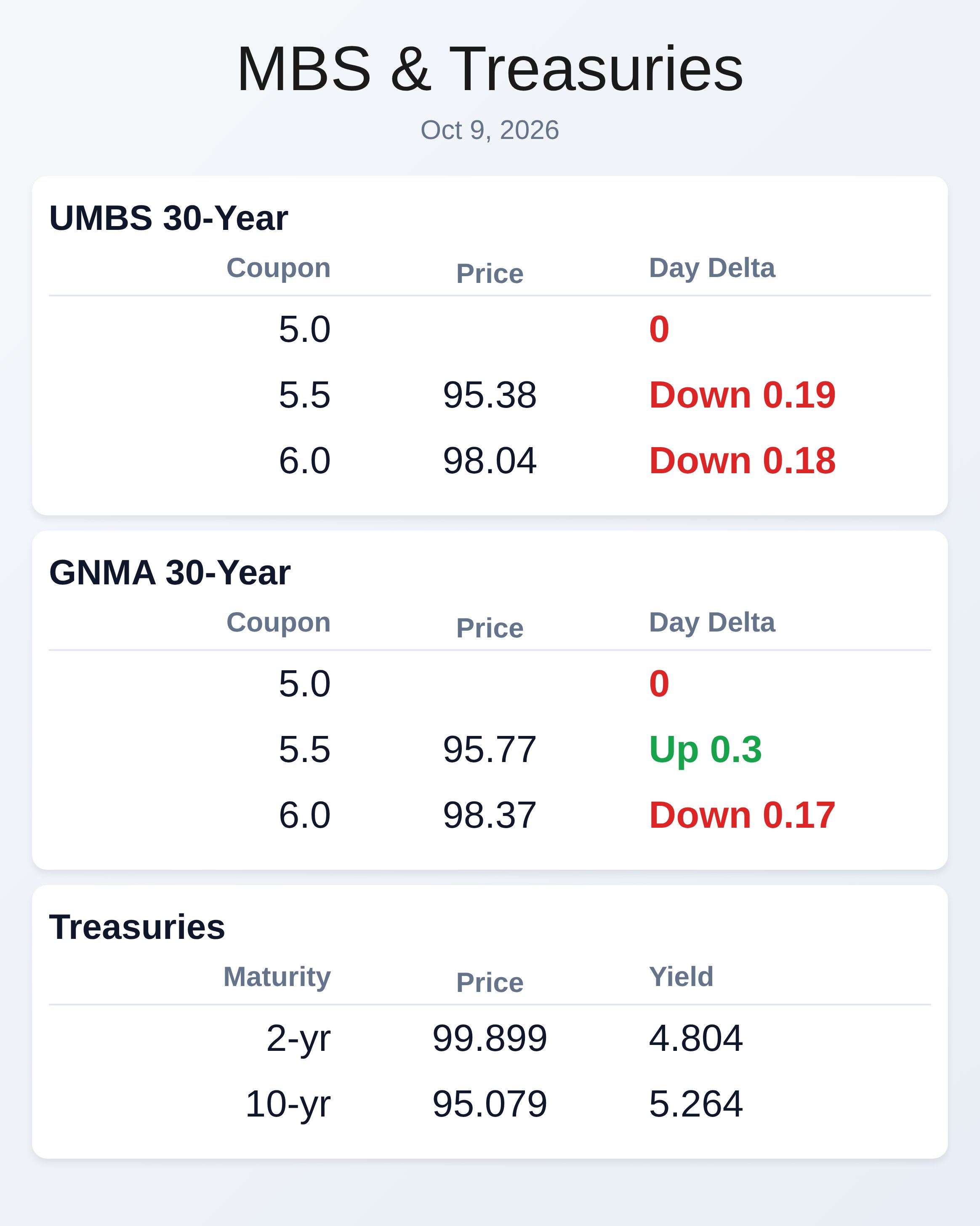
READ MORE **WTMS Blog Today = What's up in Mortgage Today (AM) - 10/09/2026** Bonds staged a modest rally Thursday after Fed official Chris Waller's hawkish comments spooked markets in early trading, but Treasury yields retreated from multidecade highs as oil prices fell and geopolitical tensions eased around Iran. The 10-year yield closed near 5.23%, down from earlier peaks around 5.34%, signaling that investors remain torn between inflation concerns and hopes for relief. UMBS 6.0 coupons finished Thursday around 97.78, holding most of their recent losses. Initial jobless claims fell to 197,000 for the week ending October 3, reinforcing that labor markets remain resilient despite some softening in continued claims data. The calendar ahead is extremely light, with only preliminary University of Michigan Consumer Sentiment and Boston Fed President Collins's remarks on tap. Thursday's Treasury auction cycle showed solid demand at the longer end of the curve, with the 30-year sale generating a 2.54x bid-to-cover ratio and nearly 94% of awards going to non-dealers—well above historical averages. This strong indirect bidding suggests institutional investors still see value despite the elevated yield environment. The Treasury's $6 billion long-end buyback program also provided price support. However, the follow-through after the auction was mixed, as bonds cheapened once the real buying pressure subsided. Mortgage originators should note that while Thursday's rally felt encouraging, it represents a technical bounce rather than a fundamental break in the relentless uptrend that has dominated since late August. Servicer-level prepayment speeds reveal meaningful differences in borrower behavior across originator platforms. Rocket/Quicken continues to lead as the fastest payer on both 30-year and 15-year UMBS loans, while Freedom Mortgage and Fifth Third rank among the quickest on longer-dated securities. Conversely, Bank of America, loanDepot, and Provident frequently trail as the slowest servicers on 30-year pools, with Lakeview, JPMorgan Chase, and Provident lagging on 15-year mortgages. These servicer-specific patterns have persisted for months, suggesting structural differences in loan origination, customer demographics, or operational practices. September mortgage prepayments continued their sharp deceleration, with Fannie Mae speeds falling to 6.7 CPR—the slowest pace since April 2025—as rates climbed from 5.98% in February to 7.28% by early October. Equity markets bounced Friday as oil prices slipped below $103 per barrel and investors digested OpenAI's guidance that it will hit $70 billion in annualized revenue by year-end. The S&P 500 futures rose 0.4% and Nasdaq 100 contracts climbed 0.9%, buoyed by relief that the artificial-intelligence investment boom remains on track despite rising borrowing costs. President Trump's statement that the U.S. will not attack Iran before the midterm elections eased geopolitical risk, removing a major inflation catalyst that had pushed crude prices higher. European markets rallied as well, with the Stoxx 600 rising 1.2% and French bonds outperforming as political uncertainty began to fade. The narrowing of the French yield premium over German debt—from 160 basis points to under 130—signals that global bond-market stress, while still elevated, is moderating. September mortgage fundings declined 15% year-over-year and 10% month-over-month, according to Curinos proprietary data drawn directly from lenders. The average 30-year conforming retail funded rate in September stood at 6.58%, up 8 basis points from August and 10 basis points from last year. Refinance rates climbed 15 basis points month-over-month and 20 basis points year-over-year, while purchase rates rose a more modest 7 basis points month-over-month. Mortgage volume weakness reflects both the higher-rate environment and the dwindling pool of economically viable refinance candidates—currently estimated at only 0.5% of outstanding mortgages. Lenders should prepare for continued volume headwinds through year-end unless rates reverse meaningfully. Capital markets execution remains a core focus for originators looking to capture margin that best-efforts delivery leaves on the table. Polly announced a partnership with newly launched F9 Advisors, a capital markets execution firm led by former Compass Analytics leaders including Brandon Story and Virgil Caselli Jr. F9 will run pipeline hedging, lock desk operations, and loan sales inside the Polly operating system, ensuring that data, pricing, and positions remain entirely within the lender's platform and visible to leadership. This model allows lenders to scale capital markets expertise without building expensive internal teams or switching technology stacks. Rob Kessel, founder of Compass Analytics and Panoramic Capital Academy, serves in an advisory capacity to the partnership. **Locking vs Floating** Rates have climbed relentlessly since late August, with the 10-year yield hitting multidecade highs near 5.34% this week before modest recovery Thursday. Originators should remain defensive until the market proves it can sustain a correction—roughly 6 basis points of decline per day for at least two consecutive days. Multiple structural headwinds persist: geopolitical inflation from Middle East conflict, elevated Treasury issuance fueled by fiscal deficits, strong corporate bond issuance competing for investor money, resilient stocks and AI investment drawing capital away from bonds, gradual decline in foreign demand partly driven by tariffs, and a Federal Reserve willing to use rate hikes as its inflation-fighting tool. A meaningful rally would require a sustained break below the 5.20% level, though true risk-reward does not improve materially until yields reach the 5.00% range in late November. **Bond Pricing** **UMBS 30 yr** | Coupon | Price | Intra-Day Change | | 5.5 | 95.38 | -0.19 | | 6.0 | 98.04 | -0.18 | | 5.5 | 95.77 | 0.30 | **GNMA 30 yr** | Coupon | Price | Intra-Day Change | **Treasuries** | Term | Yield | Price | Intra-Day Yield Change |

Market Data
Mortgage Today (PM) - 10/08/26 {{catlist}}
October 8, 2026
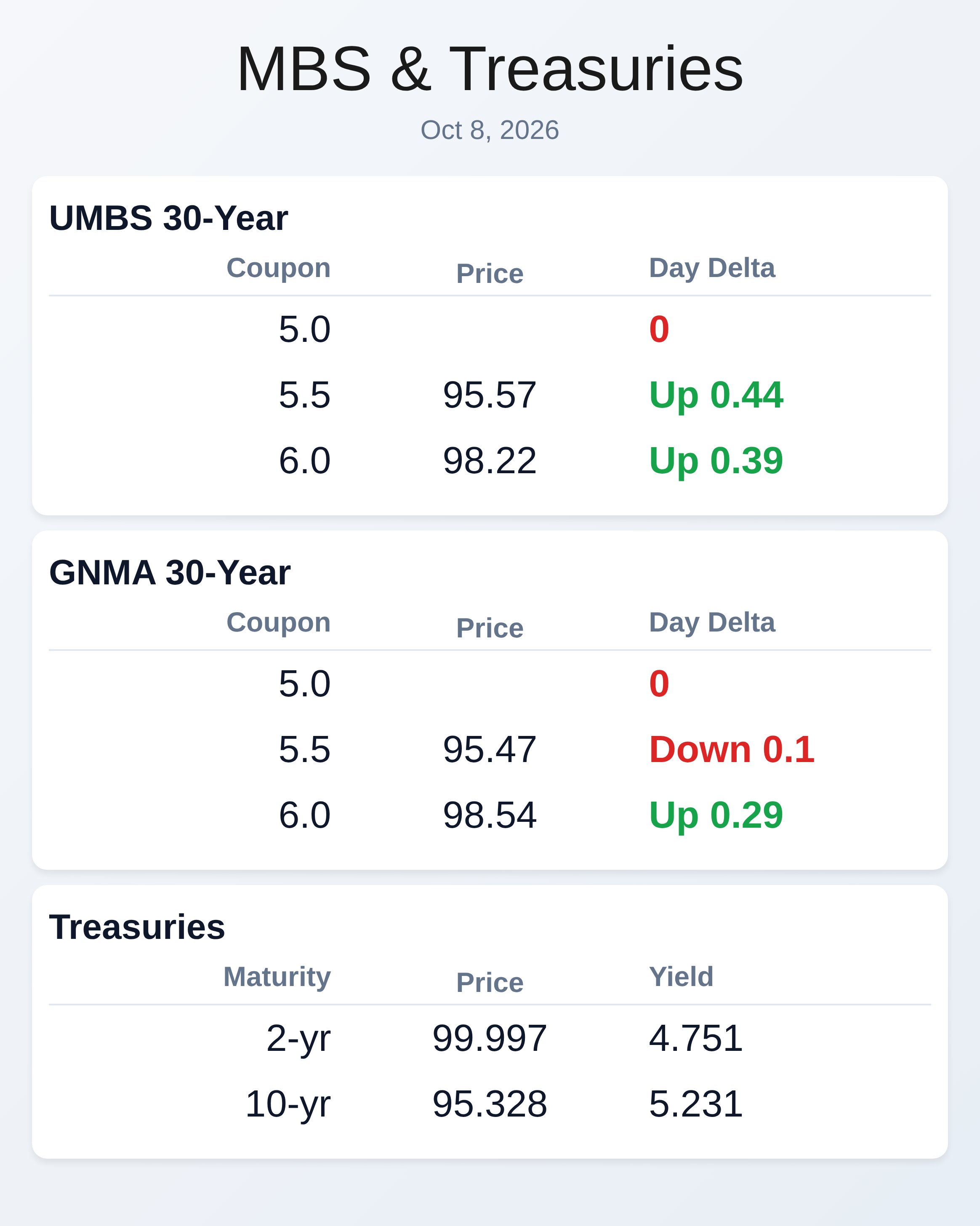
READ MORE **WTMS Blog Today = What's up in Mortgage Today (PM) - 10/08/2026** Bonds staged a genuine two-day rally that markets are calling the first real turning point since yields broke above 5.3% earlier this fall. The 10-year Treasury dropped 6.3 basis points to 5.225% by mid-afternoon, with UMBS 6.0 coupons gaining 42 basis points to 98.25. MBS pricing strength and a stronger-than-expected 30-year bond auction provided additional conviction to the move. Today's action follows Wednesday's modest recovery, creating a momentum pattern worth monitoring. However, analysts caution this remains embryonic and needs sustained conviction to confirm a real shift in direction. The rally drew support from war-related headlines and what appears to be classic "buy the dip" behavior at key yield ceilings around 5.33–5.35%. Investors appear to be testing whether the bond market's recent selling pressure has finally exhausted itself. Fed funds futures for mid-2027 moved alongside the 10-year yield, suggesting the market is repricing expectations for future rate decisions. Treasury auction results turned surprisingly solid after the rally had already pushed prices higher. The exact catalysts remain somewhat opaque, leaving traders to construct competing narratives about fundamental drivers. Seven structural headwinds continue to support elevated rates across the curve: geopolitical inflation concerns tied to ongoing conflicts, massive Treasury issuance from fiscal imbalances, heavy corporate bond supply competing for investor demand, resilient equity markets absorbing capital that might otherwise flow to bonds, weakening foreign demand partly driven by tariff uncertainty, genuinely strong economic data, and a Federal Reserve willing to deploy its rate tool aggressively. These factors remain anchored in place regardless of two good trading days. Without a meaningful shift in one or more of these elements, the rally faces headwinds that could reassert themselves quickly. Morning trading started weak after Fed Vice Chair Chris Waller reiterated that more rate hikes were needed given strong economic growth and persistent inflation concerns. His comments spooked the short end of the curve at 4:30 a.m. Eastern, pushing Fed funds futures for next year higher and dragging near-term yields with it. Rising oil prices added pressure to the bearish sentiment early on. By mid-morning, however, the tone shifted as bonds recovered almost entirely, closing out the overnight weakness without obvious new catalyst. The disconnect between morning hawkishness and afternoon strength illustrates how fragile the current sentiment remains. For originators, today's modest relief should not trigger aggressive locking strategies until the market proves it can hold gains consistently. A sustained break below 5.20% on the 10-year would represent phase one confirmation, but real conviction requires the market to close November below 5.00%. Historical precedent shows that yield rallies from peaks can run anywhere from 30 basis points over six weeks to extreme examples of 100 basis points in two months, depending entirely on economic shifts. Lock decisions should remain calibrated to client demand rather than the belief a major correction is underway. Lenders holding rate sheets steady through this volatility are positioned safely regardless of which scenario unfolds. **Locking vs Floating** Treasury auctions and yield-support levels matter more than intraday price swings when deciding lock positioning. The market appears to be testing whether 5.33–5.35% on the 10-year acts as a hard ceiling for investor demand, and today's action suggests it may be holding. A confirmed break below 5.20% would signal phase one of a potential correction, though November data and economic conditions will determine whether any rally sticks. Until the market demonstrates sustained momentum—ideally through month-end—borrowers in no rush should stay floating, while those with committed purchase deadlines should consider locking to protect certainty. **Today's Events** October 8, 2026: Initial Jobless Claims (8:30 a.m. ET) expected at 200K vs. prior 197K; Continued Claims (8:30 a.m. ET) expected at 1,710K vs. prior 1,701K. **Bond Pricing** **UMBS 30 yr** | Coupon | Price | Intra-Day Change | **GNMA 30 yr** | Coupon | Price | Intra-Day Change | **Treasuries** | Term | Yield | Price | Intra-Day Yield Change |

Market Data
Mortgage Today (AM) - 10/08/26 {{catlist}}
October 8, 2026
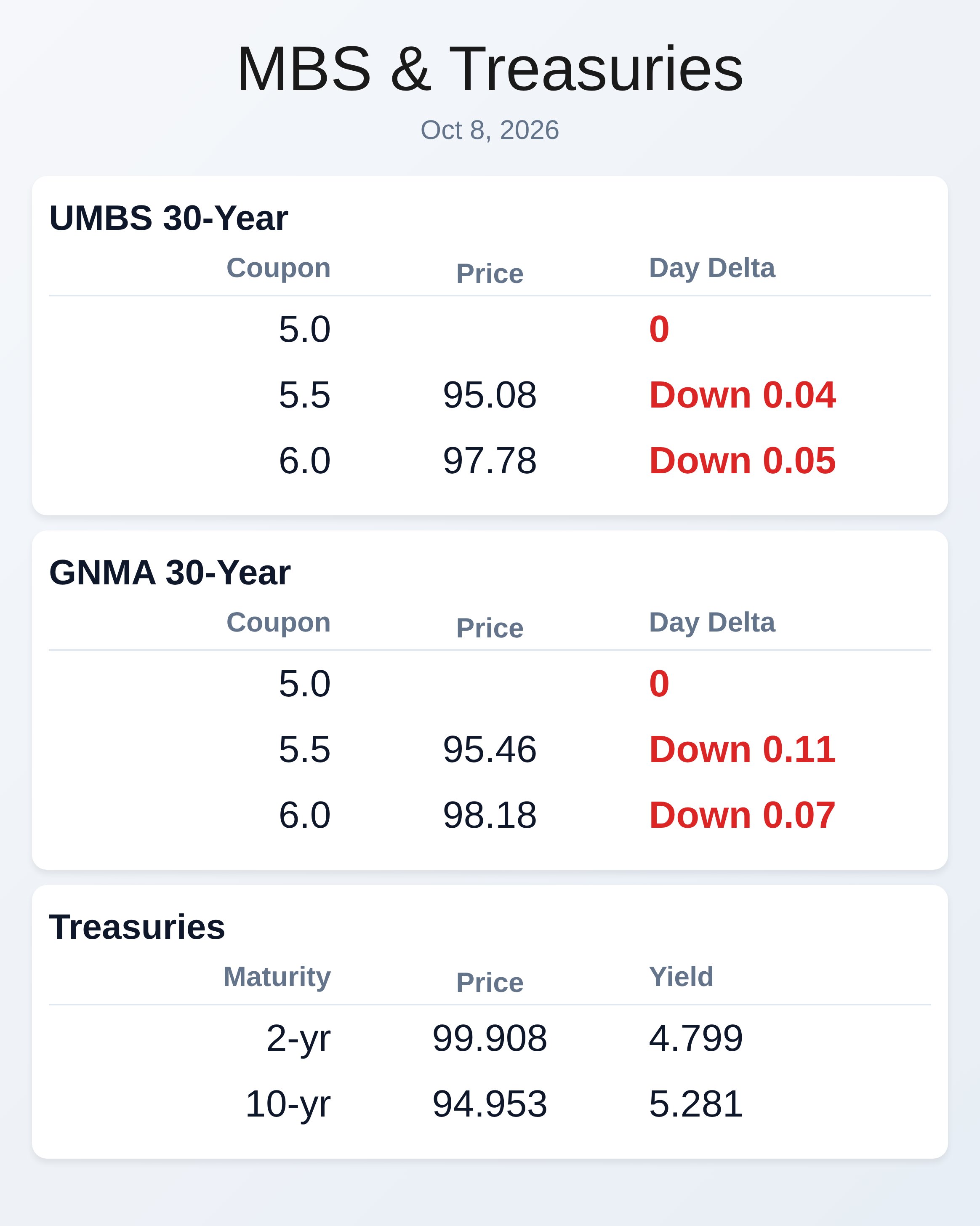
READ MORE **WTMS Blog Today = What's up in Mortgage Today (AM) - 10/08/2026** Bonds surrendered early-morning gains as Federal Reserve Governor Chris Waller signaled that additional rate hikes remain on the table despite September's softer payroll report. The 10-year Treasury yield climbed to 5.343% from the prior close, erasing gains driven by overnight strength in Japanese government bonds and a dip in crude oil below $98 per barrel. UMBS 6.0 coupons fell 25 basis points to 97.58, while GNMA 6.0 declined 9 basis points to 98.16, reflecting persistent downward pressure on mortgage-backed securities. Waller's hawkish comments on persistent inflation and unanchored inflation expectations reignited concerns about the Fed's commitment to tighter policy through at least mid-2027. Oil prices rebounding alongside Treasury weakness suggest energy inflation remains a structural headwind for originators targeting rate-sensitive refinance activity. The U.S. trade deficit widened to $105.6 billion in August, exceeding economist forecasts of $102.1 billion and underscoring the resilience in domestic demand despite elevated interest rates. Imports surged 4.3% while exports rose only 1.4%, highlighting the asymmetry driving global fiscal concerns and weighing on international bond markets. France's 10-year yield spread over Germany narrowed sharply after Marine Le Pen's deficit-reduction proposal, but global sovereign debt anxiety continues to feed spillover pressure into U.S. Treasuries. The broader equity rally powered by artificial intelligence deals and strong corporate earnings has competed aggressively for investor capital, crowding out traditional bond demand. For mortgage sellers, this dynamic means secondary marketing margins remain compressed as investors prioritize higher-yielding equities and corporate debt over agency MBS. Elevated Treasury issuance tied to the U.S. fiscal deficit, combined with war-related inflation pressures and tariff-induced price pass-through, continues to anchor longer-dated yields near multi-year highs. The Federal Reserve's willingness to deploy the Fed Funds Rate as an anti-inflation tool, along with genuine economic resilience in services data and labor markets, has sustained the upward bias in the yield curve. Foreign demand for U.S. debt has weakened gradually due to trade relationship deterioration and tariff concerns, further reducing a traditional source of bond market support. Market participants remain defensive pending tangible evidence of a yield correction, which historically requires sustained daily declines of 6 basis points or more. Originators face headwinds locking borrowers into mid-to-upper-7% mortgage rates, constraining pipeline volume and forcing margin compression strategies on competitive products. Today's economic calendar included the August Trade Balance and weekly jobless claims data, with the latter showing 197,000 initial claims against a forecast of 200,000. Fed remarks from Governor Bowman, Boston President Logan, and New York President Williams preceded a $58 billion auction of 3-year Treasury notes, testing investor appetite amid elevated yields and fiscal uncertainty. Retail sentiment appears resilient according to preliminary CNBC/NRF monitoring, though services-sector price pressures remain a persistent concern for policymakers assessing inflation momentum. The 30-year Treasury auction scheduled for later in the week will provide critical insight into investor demand at current yield levels above 5.6%. Market participants should monitor whether strong economic data continues to argue for additional Fed tightening or whether credit stress signals shift the inflation-versus-growth narrative. Secondary market strategists noted that the intraday bond recovery mid-session failed to establish a convincing floor, as yields hit new long-term highs before rebounding. This pattern reinforces the prevailing trend toward higher rates rather than signaling a durable reversal in the fixed-income outlook. The correlation between oil prices and Treasury yields remains loose but notable, suggesting energy inflation expectations continue to drive term premium compression across the curve. Rate locks remain appropriate only for borrowers with committed closing dates within 30 days, as floating-rate risk continues to outweigh the cost of locking given persistent Fed hawkishness. Loan officers should expect continued pressure on product margins and pipeline velocity until evidence of a meaningful yield correction materializes. Capital markets leaders are recalibrating hedging strategies and secondary marketing operations for an extended higher-rate environment, with some vendors announcing AI-native systems designed to optimize margin capture in compressed-spread scenarios. The mortgage industry's technology vendors gathered at industry conferences this week to demonstrate how intelligent automation could help originators reduce costs and improve execution speed despite lower-volume production. Correspondent partners and wholesale platforms continue to expand down-payment assistance options and deliver non-QM and alternative credit products to maintain borrower access. Servicers report elevated focus on fee prevention and operational efficiency as loan volumes adjust to the new rate regime. For originators, now is the time to stress-test business model assumptions and evaluate whether current staffing and technology investments align with a prolonged period of higher rates and reduced transaction volume. **Locking vs Floating** Remain defensive and avoid aggressive locking until the market demonstrates a successful yield correction, defined as average daily declines of at least 6 basis points sustained over two consecutive trading days. War-related inflation pressures, elevated Treasury issuance driven by fiscal imbalances, strong corporate bond competition, resilient economic data, and the Fed's commitment to fighting inflation all contribute to the ongoing upward bias in rates. Foreign investor demand continues to weaken due to tariff and trade concerns, removing a traditional source of bond market support. The prevailing trend remains firmly toward higher rates, making rate locks appropriate only for borrowers with imminent, committed closing dates. Floating rate risk remains preferable to locking given the Fed's persistent hawkish stance and persistent inflation concerns. **Today's Events** August Trade Balance released at 8:30 AM ET showed a widening deficit to $105.6 billion, exceeding the $102.1 billion forecast. Weekly jobless claims came in at 197,000 versus a forecast of 200,000. Fed remarks from Governor Bowman, Boston President Logan, and New York President Williams were scheduled throughout the day. Treasury auction of $58 billion in 3-year notes was held at 1:00 PM ET. 30-year Treasury bond auction was scheduled for later in the week. **Bond Pricing** **UMBS 30 yr** | Coupon | Price | Intra-Day Change | **GNMA 30 yr** | Coupon | Price | Intra-Day Change | **Treasuries** | Term | Yield | Price | Intra-Day Yield Change | **UMBS 30 Year** | Coupon | Price | Intra-Day Change | |---:|---:|---:| | 5.5 | 95.08 | -0.04 | | 6.0 | 97.78 | -0.05 | | 6.5 | 100.30 | -0.01 | **GNMA 30 Year** | Coupon | Price | Intra-Day Change | |---:|---:|---:| | 5.5 | 95.46 | -0.11 | | 6.0 | 98.18 | -0.07 | | 6.5 | 100.49 | -0.16 | **Treasuries** | Term | Yield | Price | Intra-Day Yield Change | |---:|---:|---:|---:| | 2 yr | 4.799 | 99.908 | 0.040 | | 3 yr | 4.941 | 99.818 | 0.032 | | 5 yr | 5.045 | 99.802 | 0.021 | | 7 yr | 5.166 | 99.038 | 0.008 | | 10 yr | 5.281 | 94.953 | -0.010 | | 30 yr | 5.646 | 92.509 | -0.024 | Stay informed on mortgage markets and secondary strategy. Subscribe free at WellThatMakesSense.com.

Market Data
LATEST ARTICLES

RECENT ARTICLES

Bob Farrell’s 10 Rules for Investing

June 6th, 2020|Money|

From https://ritholtz.com/2008/08/bob-farrells-10-rules-for-investing/ Bob Farrell’s 10 Rules for Investing Bob Farrell was a legend at Merrill Lynch & Co. for several decades. Farrell had a front-row seat to the go-go markets of the late 1960s, [...]

June 4th, 2020|Money|

Ask yourself... What is more important? Feeling smart and telling people they are wrong OR getting along with the people in your life? If #1 - Why??!!

Article Archive

Subscribe

Send me some brain food

Go to Top