
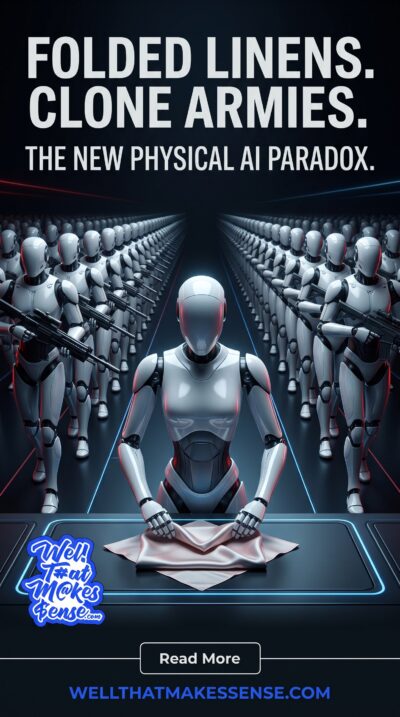
Your Future Laundry-Folding Robot Could Also Lead a Clone Army (And Here’s Why That’s Perfectly Normal)
How NVIDIA and Xiaomi’s breakthrough AI models are teaching robots to understand reality—whether that’s your messy bedroom or a galaxy far, far away
Picture this: It’s 2027, and you’re lounging on your couch while a sleek robot carefully folds your laundry, organizes your closet, and maybe even figures out that those mystery socks actually do have matches somewhere in the universe. Sounds delightful, right? Now picture this: That same technological foundation could theoretically command legions of automated soldiers marching in perfect formation like something straight out of Attack of the Clones. Welcome to the wonderfully weird world of physical AI, where the line between domestic helper and potential droid army is thinner than your patience when folding fitted sheets.
Two massive announcements dropped recently that should make anyone interested in the future of robotics sit up and pay attention. NVIDIA released Cosmos 3, which they’re calling “the first open omni-model for physical AI,” while Xiaomi unveiled their Xiaomi-Robotics-1 foundation model. Both represent quantum leaps in teaching robots to actually understand the physical world—not just see pixels on a screen, but comprehend motion, causality, physics, and how objects interact in three-dimensional space. And here’s the kicker: the same AI that helps a robot understand how to gently pick up your favorite coffee mug without shattering it could also help a military robot navigate complex terrain while carrying… well, considerably less friendly cargo.
The Technology That Teaches Robots to Actually “Get It”
Let’s break down what makes these developments so revolutionary. NVIDIA’s Cosmos 3 isn’t just another AI model—it’s what researchers call a “physical AI system” that can understand the real world in ways that would make previous generations of robots look like confused toddlers. We’re talking about AI that comprehends cause and effect, predicts how objects will move when pushed or pulled, and understands the difference between a fragile wine glass and a rubber ball.
Meanwhile, Xiaomi’s approach with Robotics-1 is equally fascinating. They’ve combined something called “embodiment-free pre-training” (basically teaching the AI about the world without needing an actual robot body) with real-world robot data. Think of it like learning to drive by playing an incredibly realistic video game for months, then spending a few weeks in an actual car. The AI develops a sophisticated understanding of how the physical world works before it ever touches a real object.
What makes both approaches groundbreaking is their use of vision-language-action models. These aren’t just robots that can see or robots that can move—they’re robots that can see, understand what they’re seeing through language processing, and then decide on appropriate physical actions. It’s the difference between a robot that’s programmed to “pick up red objects” versus a robot you can tell, “Hey, grab that red coffee mug on the counter, but be careful because it’s my favorite and also it’s full of hot coffee.”
From Sock-Sorting to Storm Troopers: The Dual-Use Dilemma
Here’s where things get a bit uncomfortable, like realizing your innocent-looking kitchen knife could theoretically be used for purposes other than chopping vegetables. The exact same technological foundations that make a helpful home robot possible also make autonomous military robots considerably more feasible. And we’re not talking about clunky, remote-controlled devices that require a human pilot—we’re talking about machines that can understand complex environments, make decisions, and execute physical tasks independently.
Consider what these AI models can do: They understand spatial relationships, predict physical outcomes, navigate unpredictable environments, manipulate objects with varying levels of delicacy, and adapt to new situations without explicit programming for every scenario. Now, if you’re designing a robot to do laundry, these capabilities mean it can distinguish between your delicate silk blouse and your gym socks, navigate around your cat who’s inevitably sleeping in the middle of the floor, and figure out the optimal way to fold a fitted sheet (which, let’s be honest, would already qualify it as more intelligent than most humans).
But if you’re designing autonomous military systems, these exact same capabilities become considerably more concerning. A robot that can navigate your cluttered living room can also navigate a battlefield. One that can determine the appropriate grip strength for your grandmother’s china can also handle weapons with precision. The AI that helps a domestic robot understand “be gentle with this” versus “you can be rough with that” translates directly to decision-making capabilities in tactical situations.
The collaboration between Hugging Face and NVIDIA to “democratize” this technology through open-source communities is both exciting and slightly terrifying. Open-source means faster innovation, more accessibility, and breakthrough applications we haven’t even imagined yet. It also means that the technology isn’t locked behind military research facilities or corporate vaults—it’s out there for anyone with the technical know-how to build upon.
The Scale of What’s Happening Right Now
Both NVIDIA and Xiaomi are talking about scaling in ways that should make us pause and think. Xiaomi’s research specifically focuses on “scaling in robot learning”—essentially asking, “What happens when we make these models bigger, train them on more data, and give them more computational power?” History suggests that when AI models scale up, they don’t just get incrementally better—they often develop entirely new capabilities that researchers didn’t specifically program.
NVIDIA’s Cosmos 3 is being positioned as a foundation for building physical AI systems across industries. When tech companies talk about “foundation models,” they mean AI systems that can be adapted for countless different applications. GPT-4 is a foundation model for language. Cosmos 3 aims to be a foundation model for understanding and interacting with physical reality. That’s huge. That’s “every robot application you can imagine, from surgery to manufacturing to exploration to, yes, military applications” huge.
The research NVIDIA is presenting on simulation-to-reality transfer is particularly noteworthy. They’re getting really good at training robots in simulated environments (where you can run millions of scenarios quickly and safely) and then having those skills transfer to the real world. This dramatically accelerates development because you don’t need thousands of expensive physical robots breaking things while they learn. You can break virtual things instead, which is considerably cheaper and less likely to result in your actual coffee mug becoming a casualty of technological progress.
So Should We Be Excited or Terrified?
The honest answer? Both. And that’s okay. Every transformative technology in human history has had dual-use potential. Nuclear physics gave us both cancer treatments and nuclear weapons. The internet gave us both instant global communication and, well, everything terrible about the internet. Drones deliver medical supplies to remote villages and also… other things in other contexts.
What makes this moment particularly significant is the pace of development and the open-source nature of the research. We’re not talking about technology that might exist in 20 years—companies are deploying these systems now. Xiaomi is already testing robots that can learn complex manipulation tasks. NVIDIA is actively collaborating with robotics researchers worldwide to accelerate development.
The same AI breakthrough that will let you come home to folded laundry and a vacuumed floor is also making autonomous systems exponentially more capable across all domains. A robot that truly understands physical reality—that can predict, adapt, and execute complex tasks—is useful whether it’s organizing your pantry or performing considerably less domestic functions.
The question isn’t whether this technology will be developed—that ship has sailed, and it’s currently traveling at warp speed. The question is how we govern its use, what safeguards we implement, and whether we can maintain the beneficial applications while preventing the dystopian ones. It’s worth noting that even in Star Wars, the clone army was initially created with good intentions before things went, shall we say, sideways.
For now, most of us will first encounter this technology in decidedly mundane ways. Your next robot vacuum will be smarter. Warehouse automation will get more sophisticated. Manufacturing will become more flexible. And yes, someday relatively soon, you might actually have a robot that can competently handle your laundry without turning your white shirts pink or creating a fitted-sheet origami disaster.
But it’s worth keeping in mind that the innocent-looking robot folding your socks is powered by the same fundamental breakthroughs that could enable far less innocent applications. The technology doesn’t have morality—it’s just really, really good at understanding physical reality and executing tasks within it. What we choose to do with that capability? Well, that’s the trillion-dollar question that will define the next few decades.
The future is arriving faster than most of us expected, and it’s going to be simultaneously more convenient and more complicated than we imagined. Your laundry-folding robot is coming. Let’s just hope it stays focused on the socks.