Loading...
HOME2023-01-22T13:43:33-07:00

“Damn, there is so much great knowledge out there. Did you know that “BOOKS” are full of smart?? No, I mean like life changing, I-wish-I-knew-that-years-ago type stuff.

I know that I was waaaayyy late to the game figuring it out. And I know that a lot of you are too busy to read as much as you ‘should’. And that is why you need me.

I still remember how it started for me. It started in June of 2008. After 11  years …..Click to continue

Mortgage Today (PM) - 11/03/26 {{catlist}}
November 3, 2026
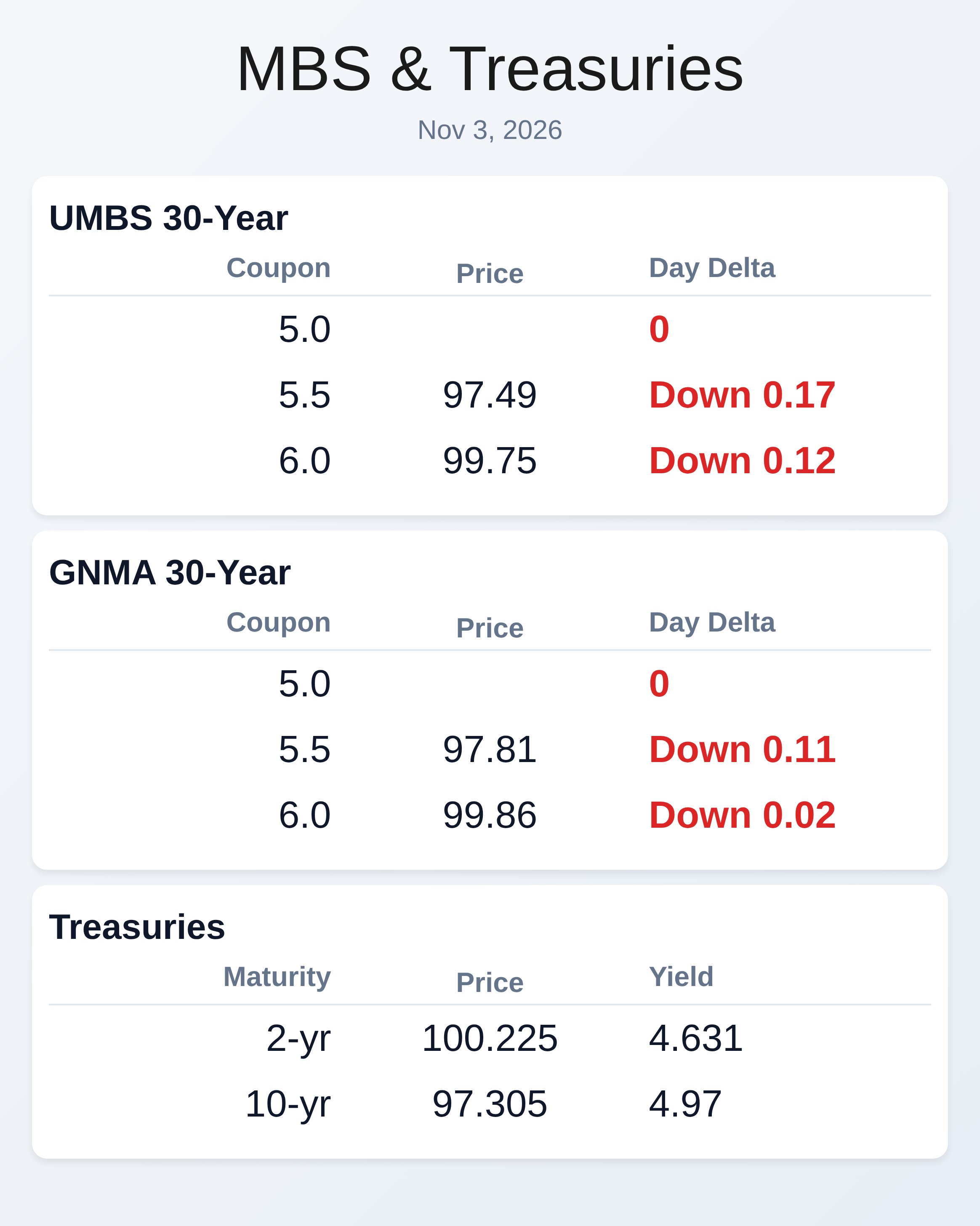
READ MORE **WTMS Blog Today = What's up in Mortgage Today (PM) - 11/03/2026** Bonds backpedaled as stronger-than-expected JOLTS job openings and firm equities undercut early gains. UMBS 6.0 closed near 99.81 (-0.05), while the 10-year Treasury yield climbed to roughly 4.97% (+5–6 bps). Earlier relief from a sharp oil drop faded, reinforcing the reduced correlation between energy and rates. After last week’s tech-driven rally, bonds appear to need a fresh macro catalyst to revisit the recent lows. Rate sheets reflected modest afternoon negative pressure for jumpier lenders. The Fed’s hold delivered minimal market impact, with the curve pivoting—front-end a touch friendlier, long-end stickier—before returning to this week’s data narrative. Traders had already priced a “wait and see” stance, keeping attention on labor tightness and inflation breadth. The recent “tech jitters” bid into Treasuries has leveled off, and bonds haven’t chased stock selloffs as aggressively in the past two sessions. Bottom line: it’s a consolidation with a defensive tilt until data break the stalemate. GNMA and conventional coupons were little changed net, but intraday swings kept pipeline management busy. GNMA 6.0 hovered near 99.85 (-0.03), and price action suggested value buyers are cautious without a clean macro trigger. MBS still face wide spread headwinds from rate volatility and uncertain demand, despite last week’s brief outperformance during risk-off. Expect coupon selection and buydown strategies to remain pivotal for execution. Credit-score competition is increasingly shaping eligibility and pricing. UWM extended VantageScore 4.0 into non-agency, potentially rescuing near-miss borrowers shut out by Classic FICO overlays. CrossCountry reported average LLPA reductions of 62 bps (about $2,500 per loan) for borrowers with better VantageScore outcomes and removed its 80% LTV cap on qualifying conventional use. For secondary teams, this means testing both models’ execution, investor appetite, and QC controls to avoid adverse selection. For originators, it’s a new reason to re-run scenarios across models before declaring a “no.” Earnings underline the market’s split personality: servicing cushions while production margins compress. Pennymac posted $29 million in profit with a production loss offset by servicing income, while Rocket touted share gains even as wholesale volume slipped. Tools like Rocket Pro’s real-time counter feature aim to defend refis by tightening the “speed-to-match” gap when a borrower presents a rival LE. The strategic theme is clear: protect recapture, move faster at the point of sale, and let MSR value stabilize the P&L. On the ground, rate stability is elusive, keeping borrowers cautious and LOs focused on precision. With headline mortgage rates hovering in the low- to mid-7s and ARMs gaining share, tactics center on targeted buydowns, exact pricing comparisons, and keeping prepaids low. Database mining and first-party engagement are outperforming spray-and-pray lead buys, particularly when paired with disciplined follow-up. In a data-driven market, execution speed and model-savvy eligibility win files at the margin. **Locking vs Floating** Momentum has shifted cautious after today’s hotter labor signal and the recent stall in tech-driven bond support. Floaters should be tactical and time-sensitive, as re-tests of last week’s yield lows likely require softer data. Lock bias makes sense for near-term closings given afternoon reprice risk and a heavier long end. If a decisive risk-off or weak jobs print emerges, reassess for incremental float opportunities. Absent that, prioritize certainty over small, timing-dependent gains. **Today's Events** Job Openings and Labor Turnover Survey (JOLTS): stronger than expected ISM Manufacturing PMI (Oct): 55.5; Prices Paid: 75.2; ISM Manufacturing Employment: 52.4 Construction Spending (Sep): -1.9% vs. 0.4% forecast Core PCE (Sep): 0.3% m/m; 3.1% y/y; GDP Q3: 3.4%; Initial Jobless Claims: 194K **Bond Pricing** **UMBS 30 yr** | Coupon | Price | Intra-Day Change | **GNMA 30 yr** | Coupon | Price | Intra-Day Change | **Treasuries** | Term | Yield | Price | Intra-Day Yield Change |

Market Data
Mortgage Today (AM) - 11/03/26 {{catlist}}
November 3, 2026
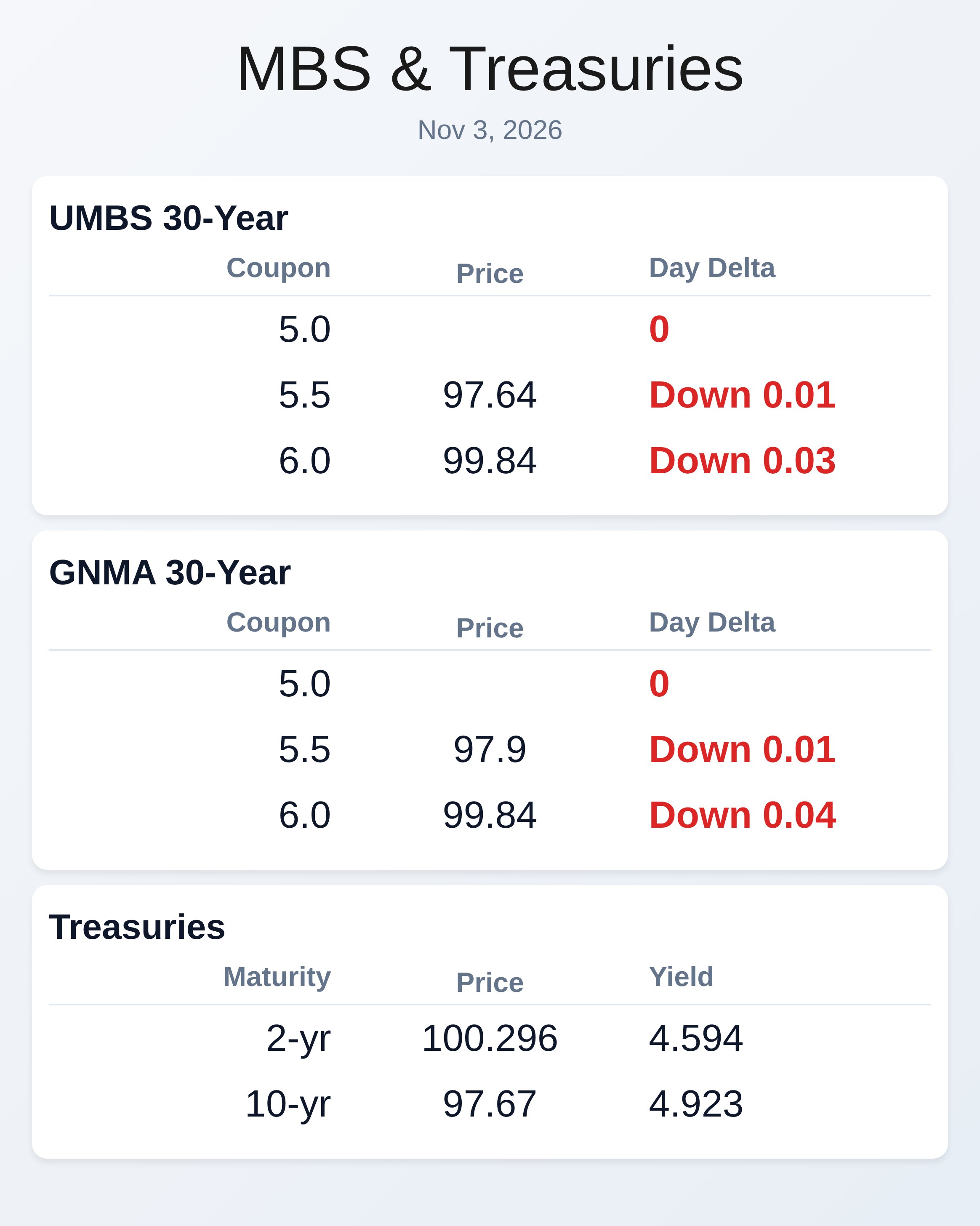
READ MORE **WTMS Blog Today = What's up in Mortgage Today (AM) - 11/03/2026** Mortgage rates held steady this week as Treasury yields declined nearly 50 basis points in October despite persistent inflation concerns. The 10-year Treasury yielded 4.93% as of Tuesday morning, down from 5.24% at month-end, driven by a flight-to-quality trade as equity market volatility spiked and artificial intelligence valuations faced scrutiny. Origination activity improved slightly, with total mortgage applications rising 3.4% last week, though purchase volume remained 18% below year-ago levels and refinancing plunged 61% year-over-year. Non-QM and ARM products continued gaining share as borrowers searched for rate relief—non-QM climbed to 12% of production while ARM usage reached 14%, its highest level since 2019. Oil prices declined sharply on optimism around U.S.-Iran diplomatic negotiations, reducing inflationary pressure and supporting Treasury rallies that benefit mortgage-backed securities. Fannie Mae and Freddie Mac reported strong third-quarter earnings despite industry headwinds, with Freddie Mac posting $3.2 billion in net income—up 17% year-over-year—as both GSEs trimmed workforce expenses. Accessible home equity reached $13.2 trillion in Q2 2026, but 88% of that pool remained locked behind mortgage rates below current prevailing rates, creating a significant gap between available equity and borrower refinancing incentives. UAD 3.6 appraisal format requirements take effect November 2, forcing lenders and AMCs to adopt new review policies and risking pipeline disruptions for those unprepared. The MBA released an "Affordability in Action" policy roadmap calling for reduced credit fees, lower FHA mortgage insurance premiums, and expanded use of automated valuation models and AI-assisted underwriting. President Trump's executive order directing agencies to lower mortgage and refinancing costs represents limited near-term impact, as implementation depends on FHFA and federal lender guidance still in development. Dark Matter acquired House Numbers' agentic artificial intelligence platform for mortgage lending, integrating proven AI agents directly into the Empower LOS to automate document recognition and workflow intelligence. Optimal Blue acquired mortgage CRM platform Usherpa, expanding its reach into lead generation and borrower engagement while maintaining ecosystem openness for independent LOS integrations. Newrez and eXp Realty launched Revenos Mortgage, a joint venture designed to serve eXp's 25,000-plus agents and their clients through Newrez's lending and servicing infrastructure. CrossCountry Mortgage sent cease-and-desist letters to at least 25 former loan officers, citing two-year non-solicitation agreements and demanding 75 basis points on each refinanced borrower loan, signaling aggressive enforcement of non-compete clauses. These industry consolidations and vendor partnerships reflect lenders' focus on operational efficiency, lead generation automation, and integrated technology ecosystems amid compressed margins. The mortgage industry absorbed employment uncertainty as midterm elections proceeded Tuesday, with investors cautious ahead of policy outcomes affecting fiscal spending and interest rate trajectory. Lender loan officer productivity, compensation structures, and retention strategies became focal points as independent mortgage bankers shed approximately 100 net originators in the first nine months of 2026 while broker and non-delegated channels gained 327 LOs and $7 billion in production volume. MBA Homebase launched as a new education and coaching initiative for loan officers, providing professional development and advocacy regardless of lender affiliation—signaling industry recognition that LO support and retention directly impact production stability. September mortgage origination costs held steady around $10,700-$12,600 per loan, according to MBA data, creating pressure on profitability as volumes declined and competition for qualified borrowers intensified. Compliance requirements expanded with California and Iowa moving toward Mortgage Compliance Dataset (MCD) implementation in 2027, requiring lenders to prepare electronic transaction files in standardized format for regulatory examinations. **Locking vs Floating** Pipeline hedgers face two-sided risk as uncertainty persists over whether duration extension and convexity-related selling have peaked. Further rate increases could widen mortgage spreads, while a Treasury rally could shorten MBS duration and force costly hedge adjustments. The next inflation readings and Fed's response will shape both Treasury direction and mortgage-market stability, with basis volatility, hedge positioning, and origination profitability remaining key concerns. Strong earnings from tech and AI companies could reinforce expectations that the economy can withstand tighter financial conditions, keeping yields elevated. Conversely, weakening demand, margin compression, or cautious guidance could expose delayed economic impact of higher rates and support Treasury recovery. **Today's Events** September Business Inventories September JOLTS Job Openings (expected 7.10M vs. 7.079M prior) September Factory Orders Election Day: Midterm voting underway **Bond Pricing** **UMBS 30 yr** | Coupon | Price | Intra-Day Change | **GNMA 30 yr** | Coupon | Price | Intra-Day Change | **Treasuries** | Term | Yield | Price | Intra-Day Yield Change |

Market Data
Mortgage Today (PM) - 11/02/26 {{catlist}}
November 2, 2026
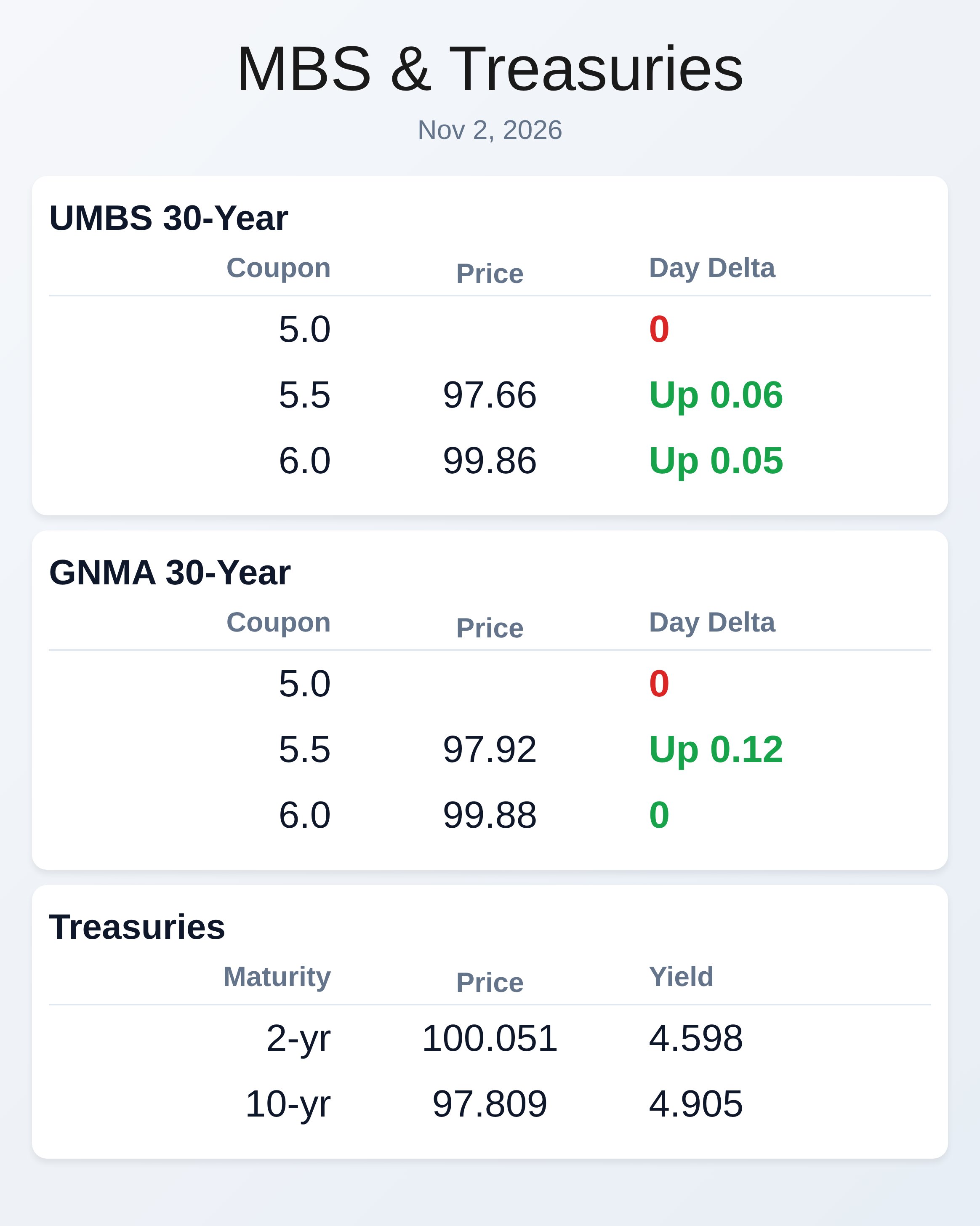
READ MORE **WTMS Blog Today = What's up in Mortgage Today (PM) - 11/02/2026** Bonds tried to extend last week’s rally but finished mixed, with UMBS little changed and the 10-year easing modestly. By the close, 30-year UMBS 6.0 sat near 99.86, up 0.05, while the 10-year yield slipped to roughly 4.91%. The usual “tech jitters” tailwind faded intraday as rates decoupled from equities. Net: constructive, but not conclusive. Sellers should treat today as consolidation, not a breakout. The day opened with a bid on new-month flows and a firmer ISM manufacturing print that markets largely absorbed. ISM PMI rose to 55.5, with prices paid easing a touch versus forecasts. Midday, MBS gave back an eighth from the morning’s highs, triggering a few negative reprice watches for jumpier lenders. Even so, UMBS 6.0 held green into the afternoon. Rate sheets tracked that drift, not a trend change. The afternoon wobble came when Treasury’s quarterly borrowing preview hit, showing higher-than-expected financing needs before cash-balance adjustments. That supply signal trimmed gains and reminded traders that refunding details still matter for term premia. Treasuries ended narrowly better on the day, but the knee-jerk safe-haven move stayed muted. Translation: value buyers remain cautious without a clear macro catalyst. Watch refunding and jobs data to confirm direction. GNMA performance was similarly mixed, with 30-year Ginnie 6.0 at 99.87, down 0.01, and 15-year conventionals a touch firmer. Conventional 6.5s leaked slightly while 6.0s held, keeping stack tone steady. Spreads versus Treasuries were largely unchanged intraday, reflecting a market that wants proof, not hope. Hedgers should stay disciplined on coupon selection and buydown exposure. Less conviction equals tighter risk knobs. On the credit front, score-model competition is migrating beyond agency. One major wholesale lender is extending VantageScore into non-agency, while a large retail lender reported roughly 62 bps average LLPA benefit for borrowers who scored better under VS 4.0 and widened program eligibility. For sellers, the takeaway is execution math, not headlines: test investor appetite, rep/warrant terms, AUS interplay, and how grids pass savings through. Governance and pricing controls must evolve with model choice. Policy risk remains a wild card. The new housing EO tasks FHFA with streamlining refi frictions (title acceptance, potential LLPA relief) and piloting proactive PMI cancellation for future originations, but borrower savings hinge on agency design and servicer operations. That helps pipelines only if implementation scales cleanly. For now, affordability is still constrained even with last week’s modest rate relief, so focus on concessions, buydowns, and home-equity solutions. **Locking vs Floating** With bonds decoupling from tech today and refunding supply in focus, treat rallies as tactical. Favor locking on intra-day strength unless you have time and risk budget for event volatility. A bigger rate leg lower likely needs a clear macro shock or softer labor data. Until then, expect two-way chop, especially around refunding details and Friday’s jobs report. Defensive posture remains prudent. **Today's Events** Construction Spending (Sep): -1.9% vs 0.4% forecast, 0.9% prior ISM Manufacturing Employment (Oct): 52.4 vs 52.7 prior ISM Manufacturing PMI (Oct): 55.5 vs 54.6 forecast, 54.5 prior ISM Manufacturing Prices Paid (Oct): 75.2 vs 77 forecast, 77.9 prior **Bond Pricing** **UMBS 30 yr** | Coupon | Price | Intra-Day Change | **GNMA 30 yr** | Coupon | Price | Intra-Day Change | **Treasuries** | Term | Yield | Price | Intra-Day Yield Change |

Market Data
LATEST ARTICLES

RECENT ARTICLES

Article Archive

Leaders Eat Last Post 5

January 7th, 2020|0 Comments

Simon Sinek Explains how to Control the Chemicals that control Human Behavior. Our body is specifically built to increase our survival.   Including the chemicals it creates.   There are 4 primary chemicals that [...]

Make Better Connections with Body Language

January 4th, 2020|0 Comments

REAL rapport is at away different level.   You ready for some deep shit? REAL rapport is at the unconscious level. You know how we always hear that "we only use 10% of our brain"?   [...]

Leaders Eat Last Post 4

December 30th, 2019|0 Comments

In the Marines, the leaders always eat last and don't give an order to do so.   The leaders feel it's their privilege to lead their soldiers. Aesop's Fable:   When a lion stalked 4 ox [...]

Leaders Eat Last – Post 3

December 24th, 2019|0 Comments

Based on our caveman genes, too many business leaders think that the best way to handle external threats is applying more pressure.  Biology and anthropology disagree.   Actually, when we feel safe and like [...]

Subscribe

Send me some brain food

Go to Top