Loading...
HOME2023-01-22T13:43:33-07:00

Damn, there is so much great knowledge out there. Did you know that “BOOKS” are full of smart?? No, I mean like life changing, I-wish-I-knew-that-years-ago type stuff.

I know that I was waaaayyy late to the game figuring it out. And I know that a lot of you are too busy to read as much as you ‘should’. And that is why you need me.

I still remember how it started for me. It started in June of 2008. After 11  years …..Click to continue

Mortgage Today (AM) - 09/24/26 {{catlist}}
September 24, 2026
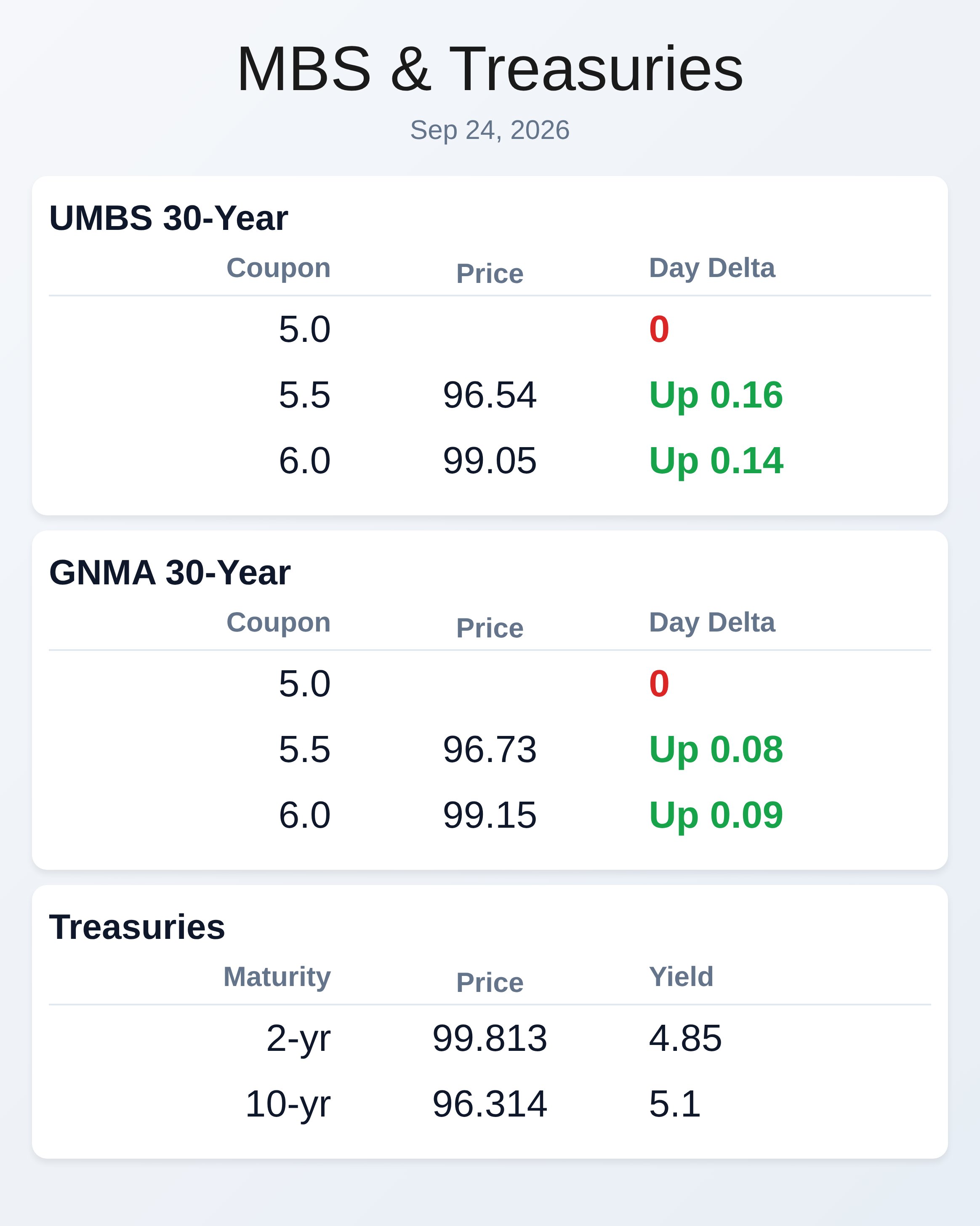
READ MORE **WTMS Blog Today = What's up in Mortgage Today (AM) - 09/24/2026** Bonds suffered their worst selloff in weeks yesterday as yields spiked to 20-year highs across the curve, forcing mortgage rates upward and squeezing originator margins. The 10-year Treasury jumped 14 basis points to around 5.125 percent, while the 30-year approached 5.4 percent, dragging the FNCL conventional coupon up 19 basis points to 6.22 percent. Fast-money traders amplified long-end moves as the market repriced against Fed hawkishness and inflation concerns. The par note rate climbed 15 basis points to a restrictive 7.125 percent, and the probability of an October rate hike surged to 70 percent. This morning, MBS gained 2 ticks while the 10-year backed down 1.9 basis points, but the damage is done and volatility remains elevated. The bond rout was driven by multiple factors converging simultaneously. The preliminary September PMI reading showed a sharp acceleration in U.S. business activity to multi-year highs, stoking recession-prevention concerns and spurring expectations for further Fed tightening. Fed Governor Barr signaled hawkishly that his baseline includes additional policy adjustments, adding credibility to tightening bets. A weak $70 billion 5-year Treasury auction cleared above 5.03 percent with a wide 3.1-basis point tail, revealing that foreign indirect bidders plummeted to just 54 percent. Crude oil futures rose again amid continued Middle East tensions, lifting inflation expectations across the board. Mortgage originators faced a brutal repricing session as spreads widened materially on light volume and rate locks came under pressure. The sharp move in long-end yields hit the mortgage market harder than the short end, which reacted more logically to Fed catch-up tightening. A lender that locked loans yesterday morning faced serious pullback risk, and anyone floating into today's session has to weigh whether prices stabilize or continue deteriorating. The broad-based selloff suggests market participants are genuinely worried about further Fed action and fiscal drag from the mounting budget deficit. For now, the stance remains conservative: wait for a definitive rally before aggressively locking loan flow. The economic calendar is packed today, starting with jobless claims that came in right on forecast at 197,000. Continuing claims eased to 1.719 million versus expectations of 1.750 million, offering a small bit of good news on labor market softness. Later today brings August new home sales, a $44 billion 7-year Treasury auction, and a $6 billion buyback operation in long-dated bonds. Fed speakers are scheduled, and there's also a President Trump and President Xi meeting on the agenda, adding geopolitical uncertainty to an already nervous market. Any additional inflation prints or hawkish commentary could trigger another round of selling. **Locking vs Floating** The technical break above 5.01 percent on the 10-year is a clear warning sign, and there's no telling whether the market will find a bid today or months from now. Until bonds show a definitive shift and rally, the prudent approach is to remain conservative with rate locks and avoid overcommitting to floating inventory. Nerves are running high ahead of next week's economic data, and spreads have widened enough that many originators are pulling back on risk exposure. The default stance since early July has not changed: do not become aggressive until you see a convincing rally. **Today's Events** Jobless Claims (Sep/19): 197.0K vs 201K forecast, 196K previous Continued Claims (Sep/12): 1,719K vs 1,750K forecast, 1,730K previous August New Home Sales (later today) $44 billion 7-year Treasury note auction (later today) $6 billion Treasury buyback operation in 20-year to 30-year bonds (today) Federal Reserve speakers (Fedspeak scheduled throughout the day) President Trump and President Xi bilateral meeting **Bond Pricing** **UMBS 30 yr** | Coupon | Price | Intra-Day Change | **GNMA 30 yr** | Coupon | Price | Intra-Day Change | **Treasuries** | Term | Yield | Price | Intra-Day Yield Change | | 2yr | 4.85 | 99.813 | -0.047 | | 3yr | 4.926 | 98.481 | -0.049 | | 5yr | 4.971 | 100.129 | -0.023 | | 7yr | 5.026 | 96.927 | -0.024 | | 10yr | 5.1 | 96.314 | -0.012 | Market Data
Mortgage Today (PM) - 09/23/26 {{catlist}}
September 23, 2026
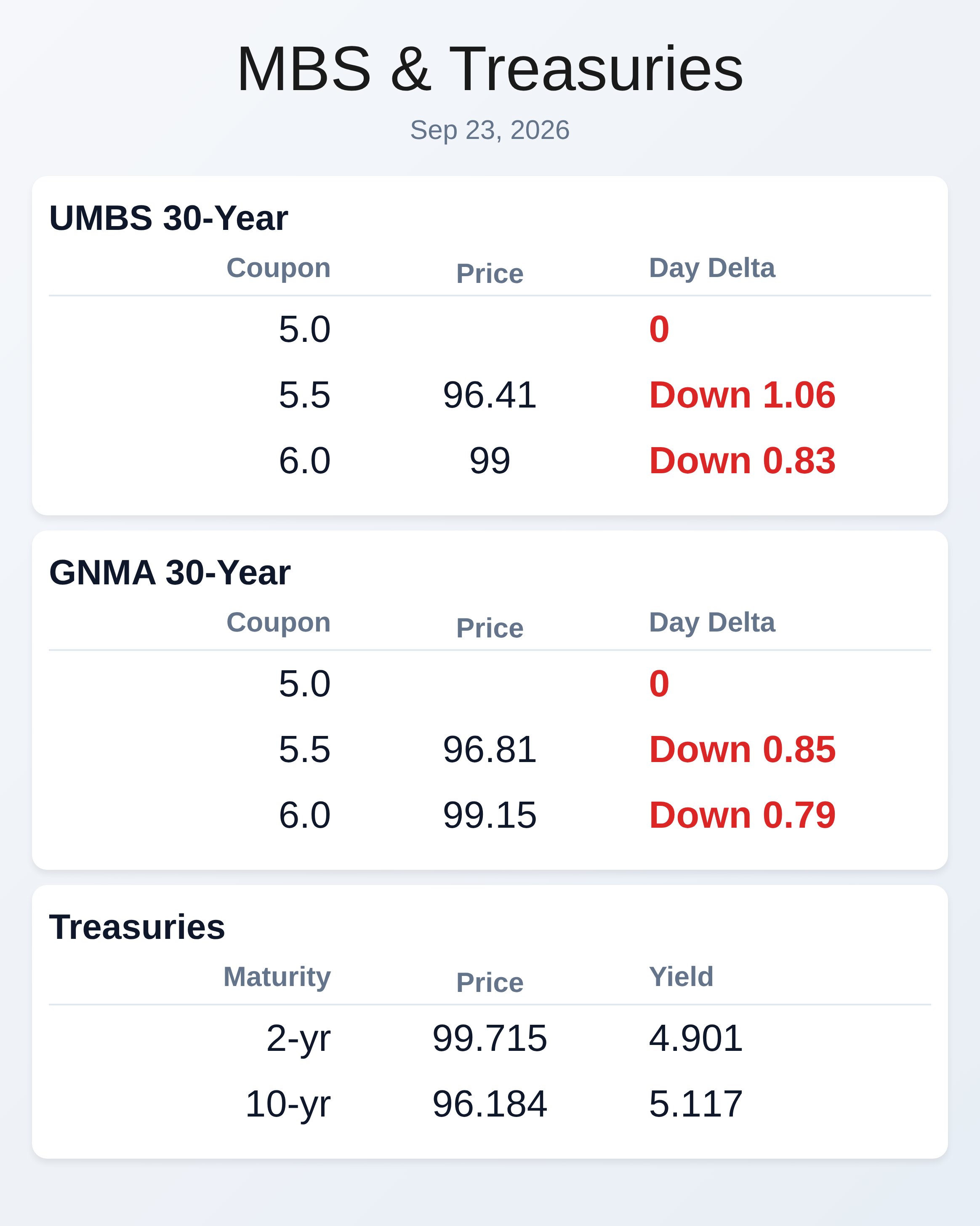
READ MORE **WTMS Blog Today = What's up in Mortgage Today (PM) - 09/23/2026** UMBS securities tanked more than half a point today as surprisingly strong economic data pushed Treasury yields to their highest levels since 2007, signaling the Fed has room for additional rate hikes. The S&P Global PMI data hit multi-year highs across both manufacturing and services, triggering immediate bond selling and forcing lenders to reprice rate sheets downward. Ten-year Treasury yields jumped from 5.0% to over 5.04%, with market pricing showing over 50% odds for a second rate hike at the next Federal Reserve meeting. MBS are down approximately 56 basis points on the day, leaving many lenders scrambling with negative reprices before borrowers see updated rates. This kind of volatility creates urgency for borrowers sitting on the fence to lock rather than float. The mortgage origination business faces a structural problem that has little to do with whether rates are 7% or 6%. According to analysis from The Mortgage Scoop, the industry is producing roughly half as many loans today compared to the late 1990s when rates were similarly elevated, yet average loan balances have grown 53% since 2015 while production expenses exploded. Loan officer compensation has remained indexed to loan balance at roughly 100 basis points, meaning a $400,000 mortgage pays twice what a $250,000 mortgage does, even though the work required is nearly identical. When production revenue per loan dropped from 434 basis points in 2020 to 333 basis points in Q2 2026, that same $4,000 LO commission suddenly represented 30% of lender revenue instead of 23%. Originators now need roughly 1,515 loans annually to generate the same $1.19 million in production profit that 1,000 loans produced in 2015. The compensation model created after the 2008 crisis to eliminate conflicts of interest has ironically become a new pressure point as markets tighten. When loan amount became the index for LO pay, it worked because rates were falling and home values were surging, so bigger loan balances correlated with bigger lender revenues. Today's environment inverts that equation—lenders must chase more volume with shrinking margins while loan officers still expect their balance-based commissions. This mismatch explains why even "historical" rate levels feel desperate to the industry; the business model supporting those rates depends on either massive volume or massive margins, and borrowers are not materializing regardless of messaging about historically normal rates. Freddie Mac's mortgage-backed securities buying could help compress spreads by another 10 to 12 basis points, according to the Community Home Lenders of America, though that relief depends on Treasury yields cooperating. The FHFA disclosed last week that Fannie and Freddie were ramping up large-quantity MBS purchases after three consecutive months of declining holdings. Even 12 basis points of spread compression would matter to originators grinding through lower profitability, but Treasury yields can easily move in the opposite direction and erase any gains from secondary market support. The real question for mortgage sellers is whether policy support translates to rate sheet improvement or simply prevents spreads from blowing wider. Loan officers may be underestimating borrower demand for digital closing technology, according to new ServiceLink research highlighting a disconnect between originator assumptions and consumer expectations. Many borrowers want streamlined digital experiences, yet lenders continue deploying traditional paper-based processes or half-measures that frustrate both parties. UWM's new Underwriting+ platform combines underwriting, processing, and borrower communication into a single workflow, with pilot loans averaging just 8.3 days from submission to clear-to-close. This kind of technology adoption becomes even more critical when originators must close more volume with fewer staff and tighter economics. Mutual of Omaha's mortgage division auction caught even internal stakeholders by surprise, signaling potential consolidation in a market already under pressure from rate volatility and volume constraints. The broader mortgage industry faces a test of resilience as borrower demand remains soft at 4.5% to 4.6% rate levels, production margins compress further, and compensation models designed for a different era strain lender profitability. Companies that cannot adapt their cost structures or technology infrastructure risk becoming acquisition targets or casualties. **Locking vs Floating** With the 10-year Treasury at 5.06% and strong economic data supporting further Fed rate hikes, borrowers with closings approaching should strongly favor locking rates. Treasury yields are at their highest since 2007, and market pricing suggests additional rate increases are likely, making floating a high-risk bet for near-term closings. **Today's Events** September 23, 2026: MBA Mortgage Market Index (230.8 forecast), MBA Purchase Index (156.2 forecast), S&P Global Composite PMI (56 forecast), S&P Global Manufacturing PMI (53.6 forecast), S&P Global Services PMI (56 forecast), 5-Year Note Auction. **Bond Pricing** **UMBS 30 yr** | Coupon | Price | Intra-Day Change | **GNMA 30 yr** | Coupon | Price | Intra-Day Change | **Treasuries** | Term | Yield | Price | Intra-Day Yield Change | Market Data
Mortgage Today (AM) - 09/23/26 {{catlist}}
September 23, 2026
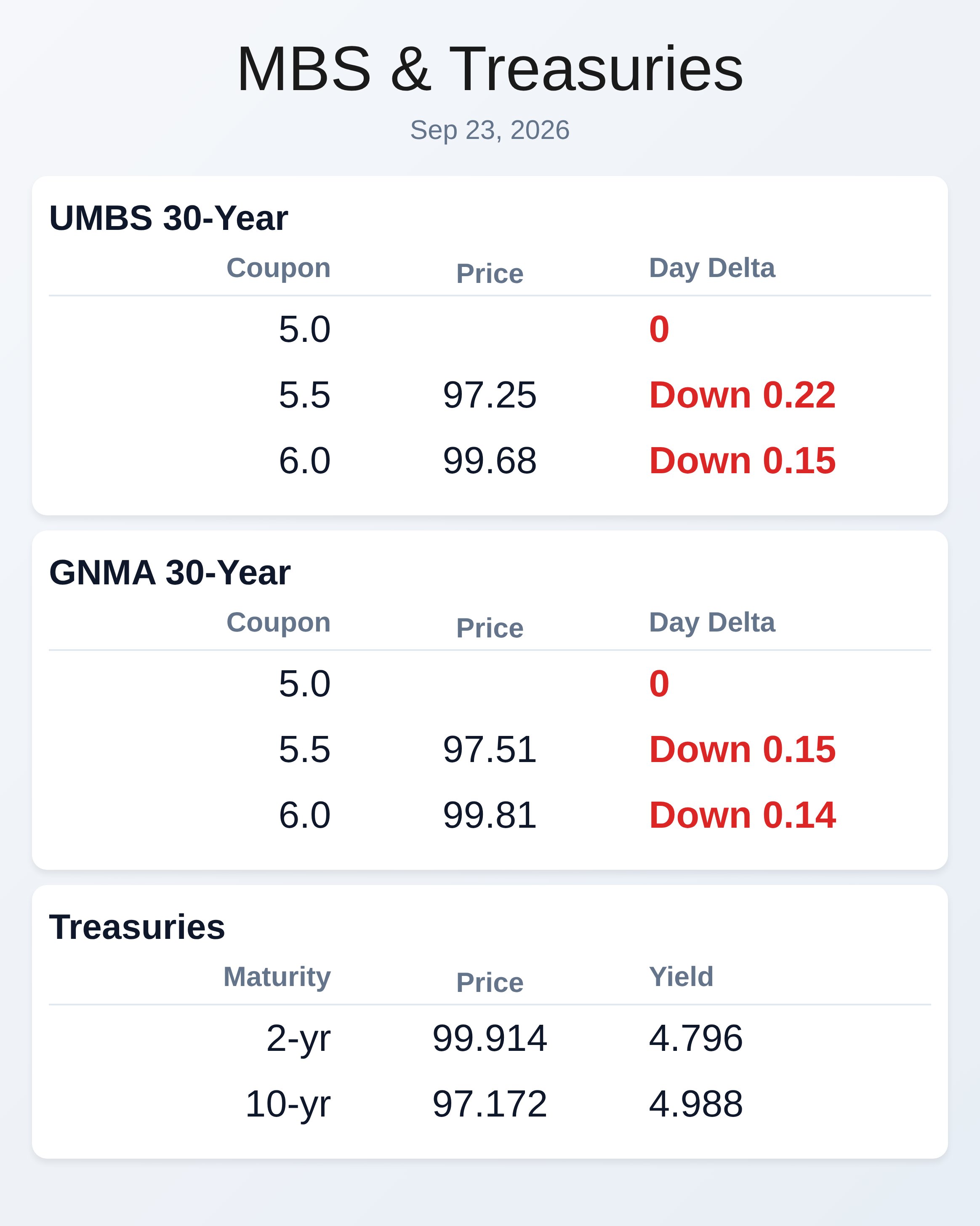
READ MORE **WTMS Blog Today = What's up in Mortgage Today (AM) - 09/23/2026** Mortgage rates surged to 7.12% last week, the highest level since 2024, forcing application volume down 1.5% and pushing nearly one in ten borrowers toward adjustable-rate mortgages. Refinance activity collapsed to its lowest level since February 2025, with refi applications down 62% year-over-year. The 30-year fixed is now more than a percentage point above ARM rates, making the exotic product suddenly attractive during this affordability crisis. Purchase applications slipped just 1% week-over-week but remain 11% lower than last year. As the fall market officially begins, real estate agents are already reporting a sharp pullback from prospective buyers. War headlines and oil price volatility are dominating bond market attention, with geopolitical uncertainty creating daily swings that overwhelm economic data. Late yesterday, reports of productive U.S.-Iran negotiations temporarily stabilized Treasuries and helped the market absorb a $69 billion 2-year note auction. The 10-year Treasury sits at 4.988%, while Agency MBS prices remain little changed from yesterday's close. Without a clear catalyst for rate relief, the structural deficit and persistent oil concerns should keep upward pressure on long-end yields. The Fed's public silence on skyrocketing fiscal spending contrasts sharply with its aggressive stance on inflation tied largely to crude oil pricing. Homebuilders are increasingly dependent on FHA-financed buyers to move volume during this cyclical slowdown. Ashton Woods has seen FHA-financed sales surge from 15% of total transactions in 2022 to 39% today. This trend reflects broader affordability pressures squeezing move-up buyers out of traditional markets. The shift demonstrates how housing affordability deterioration is forcing both lenders and builders to lean more heavily on government-backed programs. KB Homes warned in earnings that market conditions have weakened significantly since June, with higher rates and buyer hesitation dampening demand. Fannie Mae is tightening documentation requirements for investors converting homes into rentals, eliminating lease agreements as acceptable proof of rental income effective November 1. Lenders must now use appraisals, Form 1007, or comparable market data from sources like Zillow or MLS with three recent comps. Move-up buyers benefit because they no longer need an existing tenant before applying, though the qualifying math remains unchanged with a 25% reduction for vacancy and expenses. Freddie Mac maintains a more flexible approach, still accepting leases and refusing market-analysis tools. Lenders must verify which GSE they're delivering to before presenting rental income strategies to borrowers. A bipartisan proposal would provide up to $50,000 in down payment assistance to first-time homebuyers, addressing the affordability crisis gripping the market. The legislation represents a direct response to the mounting pressure consumers face as rates hover near 7% and median home prices remain historically elevated. Zillow faces a new legal challenge seeking to dismiss a RESPA lawsuit accusing the platform of steering borrowers to its in-house mortgage business through its real estate referral program. The court has already rejected two previous versions of the complaint, and Zillow is now pushing for permanent dismissal with prejudice. Pending home sales edged up just 0.3% in August, suggesting buyer activity remains tepid despite seasonal expectations. UAD 3.6 appraisal format changes are driving costs higher as appraisers navigate expanded inspection requirements and extended reporting timelines. Class Valuation's analysis shows appraisers already charging premium fees due to the added labor and time demands of the new standards. Hybrid appraisals that meet UAD 3.6 data capture standards offer lenders faster turnarounds and lower pricing, making them increasingly attractive as traditional appraisal fees climb week-to-week. Lenders should disclose longer appraisal timelines now and prepare borrowers for extended underwriting schedules over the next 90 days. Ignoring hybrid appraisal options during this transition period could cost originators both time and revenue as conventional processing delays mount. **Locking vs Floating** War and oil volatility are controlling daily bond moves without creating a directional bias. Technical levels remain relevant between 4.93% and 5.01% on the 10-year, so traders should wait for a definitive break outside this range before shifting lock-float strategy. The default conservative stance established in July remains unchanged—originators should maintain cautious locking discipline until a clear rally develops in bond pricing. **Today's Events** Fed Governor Barr remarks, preliminary S&P Global Manufacturing PMI, Services PMI, crude oil inventory reports, and a $70 billion 5-year Treasury note auction are scheduled for later today. **Bond Pricing** **UMBS 30 yr** | Coupon | Price | Intra-Day Change | | 5.5 | 97.25 | -0.22 | | 6.0 | 99.68 | -0.15 | | 5.5 | 97.51 | -0.15 | **GNMA 30 yr** | Coupon | Price | Intra-Day Change | **Treasuries** | Term | Yield | Price | Intra-Day Yield Change | Market Data
LATEST ARTICLES

RECENT ARTICLES

Article Archive

Subscribe

Send me some brain food

Go to Top