Loading...
HOME2023-01-22T13:43:33-07:00

Damn, there is so much great knowledge out there. Did you know that “BOOKS” are full of smart?? No, I mean like life changing, I-wish-I-knew-that-years-ago type stuff.

I know that I was waaaayyy late to the game figuring it out. And I know that a lot of you are too busy to read as much as you ‘should’. And that is why you need me.

I still remember how it started for me. It started in June of 2008. After 11  years …..Click to continue

Mortgage Today (AM) - 07/31/26 {{catlist}}
July 31, 2026
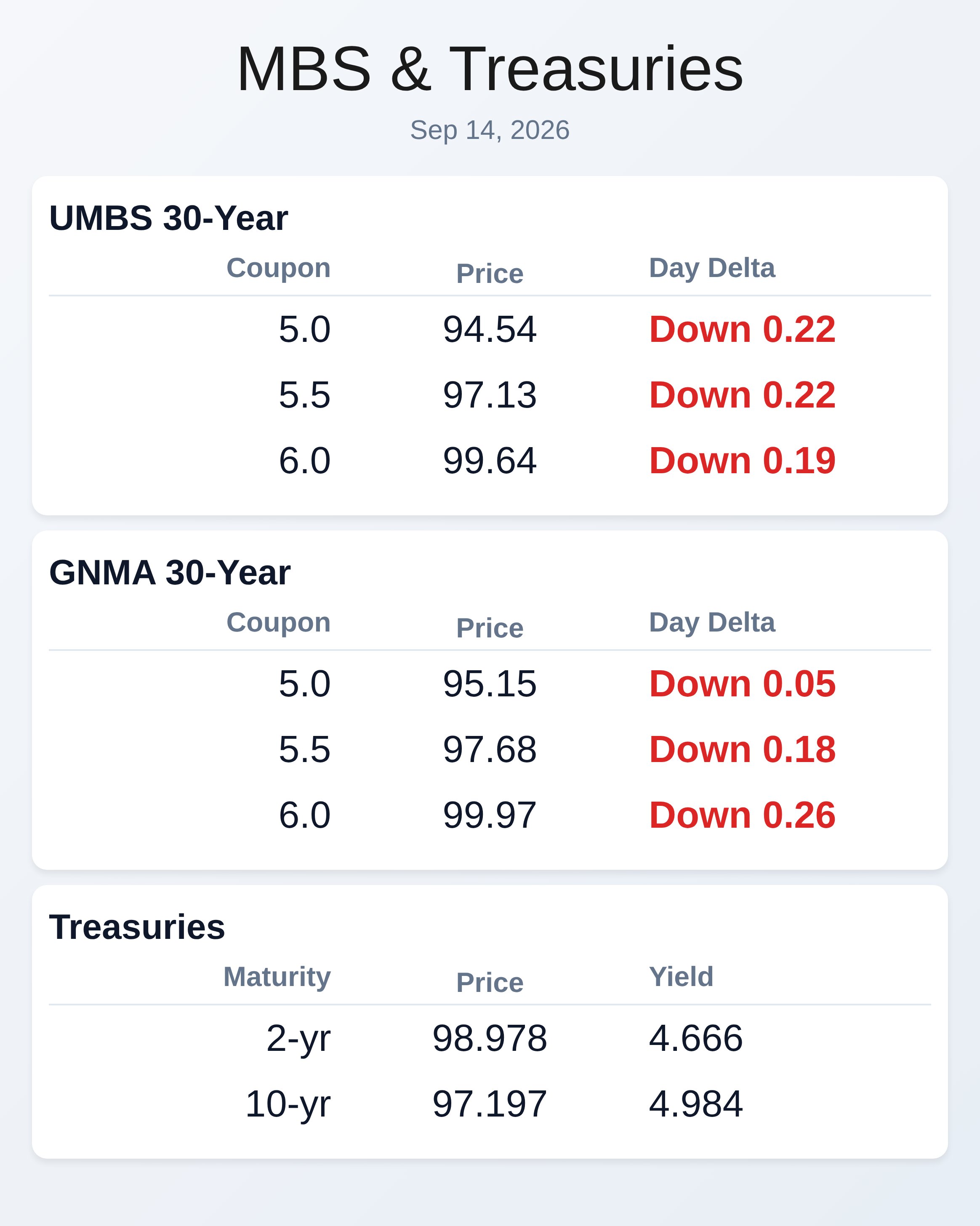
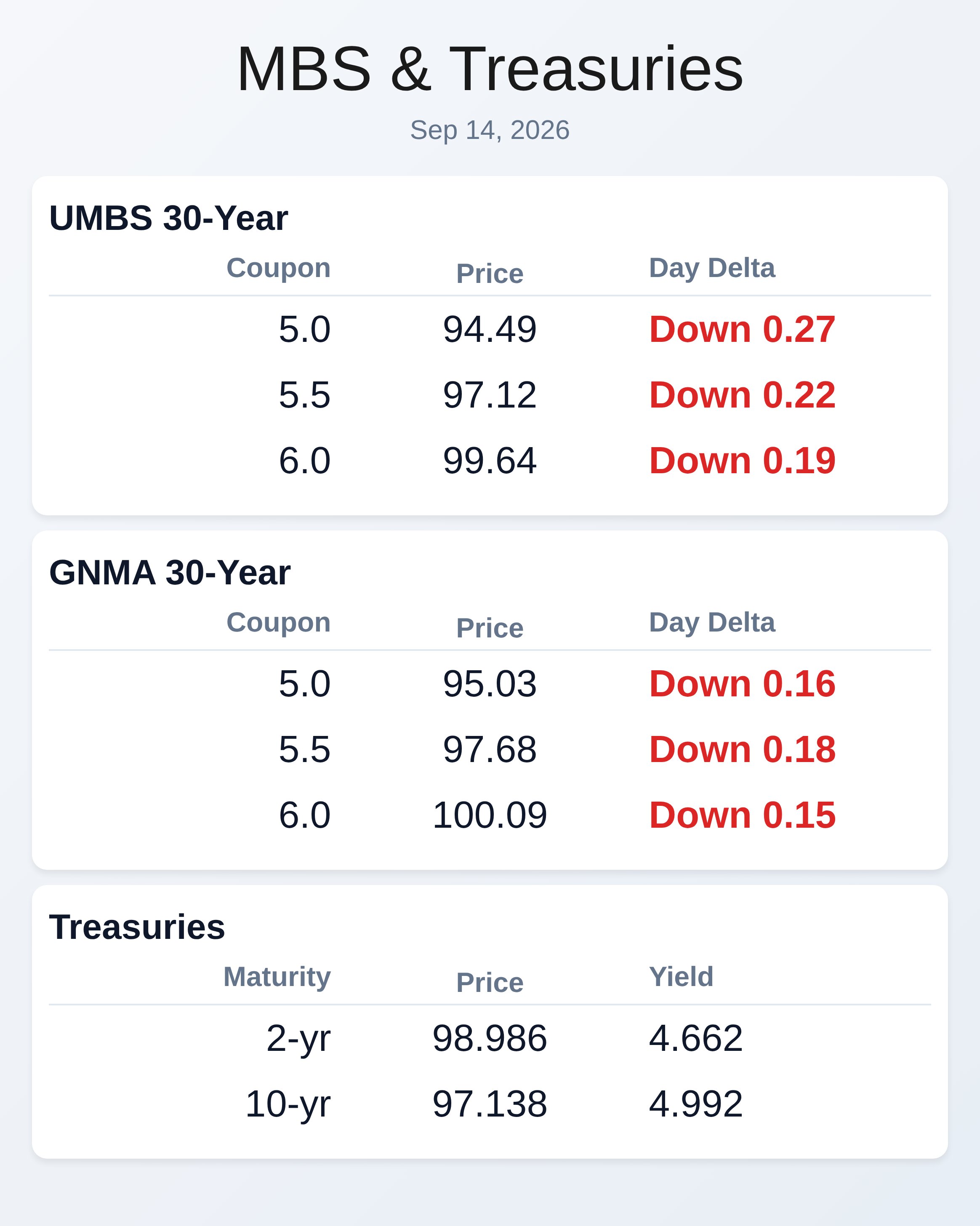
READ MORE **WTMS Blog Today = What's up in Mortgage Today (AM) - 07/31/2026** Employment cost inflation came in hotter than expected, pushing bonds weaker and causing UMBS 5.5s to trade down about 0.18 points as the 10-year yield rose to 4.70%. Japan's currency intervention overnight and rising oil prices added selling pressure, but markets are taking the move in stride after Fed Chair Warsh signaled that rate decisions will be driven by data, not forward guidance. The bond market's "protest" against Warsh policy messaging appears to have cooled from worst-case scenarios, allowing traders to focus on technical levels rather than policy shock. MBS prices remain under pressure, but the intraday weakness is modest given the negative inputs. This represents a meaningful shift: risk-averse clients can hold their ground while risk-takers watch familiar yield ceilings for bounce opportunities. A top mortgage loan officer's guilty plea is shaking the industry's compliance culture. Christopher Gallo, once among the nation's most productive loan officers, pleaded guilty to conspiring to commit bank fraud for systematically falsifying property occupancy status from 2018 through 2023, allowing borrowers to qualify for lower rates on investment properties disguised as primary residences. His scheme operated at two major firms and could result in 30 years in prison at December sentencing. Lender reputations depend on document integrity and borrower truthfulness; any evidence of systematic falsification triggers immediate regulatory scrutiny and potential loss of selling authority. The guilty plea underscores that enforcement remains sharp despite industry headwinds. First-time buyers are driving Fannie Mae's strongest quarter since the housing recovery began. The mortgage giant reported $4 billion in net income for Q2 2026, its 34th consecutive profitable quarter, fueled by $72.8 billion in single-family purchase acquisitions—the highest quarterly volume since Q3 2022—with nearly 55% of purchases going to first-time homebuyers. This cohort's dominance signals that lower-income and credit-constrained borrowers remain central to origination pipelines even as rates hold elevated. Refinance volume declined 12.3% as rates stay sticky, though it remains more than double year-ago levels. Serious delinquency held steady at 0.58%, reflecting borrower resilience. Median mortgage payments fell $7 month-over-month despite higher rates, a sign that loan sizes are shrinking as affordability constraints bite harder. The MBA's affordability index declined 0.3% to 157.9, yet household income growth of 4.6% year-over-year means payments are consuming a smaller income share than a year ago. New construction bucked the trend with payments rising $26 to $2,199, signaling builder strength in premium segments. Idaho, Nevada, and Arizona remain least affordable; Louisiana and D.C. rank most affordable. Originators should expect continued volume concentration in starter segments and geographic pockets where payment-to-income ratios remain favorable. Reverse mortgage opportunities are being overlooked by mainstream lenders targeting younger demographics. Senior home equity surged to a record $14.92 trillion in Q1 2026, representing an estimated $314.8 billion increase in home values among ages 62 and older, even as senior-held mortgage debt increased modestly. Hundreds of thousands of Americans turn 62 monthly; establishing reverse mortgage divisions requires far less capital complexity than wholesale lending expansion. Lenders capturing this segment differentiate their product mix while tapping a defensive asset base with lower default risk. Treasury yields hit their highest levels in 19 years as fiscal concerns, persistent inflation expectations, and policy uncertainty weigh on long-duration bonds. The 30-year yield closed at 5.24%, up 24 basis points intraday, while the 2-year held at 4.29%. Curve steepening accelerated yesterday as investors absorbed the message that Fed guidance matters less than incoming data, reducing the "Warsh shock" premium that drove selling early in the week. Longer-dated yields now do "the tightening the Fed is not doing," potentially improving servicing margins but creating customer acquisition challenges for loan officers. August trading books are thin, meaning modest economic data could spark outsized moves. **Locking vs Floating** Bond market momentum has shifted meaningfully after Wednesday's Fed messaging reduced policy shock fears. Risk-averse clients should wait for legitimate, sustained rally confirmation before moving to floating-rate lock strategies; yields bouncing off familiar technical ceilings do not yet signal trend reversal. Risk-takers can eye technical levels for tactical entry points, though the negative bias risk has diminished significantly now that the worst-case policy outcomes are off the table. **Today's Events** Q2 Employment Cost Index: 0.8% forecast (actual: 0.9% vs. 0.9% prior) July Chicago PMI: 56 forecast (prior: 56.7) Final July University of Michigan Consumer Sentiment **Bond Pricing** **UMBS 30 yr** | Coupon | Price | Intra-Day Change | | 5.0 | 96.68 | -0.21 | | 5.5 | 99.12 | -0.18 | | 6.0 | 101.26 | -0.08 | **GNMA 30 yr** | Coupon | Price | Intra-Day Change | | 5.0 | 97.02 | -0.23 | | 5.5 | 99.55 | -0.20 | | 6.0 | 101.65 | -0.15 | **Treasuries** | Term | Yield | Price | Intra-Day Yield Change | Market Data
Mortgage Today (AM) - 07/30/26 {{catlist}}
July 30, 2026
READ MORE **WTMS Blog Today = What's up in Mortgage Today (AM) - 07/30/2026** Economic data disappointed this morning, with second-quarter GDP growth coming in at just 1.5% versus the 2.0% forecast, though consumer spending surged 3.2% and inflation continued moderating. Core PCE rose only 0.1% month-over-month in June, matching expectations and falling well short of the prior 0.3%, while the annual core rate held steady at 3.3%. Jobless claims came in hotter at 197,000 versus the 200,000 forecast, with continuing claims at 1.782 million, signaling a still-resilient labor market despite the softer economic growth. The mixed signals left markets puzzled about the Federal Reserve's next moves, especially after Chair Warsh's sparse communication style failed to clarify whether rate cuts might be coming. MBS prices managed modest gains overnight, with the 30-year up roughly 3 ticks, but longer-dated Treasuries now face headwinds from renewed inflation concerns and Middle East geopolitical tensions. Fed policy uncertainty is creating a paradoxical reaction in markets: weaker GDP data should push rates lower, yet longer-dated bonds are actually higher because investors doubt the Fed's commitment to price stability. Warsh's minimal forward guidance during yesterday's post-meeting press conference has left traders interpreting every data point as a potential policy signal rather than relying on official Fed communication. Mortgage originators face a credibility problem in this environment—without clear direction from the central bank, borrowers and lenders alike are holding back on rate locks and commitments. The mortgage servicing industry has consolidated dramatically with Rocket's acquisition of Mr. Cooper and bank exits from Ginnie Mae, concentrating 60% of conventional servicing and 75% of Ginnie Mae servicing among the top ten firms. This concentration brings operational scale but also increases systemic risk that regulators will eventually scrutinize. The broader economic backdrop shows consumer resilience offsetting growth disappointments, with personal spending and AI-driven business investment providing support against headwinds from geopolitical conflict and higher energy costs. Real GDP price inflation hit 6.2% on a quarterly basis, well above the Fed's 2% target, though core measures remain elevated rather than accelerating. The U.S. economy continues demonstrating notable resilience, but the path forward hinges on whether tariffs, supply disruptions, and AI-related bottlenecks ease as expected or persist longer. Treasury yields on the 30-year maturity have hit their highest levels since 2007, creating a challenging competitive environment for mortgage originators trying to capture loan share. Unless significant economic deterioration emerges, mortgage rates may struggle to fall materially from current levels, forcing lenders to compete on service quality and speed rather than price. Geopolitical escalation in the Middle East is amplifying safe-haven demand and widening credit spreads across riskier segments of the bond market, though equity markets rallied today on strong Microsoft earnings. The market's focus has shifted sharply from rate-cut expectations to questions about whether massive AI investment spending will eventually generate profitable returns. Nasdaq 100 futures jumped 1.4% and the S&P 500 gained 0.7% in morning trading as technology stocks found footing after five consecutive days of losses. Energy volatility persists with Brent crude trading near $90 per barrel, adding inflationary pressure that the Fed cannot easily dismiss. For mortgage professionals, this technical bounce in equities may mask underlying weakness—the shift from riskier assets back to Treasuries reflects deep uncertainty about monetary policy and economic direction. UAD 3.6 appraisal changes arrive November 2, but mortgage professionals should mark October 1 as their operational deadline to account for appraisal turn times and system integration testing. The modernized appraisal form collapses five separate documents into one dynamic report, introduces roughly 750 new data points, and may quietly break legacy LOS integrations requiring heavy underwriting retraining beyond typical operations preparation. Freddie Mac and Fannie Mae both reported strong profitability this quarter—Freddie earning $3.8 billion and Fannie $4.0 billion—fueling ongoing policy adjustments across loan eligibility, credit scoring, manufactured housing, and gift fund requirements. Correspondents and sellers must track bulletins from Freddie, Fannie, and servicers like Pennymac, Newrez, Citi, and AmeriHome for compliance deadlines that shift weekly. The capital markets backdrop of elevated long-term rates and policy uncertainty makes this a difficult moment to navigate operational transitions and pricing changes simultaneously. **Locking vs Floating** Markets are sending paradoxical signals today: weaker-than-forecast GDP should encourage rate cuts, yet the 10-year Treasury actually climbed higher due to investor doubts about the Fed's inflation-fighting resolve. Chair Warsh's sparse communication style has traders second-guessing whether the Fed will act decisively on price pressures, creating a regime uncertainty that neither rate locks nor floats can reliably protect against in the short term. The safest approach on volatile days like today is to guard against conditions getting worse before improving—in other words, avoid aggressive lock or float decisions until this move in the bond market demonstrates it has run its course. With mortgage rates near their highest levels in over a year, most borrowers are already priced out of refinancing activity, so the margin for further rate deterioration grows limited. Monitor the 10-year Treasury's behavior around the 4.65 level; a break below that would signal meaningful momentum toward lower rates and justify taking a more constructive stance on new purchases. **Today's Events** Continued Claims (Jul/18): 1,782K vs. 1,800K forecast, 1,796K prior Core PCE (m/m) (Jun): 0.1% vs. 0.2% forecast, 0.3% prior Core PCE (y/y) (Jun): 3.3% vs. 3.3% forecast, 3.4% prior GDP Q2: 1.5% vs. 2.1% forecast, 2.1% prior Jobless Claims (Jul/25): 197.0K vs. 200K forecast, 187K prior PCE (y/y) (Jun): 3.7% vs. 3.7% forecast, 4.1% prior PCE prices (m/m) (Jun): -0.1% vs. -0.1% forecast, 0.4% prior **Bond Pricing** **UMBS 30 yr** | Coupon | Price | Intra-Day Change | | 5.0 | 96.96 | 0.1 | | 5.5 | 99.4 | 0.13 | | 6.0 | 101.41 | 0.1 | **GNMA 30 yr** | Coupon | Price | Intra-Day Change | | 5.0 | 97.35 | 0.03 | | 5.5 | 99.8 | 0.16 | | 6.0 | 101.81 | 0.1 | **Treasuries** | Term | Yield | Price | Intra-Day Yield Change | | 2yr | 4.217 | 100.063 | -0.056 | | 3yr | 4.277 | 99.576 | -0.053 | | 5yr | 4.37 | 100.024 | -0.033 | | 7yr | 4.514 | 99.176 | -0.029 | | 10yr | 4.664 | 97.71 | -0.016 | | 30yr | 5.209 | 96.843 | 0.007 | Market Data
The $100 Landlord: How Fractional Real Estate Is Creating Your Next Generation of Clients {{catlist}}
July 30, 2026
READ MORE
 

The $100 Landlord: How Fractional Real Estate Is Creating Your Next Generation of Clients

Jeff Bezos is betting on micro-investors becoming macro-property owners, and you should probably pay attention

There's a peculiar phenomenon happening in the real estate investment world that should have every mortgage professional simultaneously excited and slightly concerned. A 24-year-old barista with $500 in spare cash can now own a piece of a rental property in Austin, collect quarterly dividends, and bore their friends with landlord stories—all without knowing the difference between a P&L statement and a PB&J sandwich. Welcome to the era of fractional real estate investing, where the barrier to entry is lower than a limbo stick at a hedge fund manager's beach party, and the implications for traditional real estate financing are more interesting than they first appear. Platforms like Arrived.com (backed by Jeff Bezos, because apparently disrupting retail wasn't enough) are turning real estate investing into something that looks more like buying stocks than buying property. And before you dismiss this as just another tech fad that'll disappear faster than a Bitcoin maximalist's credibility during a bear market, consider this: these platforms are creating a massive pipeline of future mortgage clients who are learning about real estate returns, understanding property markets, and developing an appetite for real estate investing—just at a scale that doesn't require them to call you. Yet.
Fractional Real Estate 101: The Spotify Model Comes to Rental Properties
Let's break down how fractional real estate platforms actually work, because understanding this model is crucial to understanding where your next generation of investment property clients is currently hanging out. Companies like Arrived, Fundrise, RealtyMogul, and others have essentially taken the REIT (Real Estate Investment Trust) model and given it a millennial makeover—better user interface, lower minimums, and way more Instagram-worthy property photos. Here's the basic playbook: The platform identifies and purchases rental properties or vacation homes in markets with strong fundamentals. They then divide ownership of that property into shares, which investors can purchase for as little as $100 to $500, depending on the platform. Investors receive quarterly dividends from rental income (after the platform takes its management fee, because nobody works for free, not even Jeff Bezos-backed startups). When the property eventually sells—typically after 5-7 years—investors receive their proportional share of any appreciation. It's like being a landlord, but without any of the parts that involve actual landlording. Arrived.com, specifically, has become one of the most prominent players in this space. Launched in 2019 and backed by Bezos Expeditions (along with other heavyweight investors), Arrived focuses on single-family residential properties and vacation rentals. Their pitch is beautifully simple: invest in rental properties the same way you'd invest in stocks. As of 2026, they've facilitated hundreds of millions in real estate investments across thousands of properties, creating a small army of fractional property owners who are learning the rental property game without the traditional risks and headaches. The platform handles everything—property selection, purchase, management, maintenance, tenant relations, and eventual sale. Investors simply log into their account, browse available properties (complete with projected returns, market analysis, and property details), select their investments, and watch the quarterly dividends roll in. It's passive income so passive it makes index fund investing look like active day trading.
Why Smart Mortgage Pros Should Care About $100 Investors
Now, you might be thinking: "Cool story, but how does someone investing $500 in fractional real estate affect my mortgage business?" Fair question. The answer is that these platforms are creating the largest, most educated pipeline of future investment property buyers that the industry has ever seen, and most mortgage professionals are completely ignoring them. Think about the traditional path to becoming an investment property owner. Someone builds up capital, overcomes their fear of being a landlord, finds a property, secures financing, and then learns all the hard lessons about property management through expensive trial and error. It's a high-barrier-to-entry process that keeps many would-be investors on the sidelines indefinitely. They're stuck in analysis paralysis, reading BiggerPockets forums at 2 AM and never pulling the trigger. Fractional real estate platforms are changing this equation entirely. They're giving people a low-risk way to test the waters of real estate investing, learn the fundamentals, see actual returns, and build confidence—all with capital they can afford to tie up. It's like a flight simulator for real estate investors. And here's what's beautiful for mortgage professionals: these simulator pilots eventually want to fly the real plane. Consider the investor journey. Someone starts with $1,000 across a few fractional properties. They see 8-12% annual returns (dividends plus appreciation). They learn about cap rates, cash-on-cash returns, market selection, and property types. They get comfortable with real estate as an asset class. Their fractional portfolio grows to $10,000, then $25,000. And then one day, they have a revelation: "Wait, if I'm getting these returns on fractional investments, what could I do with a full property and the leverage of a mortgage?" That's when they call you.
The Bezos Factor: Why Big Money Is Betting on Small Investors
Jeff Bezos didn't become one of the wealthiest humans on the planet by investing in bad ideas (okay, maybe there were a few questionable Amazon product categories along the way, but overall, the man has a decent track record). His backing of Arrived through Bezos Expeditions signals something important: the democratization of real estate investing isn't just a cute fintech trend—it's a fundamental shift in how Americans will build wealth through real estate. The thesis is straightforward. For decades, real estate investing was largely bifurcated: you either bought physical properties (high capital requirement, high operational involvement) or you bought REITs (liquid but less control, different tax treatment, often focused on commercial properties). There was a massive gap in the middle—people who wanted real estate exposure, understood the benefits of rental income and appreciation, but didn't have the capital or appetite for full property ownership. Fractional platforms fill that gap. The total addressable market is enormous. According to various estimates, there are millions of Americans who want real estate investment exposure but haven't taken the plunge into full property ownership. If even a fraction of these people start with fractional investing and eventually graduate to full properties, we're talking about a massive wave of new investment property buyers over the next decade. This isn't a niche market—it's a demographic shift in how Americans approach real estate investing. Moreover, the data from these platforms is incredibly valuable. Arrived and similar companies are accumulating massive datasets about which properties perform well, which markets are strong, what types of investors are most successful, and how to optimize rental property returns. This intelligence will eventually flow back into the broader real estate market, making everyone smarter about investment property selection and management. And smarter investors are better mortgage clients—they understand the numbers, they make better decisions, and they're less likely to panic at the first maintenance issue.
How to Position Yourself for the Fractional-to-Full Pipeline
So how do you, as a mortgage professional, tap into this emerging pipeline of fractional investors who are destined to become full property buyers? It starts with education and positioning. You need to be the expert who understands both worlds—the fractional investing space and traditional property ownership—and can articulate the bridge between them. First, get educated about these platforms. Create accounts on Arrived, Fundrise, and other major players. Invest a small amount yourself if possible. Understand the user experience, the return profiles, the fee structures, and the investment thesis. You can't speak credibly about something you don't understand, and your future clients will absolutely know if you're faking it. This is a generation that can smell inauthenticity from across the internet. Second, create content that speaks to fractional investors about the next step in their journey. Blog posts, social media content, videos, or newsletters that address questions like: "When does it make sense to move from fractional to full property ownership?" or "How to use mortgage leverage to amplify returns you're seeing in fractional investments" or "The tax advantages of full property ownership vs. fractional investing." Position yourself as the guide for this transition, not just another mortgage person pushing loans. Third, develop relationships with the fractional platforms themselves. While they're not going to hand you their user lists (privacy laws, people), many of these companies are interested in partnerships that help their investors succeed. Could you create educational content for their users? Sponsor their investor webinars? Offer free consultation calls to platform users who are considering full property purchases? Think creatively about how to get in front of this audience in value-added ways. Fourth, adjust your investment property mortgage pitch to acknowledge and incorporate fractional investing. When talking to potential investment property clients, ask about their experience with fractional platforms. If they have experience, build on that knowledge. If they don't, suggest they start there to learn the fundamentals. This might seem counterintuitive—why would you send potential clients away?—but it positions you as a trusted advisor rather than a transactional salesperson. And when they're ready for a full property, who do you think they'll call? Finally, understand that the financial profile of fractional investors might look different than traditional investment property buyers. They might have significant assets tied up in various alternative investments, some of which are liquid and some of which aren't. They might have non-traditional income streams. They might think about risk and diversification differently than previous generations. Your job is to understand their full financial picture and help them optimize their real estate strategy within that context, not to force them into a traditional borrower box that doesn't fit. The fractional real estate revolution isn't coming—it's already here. Millions of Americans are currently learning about real estate investing, seeing returns, and building confidence through platforms like Arrived. The only question is whether you'll be positioned to help them take the next step when they're ready, or whether you'll be sitting on the sidelines wondering where all the investment property buyers went. The $100 landlords of today are the six-figure mortgage clients of tomorrow. Start building those relationships now.
Ready to stay ahead of industry trends before they become yesterday's news? Subscribe to Well That Makes Sense at WellThatMakesSense.com where we translate mortgage industry shifts into actionable intelligence, with just enough humor to keep you awake during your lunch break. Your future self (and your pipeline) will thank you.
LATEST ARTICLES

RECENT ARTICLES

The 21st Century ROAD to Housing Act: Your Guide to the Law That Tried to Save Housing (But Probably Won’t)

July 23rd, 2026|Money, Mortgage, WellThatMakesSense|

  The 21st Century ROAD to Housing Act: Your Guide to the Law That Tried to Save Housing (But Probably Won't) Congress just passed a housing bill that's like putting a Band-Aid on a [...]

Mortgage Today (AM) – 07/22/26

July 22nd, 2026|Week In Review|

**WTMS Blog Today = What's up in Mortgage Today (AM) - 07/22/2026** Momentum remains negative across bond markets as the 10-year Treasury yield climbed to 4.634 percent, driven by geopolitical tensions in the Middle East [...]

Mortgage Today (PM) – 07/21/26

July 21st, 2026|Week In Review|

**WTMS Blog Today = What's up in Mortgage Today (PM) - 07/21/2026** Mortgage-backed securities took a hit today as market headwinds continued to weigh on bond prices. UMBS 30-year coupons declined across the board, with [...]

Article Archive

Mortgage Today (PM) – 07/06/26

July 7th, 2026|0 Comments

**WTMS Blog Today = What's up in Mortgage Today (PM) - 07/06/2026** Two Harbors shareholders approved CrossCountry Mortgage's acquisition at $12 per share plus a stub dividend, ending months of competing bids with Ultrawealth Mortgage [...]

Mortgage Today (AM) – 07/07/26

July 7th, 2026|0 Comments

**WTMS Blog Today = What's up in Mortgage Today (AM) - 07/07/2026** Bond markets opened Tuesday with modest downward pressure as Amazon's $25 billion debt offering signaled corporate borrowing momentum, pushing the 10-year Treasury yield [...]

Mortgage Today (AM) – 07/06/26

July 6th, 2026|0 Comments

**WTMS Blog Today = What's up in Mortgage Today (AM) - 07/06/2026** Markets start the week modestly stronger after the holiday break, with the 10-year Treasury yield dropping 2.1 basis points to 4.465% and mortgage-backed [...]

Mortgage Today (AM) – 07/01/26

July 1st, 2026|0 Comments

**WTMS Blog Today = What's up in Mortgage Today (AM) - 07/01/2026** The sell-off that defined Tuesday is holding into Wednesday as mortgage-backed securities decline and Treasury yields rise, signaling investor caution ahead of major [...]

Mortgage Today (AM) – 06/30/26

June 30th, 2026|0 Comments

**WTMS Blog Today = What's up in Mortgage Today (AM) - 06/30/2026** Quarter-end position squaring added only 2 basis points to the 10-year yield this morning, leaving bonds still well below the critical 4.42% technical [...]

Mortgage Today (AM) – 06/29/26

June 29th, 2026|0 Comments

**WTMS Blog Today = What's up in Mortgage Today (AM) - 06/29/2026** MBS underperformed to start the week as the 10-year Treasury climbed 1.6 basis points to 4.383 percent while UMBS 6.0 coupon dropped 7 [...]

Mortgage Today (PM) – 06/26/26

June 26th, 2026|0 Comments

**WTMS Blog Today = What's up in Mortgage Today (PM) - 06/26/2026** Friday delivered a textbook case of diminishing returns as mortgage bonds started the day strong, rallied into noon, and then gave back gains [...]

Mortgage Today (AM) – 06/26/26

June 26th, 2026|0 Comments

**WTMS Blog Today = What's up in Mortgage Today (AM) - 06/26/2026** New home sales collapsed 7.3% in May, marking the lowest pace since January as affordability crises overwhelm buyers and builders alike. The annualized [...]

Subscribe

Send me some brain food

Go to Top