Loading...
HOME2023-01-22T13:43:33-07:00

Damn, there is so much great knowledge out there. Did you know that “BOOKS” are full of smart?? No, I mean like life changing, I-wish-I-knew-that-years-ago type stuff.

I know that I was waaaayyy late to the game figuring it out. And I know that a lot of you are too busy to read as much as you ‘should’. And that is why you need me.

I still remember how it started for me. It started in June of 2008. After 11  years …..Click to continue

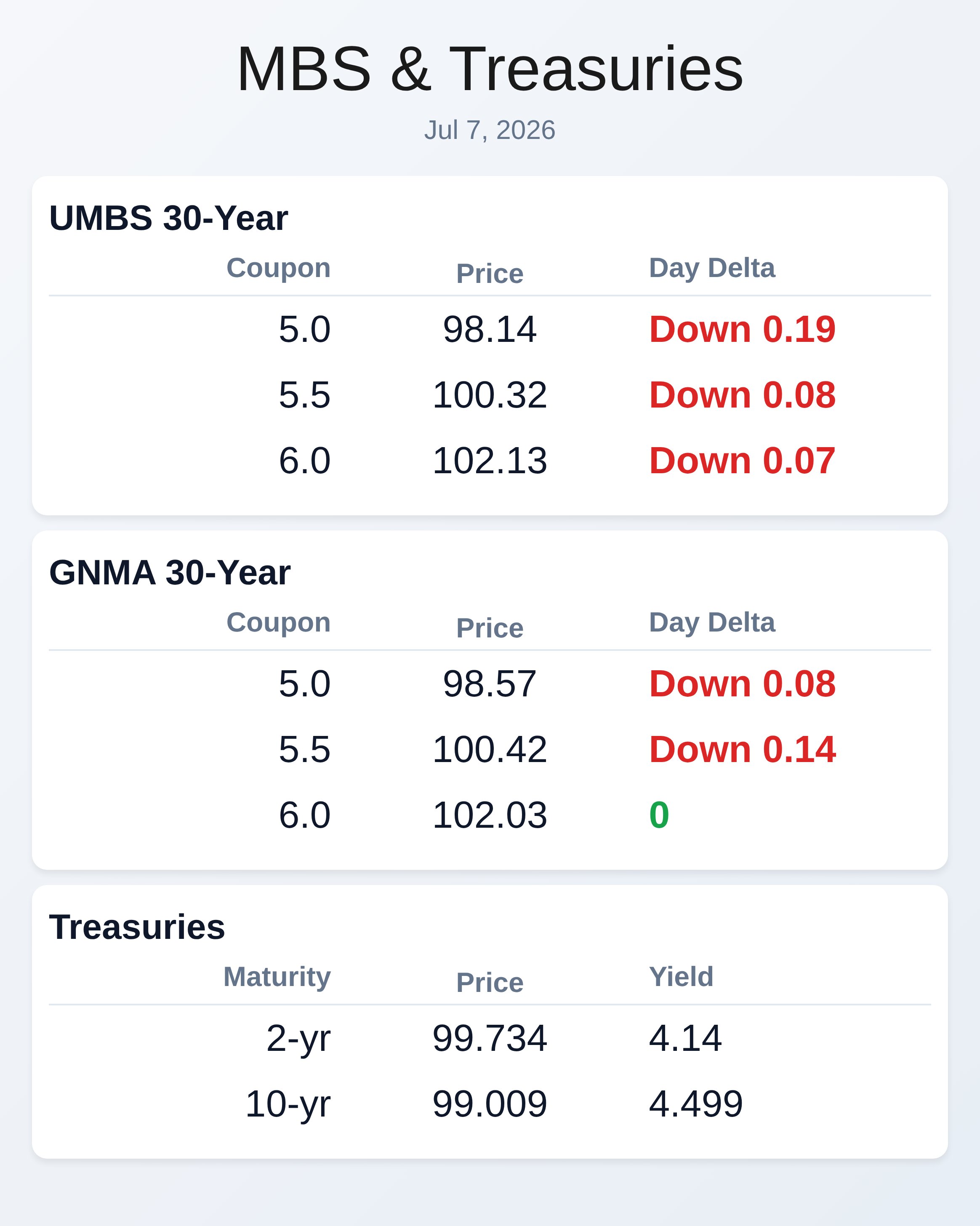
Mortgage Today (AM) - 07/07/26 {{catlist}}
July 7, 2026
READ MORE **WTMS Blog Today = What's up in Mortgage Today (AM) - 07/07/2026** Bond markets opened Tuesday with modest downward pressure as Amazon's $25 billion debt offering signaled corporate borrowing momentum, pushing the 10-year Treasury yield up 2.1 basis points to 4.492 percent by morning. UMBS securities declined across coupons, with the 5.0 coupon down 0.19 and the 6.0 coupon down 0.07, while GNMA 5.5 coupons fell 0.14 points in early trading. The overnight weakness followed a weekend hold above the 4.51 percent ceiling, though risk-tolerant clients view continued price support as constructive relative to yesterday's close. MBS investors remain focused on supply dynamics and issuance trends as the spring homebuying season gradually fades into summer activity patterns. Agency MBS supply continues recovering from 2023 lows, with refinancing activity driving growth even as purchase originations remain modest. Equity volatility in semiconductor stocks, particularly Samsung's 11 percent Seoul tumble despite record AI-driven profits, added overhead pressure to risk sentiment and tempered bond demand. Oil prices rose on Strait of Hormuz shipping attacks, climbing to $72.60 per barrel for Brent crude, which historically correlates with inflation expectations and bond yield movements. The week ahead brings the Federal Open Market Committee minutes release, which markets expect could reveal shifts in the Fed's inflation assessment given uncertain labor market data and mixed price pressures. Private payroll data from ADP showed just 21,000 average weekly gains through mid-June, suggesting continued labor market softness that may inform near-term Fed deliberation. While core inflation remains a concern for some officials, softer employment trends and retreating oil prices have raised the bar for immediate monetary policy action. Mortgage industry focus shifted toward capacity and operational readiness as November 2 approaches for Universal Appraisal Dataset 3.6 implementation. Lenders considering the deadline as early October rather than November must coordinate with appraisers, technology vendors, and GSE workflows to ensure seamless UAD 3.6 adoption. The MISMO leadership acknowledged the industry is not ready operationally, despite vendor technology being largely developed, because interconnected systems require coordinated change across thousands of firms. Summer activity typically lightens trading volume and hedging activity, which aligns with current subdued TBA hedge volumes and specified pool trading patterns observed this week. Disciplined pricing and attention to issuance patterns remain critical as volatility persists and mortgage lenders navigate a range-bound rate environment. Consumer behavior continues reshaping mortgage origination workflows, with technology increasingly serving as a friction-reduction tool rather than a loan officer replacement. Zillow's integration of pre-approval verification into home search exemplifies how digital experiences work best when they remove confusion and organize information around borrower questions. Only 28 percent of prospective buyers achieve pre-approval before searching for homes, leaving substantial opportunity for lenders to enhance transparency and compress decision timelines. The most successful digital strategies eliminate routine work while preserving human expertise for judgment, problem-solving, and relationship management. Title services integration into transaction management software further streamlines closing workflows and reduces delays for borrowers and professionals alike. Today's economic calendar includes May import and export prices, the May trade balance, Redbook same-store sales, June consumer inflation expectations, and the Atlanta Fed's GDPNow for Q2. A three-year Treasury note auction occurs this afternoon, which will provide market guidance on near-term demand for intermediate-duration fixed income. These data releases and auctions carry subdued importance given their lower market sensitivity compared to employment and inflation prints. Market participants remain positioned for patience from the Fed while awaiting clearer catalysts for directional rate movement. No major surprises are expected today, leaving bond markets likely to consolidate within established technical ranges. **Locking vs Floating** Caution remains appropriate due to lack of follow-through below the 4.42 percent 10-year yield level, though the weekend hold above the 4.51 percent ceiling provides some encouragement. Risk-tolerant clients welcomed bonds holding ground, suggesting 4.51 percent as a conservative lock trigger with 4.57 percent available as a more aggressive option. These yield ceilings and floors help track bigger-picture bond market momentum beyond intraday MBS price fluctuations. Current weakness and overnight corporate bond supply represent headwinds, but employment softness and oil price reversal offer offsetting support. Monitor Fed communications and economic data before committing rate locks given volatile positioning. **Today's Events** May Import and Export Prices | May Trade Balance | Redbook Same Store Sales | June Consumer Inflation Expectations | Atlanta Fed GDPNow (Q2) | 3-Year Treasury Note Auction **Bond Pricing** **UMBS 30 yr** | Coupon | Price | Intra-Day Change | | 5.0 | 98.14 | -0.19 | | 5.5 | 100.32 | -0.08 | | 6.0 | 102.13 | -0.07 | **GNMA 30 yr** | Coupon | Price | Intra-Day Change | | 5.0 | 98.57 | -0.08 | | 5.5 | 100.42 | -0.14 | | 6.0 | 102.03 | 0 | **Treasuries** | Term | Yield | Price | Intra-Day Yield Change | | 2 yr | 4.14 | 99.734 | 0.028 | | 3 yr | 4.164 | 99.891 | 0.031 | | 5 yr | 4.231 | 99.526 | 0.035 | | 7 yr | 4.358 | 99.354 | 0.028 | | 10 yr | 4.499 | 99.009 | 0.029 | | 30 yr | 5.012 | 99.818 | 0.025 | Market Data
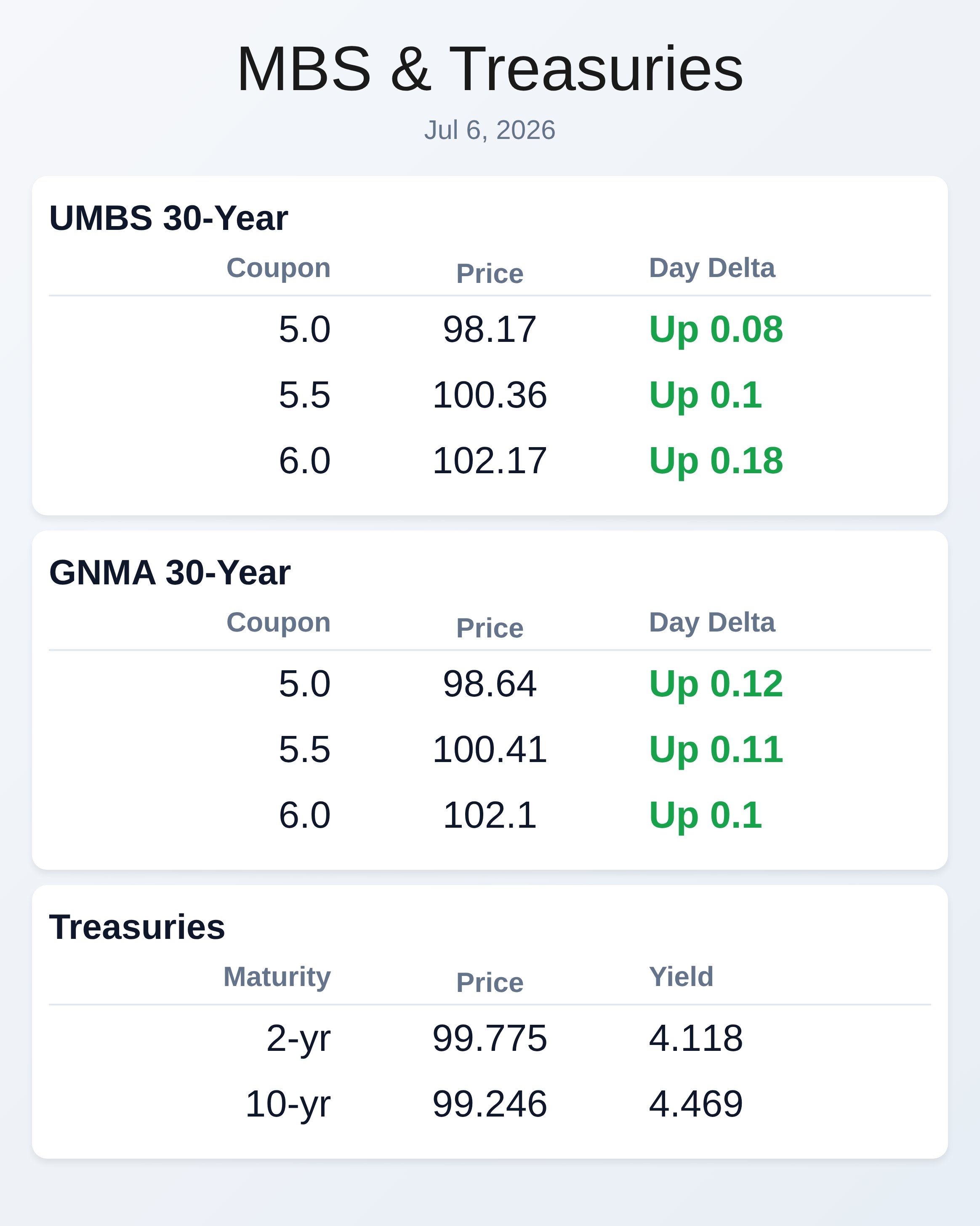
Mortgage Today (AM) - 07/06/26 {{catlist}}
July 6, 2026
READ MORE **WTMS Blog Today = What's up in Mortgage Today (AM) - 07/06/2026** Markets start the week modestly stronger after the holiday break, with the 10-year Treasury yield dropping 2.1 basis points to 4.465% and mortgage-backed securities gaining three ticks as bond buying sentiment carried over from the shortened trading week. The weak June jobs report, which showed only 57,000 payroll additions alongside significant downward revisions to prior months, offered some relief to the rate-sensitive sectors despite an unexpected dip in unemployment to 4.2%. The 10-year yield remains under pressure from expectations of slower labor force growth and persistent inflation concerns, but technicians remain cautious about following through below the 4.42% ceiling without more confirmed momentum. Agency mortgage-backed securities issuance hit $118.5 billion in June, marking the fourth consecutive month exceeding $100 billion and the strongest June since 2022 as purchase originations increasingly drive supply. Conventional and Ginnie Mae production concentrated in 5.0% and 5.5% coupons kept the pipeline healthy, though refinancing activity has declined meaningfully since Q1 due to stable mortgage rates limiting refi opportunities. On the regulatory front, Fannie Mae quietly updated its Desktop Underwriter 12.1 Release Notes with material credit tightening, effective June 27, signaling that a moderate reduction in Approve/Eligible recommendations is coming as the GSE reviews risk assessment based on recent market performance. The FHFA also proposed rescinding its existing Duty to Serve regulation in favor of a more innovation-focused framework designed to encourage high-impact lending initiatives rather than granular compliance-box checking, with the new rule targeted for January 1, 2028, and public comments due July 24. These GSE changes—combined with updates to MISMO mortgage insurance data standards supporting VantageScore 4.0 and FICO 10T, plus expanded Area Median Income limits in Desktop Underwriter reaching over 84% of census tracts—reflect a shifting compliance and credit landscape that loan originators need to track closely this week. National MI updated construction-to-permanent commitment periods to 18 months effective June 6 and modified manufactured housing guidelines, while Pennymac and other lenders are now accepting UAD 3.6 appraisal formats for GSE deliveries. Housing supply remains a stubborn problem for the industry narrative: May new home sales fell to 580,000 units (seasonally adjusted), down 7% month-over-month and year-over-year, with completed home sales down three straight months and off over 30% since November despite a months supply now over 10 months—one of the worst readings in nearly 20 years. Median new home prices continue declining, yet federal housing policy remains a moving target with no firm affordability strategy yet implemented despite months of trial balloons around federal land sales, tri-merge elimination, extended amortizations, and assumable mortgages. The lack of policy clarity leaves originators without a clear roadmap for product strategy or pricing while affordability constraints continue pressuring purchase volumes and forcing the industry to rely more heavily on non-QM and specialty lending products to capture market share. AI adoption across mortgage operations and credit decisioning is accelerating into mainstream conversation: LenderLogix's new AI-POS evaluation guide helps lenders cut through hype and focus on compliance, transparency, borrower experience, and workflow fit, while Dark Matter's LOS platform (Empower) now offers Ask Aiva, an AI assistant that answers loan-specific questions by pulling real data from your loan files rather than generic web results. Open banking and consumer-permissioned financial data modernization, powered by platforms like Plaid, is expanding cash flow and transaction-based credit decisioning, broadening credit access and shifting how lenders evaluate borrower sustainability—a shift that will reshape traditional credit models and credit bureau reliance. The broader technology ecosystem within mortgage is beginning to separate the infrastructure pioneers from traditional manual shops, with Figure's latest analysis showing that 32% of national equity-backed lending growth over three years flowed through their tech platform partners, signaling where scale advantages increasingly cluster. Chrisman Commentary and industry event calendars show a packed week ahead with webinars on open banking (July 6), STRATMOR's Technology Insight Digital Innovations study (July 7), and discussions on Fannie Mae's Desktop Underwriter updates and title insurance waiver initiatives (July 8). The Arizona Mortgage Expo kicks off July 16, followed by Western Secondary Conference (August 10), MBA of Mississippi Conference (August 20), and MISMO Fall Summit (August 24), offering networking opportunities as the industry recalibrates on AI, compliance changes, and market direction. Weekly podcast interviews feature Sei AI's Pranay Shetty, American Pacific's Jason Ponsonby, FICO's Ethan Dornhelm, and FTI Consulting's Creighton Oswald, surfacing emerging trends in automation, credit models, and servicing innovation. The week ahead carries light economic data with only Final June S&P Global Services PMI and June ISM Non-Manufacturing Index scheduled today, followed by May Trade Balance, May Wholesale Inventories, June FOMC Minutes, May Consumer Credit, June Existing Home Sales, and the quarterly refunding announcement mid-week. Tech stocks are signaling strength on Monday with Nasdaq 100 futures up 1.1% after the holiday break as chipmakers Samsung and SK Hynix prepare earnings releases that will test investor conviction in the AI supercycle, while SpaceX's Nasdaq 100 inclusion may trigger index rebalancing activity. Oil prices are softening (Brent at $71.67, down 0.6%) amid Strait of Hormuz flow concerns and OPEC+ supply signals, potentially offering some stability to broader rate markets, though central bank communication and energy newsflow remain the key variables for Treasury yields this week. **Locking vs Floating** Recent weakness in the June employment report provided some relief to rate shoppers in the bigger picture, but be cautious about reading too much into the afternoon reversal on the half-day before a three-day weekend. Risk-tolerant borrowers are hoping recent yield ceilings hold over the weekend and can be extended in coming weeks, yet caution remains warranted because follow-through below 4.42% on the 10-year has been lacking despite multiple recent attempts. **Today's Events** Final June S&P Global U.S. Services PMI and June ISM Non-Manufacturing Index. **Bond Pricing** **UMBS 30 yr** | Coupon | Price | Intra-Day Change | | 5.0 | 98.17 | 0.08 | | 5.5 | 100.36 | 0.1 | | 6.0 | 102.17 | 0.18 | **GNMA 30 yr** | Coupon | Price | Intra-Day Change | | 5.0 | 98.64 | 0.12 | | 5.5 | 100.41 | 0.11 | | 6.0 | 102.1 | 0.1 | **Treasuries** | Term | Yield | Price | Intra-Day Yield Change | | 2yr | 4.118 | 99.775 | -0.019 | | 3yr | 4.142 | 99.953 | -0.023 | | 5yr | 4.206 | 99.638 | -0.026 | | 7yr | 4.332 | 99.511 | -0.023 | | 10yr | 4.469 | 99.246 | -0.016 | | 30yr | 4.984 | 100.249 | 0.006 |

Market Data
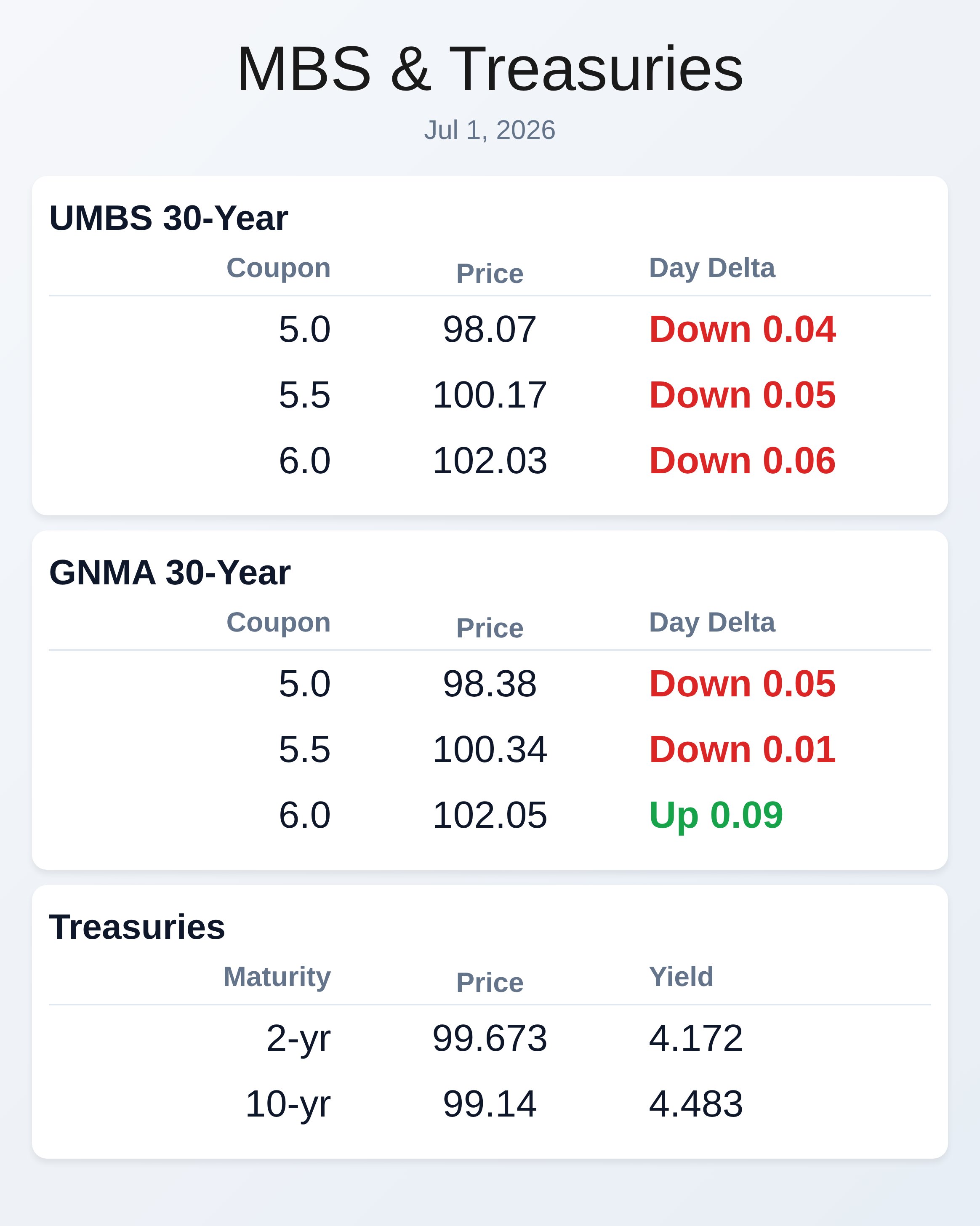
Mortgage Today (AM) - 07/01/26 {{catlist}}
July 1, 2026
READ MORE **WTMS Blog Today = What's up in Mortgage Today (AM) - 07/01/2026** The sell-off that defined Tuesday is holding into Wednesday as mortgage-backed securities decline and Treasury yields rise, signaling investor caution ahead of major economic data and Federal Reserve commentary. MBS prices are down broadly, with the 10-year yield climbing to 4.49 percent after closing at 4.42 percent yesterday, extending quarterly weakness as markets price in lingering inflation concerns. A softer-than-expected June ADP jobs report showing just 98,000 private-sector job additions versus forecasts of 113,000 has failed to provide relief, with selling continuing across the curve despite month-end rebalancing pressure. Federal Reserve Chair Kevin Warsh will speak today at 9 a.m. alongside European central bank officials in Portugal, and his remarks on price stability could set the tone for rate expectations through year-end. Holiday-shortened trading and lower market participation are keeping volatility elevated, making a defensive positioning strategy prudent until market direction becomes clearer. Geographic disparities and loan size continue to drive uneven mortgage-backed securities performance, as some high-cost coastal markets outperform while Southern and Southwestern regions lag behind. Home price growth has cooled nationally without meaningfully improving affordability, creating a patchwork where borrowers in expensive markets face persistent headwinds while cheaper regions lose momentum. The FHFA index showed a slight monthly decline, yet home values remain stubbornly above levels that would ease mortgage origination demand. This regional divergence means originators in slower-appreciation areas may face tighter margins and lower volume, while those in hot markets could see slightly better pricing. Understanding local market conditions is essential for locking rate risk and managing wholesale pricing. The labor market continues signaling strength despite the ADP disappointment, with private-sector job creation capping the best three-month stretch in more than a year and wage growth for job-changers accelerating to 6.6 percent annually. Tomorrow's official June payroll report is expected to show 115,000 net new jobs, which would mark the strongest six-month hiring streak since mid-2024 and support arguments for potential Federal Reserve rate increases. Job openings remain elevated relative to available workers, particularly in education, health services, and financial sectors, pointing to labor supply constraints rather than broad weakness. These employment trends continue to pressure the Fed's rate-pause narrative, as policymakers must balance improving inflation data with persistent labor strength. Originators should monitor tomorrow's jobs report closely, as an outsized number could reignite rate-hike expectations and trigger bond market selling. Consumer confidence edged higher in June only after a downward revision to May's reading, masking mixed underlying economic momentum that keeps Fed officials uncertain about the inflation trajectory. Business activity moderated while job openings remained stable, suggesting the economy is losing steam without deteriorating sharply—the textbook soft-landing scenario markets currently price. Headline inflation has eased thanks to lower energy prices, but core inflation persists stubbornly, preventing the Fed from declaring victory and moving to rate cuts. The disconnect between cooling goods prices and sticky services inflation means policymakers will require more employment and inflation data before adjusting policy. Originators facing borrower rate-lock decisions should focus on data dependency risk rather than calling a clear directional trend. Mortgage applications from the Mortgage Bankers Association were essentially flat for the week ending June 26, with purchase activity rising 1 percent week-over-week and up 3 percent year-ago, while refinance applications fell slightly but remain 9 percent above year-ago levels. This stability in application flow despite modestly higher rates suggests borrower demand remains genuine rather than driven by tactical window-shopping, though seasonal weakness could arrive as we enter summer months. May construction spending and today's June ISM Manufacturing Index will provide additional color on economic momentum heading into the second half. Purchase applications outpacing refinance growth indicates healthy housing demand relative to refi activity, a healthy diversification for origination pipelines. Monitor application trends closely as the busiest summer season approaches and rate volatility potentially increases. Trust and referrals, not artificial intelligence or online search, continue driving borrower lender selection, with less than 2 percent of refinance borrowers and just 4 percent of purchase borrowers finding lenders through online search, reviews, or AI recommendations combined. Instead, nearly 90 percent of borrowers still select lenders through referrals, existing relationships, and prior experience, meaning the fundamental mortgage business remains relationship-driven despite industry hype around technology innovation. This reality underscores why customer experience, operational efficiency, and referral network strength matter far more than AI adoption for capturing market share. Originators chasing cutting-edge technology while neglecting core borrower experience and referral cultivation are misallocating resources and missing growth opportunities. The lesson for mortgage professionals is clear: invest in people, processes, and relationships first; then layer in technology that enhances rather than replaces human connection. **Locking vs Floating** Tuesday's volatility suggests borrowers and originators should maintain a more defensive stance through the end of this shortened week. Higher risk events remain on the calendar—Fed commentary today, tomorrow's jobs report, and weekly economic data—making aggressive rate-lock strategies risky. The combination of technical bounce recovery, lower holiday-week participation, and elevated uncertainty argues for protecting rate risk until clearer directional confirmation emerges. Traders are watching intraday MBS price movements and 10-year yield ceiling and floor levels to gauge broader bond market momentum, with Thursday's payroll data potentially serving as the next major catalyst. **Today's Events** ADP private-sector payrolls (June): 98,000 vs. 113,000 forecast, 122,000 prior Federal Reserve Chair Kevin Warsh speaks at 9 a.m. ET in Portugal alongside European central bank officials Final June S&P Global U.S. Manufacturing PMI May Construction Spending June ISM Manufacturing Index **Bond Pricing** **UMBS 30 yr** | Coupon | Price | Intra-Day Change | | 5.0 | 98.07 | -0.04 | | 5.5 | 100.17 | -0.05 | | 6.0 | 102.03 | -0.06 | **GNMA 30 yr** | Coupon | Price | Intra-Day Change | | 5.0 | 98.38 | -0.05 | | 5.5 | 100.34 | -0.01 | | 6.0 | 102.05 | 0.09 | **Treasuries** | Term | Yield | Price | Intra-Day Yield Change | | 2 yr | 4.172 | 99.673 | -0.004 | | 3 yr | 4.184 | 99.835 | 0.002 | | 5 yr | 4.237 | 99.502 | 0.008 | | 7 yr | 4.352 | 99.391 | 0.014 | | 10 yr | 4.483 | 99.14 | 0.017 | | 30 yr | 4.978 | 100.335 | 0.016 | Market Data
LATEST ARTICLES

RECENT ARTICLES

Give the Gift of Wrong

May 1st, 2019|WellThatMakesSense|

Upon the recommendation of The Great Tim Ferris, I read a super interesting essay today entitled:  Keep your Identity Small.   Billionaire investor/philospher Paul Graham great job with this interesting title.  Though the copy writing [...]

Article Archive

Subscribe

Send me some brain food

Go to Top